


- If you are wondering whether Citigroup at around US$119.97 is still offering value after a strong run, this article will help you make sense of what the current price might be implying.
- The stock has had a mixed stretch recently, with the share price down about 5.1% over the last week and 9.2% over the last month, yet still up 1.1% year to date and 61.6% over the past year.
- Recent headlines have focused on Citigroup's ongoing efforts to simplify its global footprint and reshape parts of the business, which has put management decisions and balance sheet positioning under closer investor scrutiny. At the same time, discussion around the broader banking sector has continued to influence sentiment toward large financial stocks like Citigroup.
- Citigroup currently scores 4 out of 6 on Simply Wall St's valuation checks. You can see this in more detail through its valuation score. The rest of this article will walk through the main valuation approaches used on the stock and will also point to a more rounded way of thinking about value at the end.
Approach 1: Citigroup Excess Returns Analysis
The Excess Returns model looks at how much profit a company is expected to generate above the return that equity investors require, and then links that back to the current book value of the business.
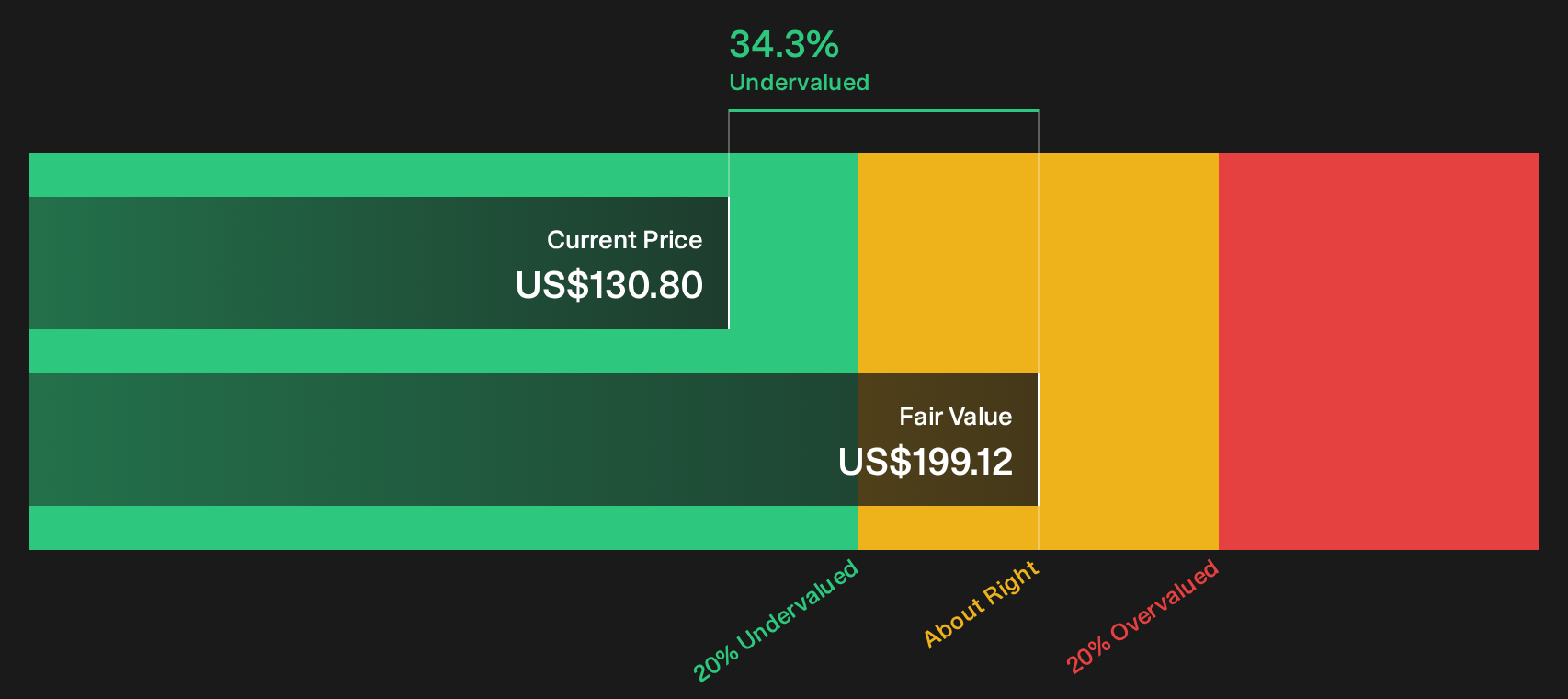
For Citigroup, the model starts with a Book Value of US$112.23 per share and a Stable EPS estimate of US$13.00 per share, based on weighted future Return on Equity estimates from 15 analysts. The Average Return on Equity is 10.18%, while the Cost of Equity is US$10.30 per share. The gap between what the equity is expected to earn and what investors require results in an Excess Return of US$2.70 per share.
The analysis also uses a Stable Book Value of US$127.67 per share, sourced from weighted future Book Value estimates from 12 analysts. Feeding these inputs into the Excess Returns framework results in an estimated intrinsic value of about US$187.39 per share.
Compared with the recent share price of around US$119.97, this Excess Returns valuation implies the stock is 36.0% undervalued.
Result: UNDERVALUED
Our Excess Returns analysis suggests Citigroup is undervalued by 36.0%. Track this in your watchlist or portfolio, or discover 54 more high quality undervalued stocks.
Approach 2: Citigroup Price vs Earnings
For profitable companies, the P/E ratio is a useful way to relate what you pay for each share to the earnings that each share is currently producing. It gives a quick sense of how many years of current earnings the market is pricing in.
What counts as a “normal” or “fair” P/E depends on how investors view the company’s earnings growth prospects and risk profile. Higher expected growth or lower perceived risk can support a higher P/E, while lower growth expectations or higher risk usually point to a lower P/E.
Citigroup currently trades on a P/E of 13.9x. That is above the Banks industry average of 11.2x and the peer group average of 11.6x. Simply Wall St’s Fair Ratio for Citigroup is 15.6x, which is their proprietary estimate of an appropriate P/E given factors such as the company’s earnings growth outlook, industry, profit margin, market cap and risk profile.
This Fair Ratio is more tailored than a simple comparison with industry or peer averages because it adjusts for Citigroup specific characteristics rather than relying on broad groupings. Since the Fair Ratio of 15.6x is higher than the current P/E of 13.9x, the P/E perspective suggests the stock is trading below that tailored fair value estimate.
Result: UNDERVALUED

P/E ratios tell one story, but what if the real opportunity lies elsewhere? Start investing in legacies, not executives. Discover our 19 top founder-led companies.
Upgrade Your Decision Making: Choose your Citigroup Narrative
Earlier it was mentioned that there is an even better way to think about valuation. That is where Narratives come in as your way of attaching a clear story to the numbers you see for Citigroup, from your fair value estimate through to your assumptions about future revenue, earnings and margins.
A Narrative on Simply Wall St is your own explanation of what you think is happening at a company, linked directly to a financial forecast and then to a fair value. This means you are not just looking at a P/E or a discount rate in isolation; you are tying it to a clear thesis you can revisit later.
On the Simply Wall St Community page, millions of investors already use Narratives as an accessible tool. Each one compares a user set fair value to the current share price to help decide whether Citigroup looks expensive or inexpensive relative to that story, and each Narrative automatically refreshes when new earnings, news or other data is added to the platform.
For example, one Citigroup Narrative on Simply Wall St currently tags fair value at about US$112.86, while another sees fair value closer to US$233.04. This shows how two investors can look at the same stock, plug in very different views on growth, margins and risk, and end up with very different but clearly explained conclusions.
For Citigroup, however, we will make it really easy for you with previews of two leading Citigroup Narratives:
Each one connects a fair value estimate, growth assumptions and risks into a single, coherent story. Use them as a benchmark against your own expectations rather than as instructions.
Fair value: US$233.04 per share
Implied discount vs that fair value at the recent US$119.97 share price: about 48.5% below the narrative fair value
Revenue growth assumption: 6.0%
- Sees Citi Token Services and clearer stablecoin rules as a key driver of new digital asset revenues, with the bank acting as a hub for always-on, cross-border payments.
- Highlights broad based strength across Services, Markets, Investment Banking, Wealth and U.S. Personal Banking, along with active use of buybacks and dividends.
- Assumes Citi can convert its transformation program, AI adoption and cost discipline into higher long term returns and a higher earnings base than today.
Fair value: US$112.86 per share
Implied premium vs that fair value at the recent US$119.97 share price: about 5.9% above the narrative fair value
Revenue growth assumption: 8.32%
- Builds on the same expense reduction and automation goals, but leans on the more cautious analyst forecasts and a lower future P/E multiple.
- Flags macro sensitivity, regulatory changes, card credit losses and ongoing transformation costs as potential drags on margins and earnings quality.
- Frames the current price as close to what the more cautious analyst cohort views as fair, and encourages readers to test those assumptions against their own view on earnings, margins and risk.
Both narratives use the same raw company information, but they draw different lines between earnings potential, required return and what counts as a reasonable multiple. That range is a useful reminder that your own conclusion on Citigroup will depend on which story you find more convincing and how those inputs compare with the Excess Returns and P/E work shown earlier.
To see how these narratives stack up against the rest of the Community views and to stress test your own assumptions, To see how these results tie into long-term growth, risks, and valuation, check out the full range of community narratives for Citigroup on Simply Wall St. Add the company to your watchlist or portfolio so you'll be alerted when the story evolves.
Do you think there's more to the story for Citigroup? Head over to our Community to see what others are saying!

This article by Simply Wall St is general in nature. We provide commentary based on historical data and analyst forecasts only using an unbiased methodology and our articles are not intended to be financial advice. It does not constitute a recommendation to buy or sell any stock, and does not take account of your objectives, or your financial situation. We aim to bring you long-term focused analysis driven by fundamental data. Note that our analysis may not factor in the latest price-sensitive company announcements or qualitative material. Simply Wall St has no position in any stocks mentioned.
Have feedback on this article? Concerned about the content? Get in touch with us directly. Alternatively, email editorial-team@simplywallst.com