


- Wondering if VeriSign at around US$303 per share is offering fair value or a potential mispricing opportunity? This article breaks down what the current valuation signals are really saying about the stock.
- The stock has posted returns of 2.7% over the past week, 9.9% over the past month, 26.0% year to date, and 8.8% over the past year. This naturally raises questions about how much of this performance is already reflected in the current price.
- Recent coverage of VeriSign has focused on its role in securing internet infrastructure and the consistency of its domain registry business. This helps explain why investors pay attention to the stock during periods of market volatility. Commentators have also highlighted how its business model can attract investors who value recurring revenue and high switching costs.
- Despite this backdrop, VeriSign scores just 1 out of 6 on a simple undervaluation checklist. The next sections will compare different valuation approaches for the stock and then finish with a broader framework that can help you make sense of those numbers.
VeriSign scores just 1/6 on our valuation checks. See what other red flags we found in the full valuation breakdown.
Approach 1: VeriSign Discounted Cash Flow (DCF) Analysis
A Discounted Cash Flow model takes estimates of the cash a company might generate in the future and discounts those figures back to today, aiming to arrive at an intrinsic value per share.
For VeriSign, the model used here is a 2 Stage Free Cash Flow to Equity approach based on cash flow projections. The latest twelve month free cash flow is about $1.04b. Analysts provide explicit free cash flow estimates up to 2027, including $953 million for 2026 and $1,050 million for 2027, and Simply Wall St extrapolates the remaining years. By 2035, projected free cash flow is $1,406.66 million, with each of those future figures discounted to reflect the time value of money.
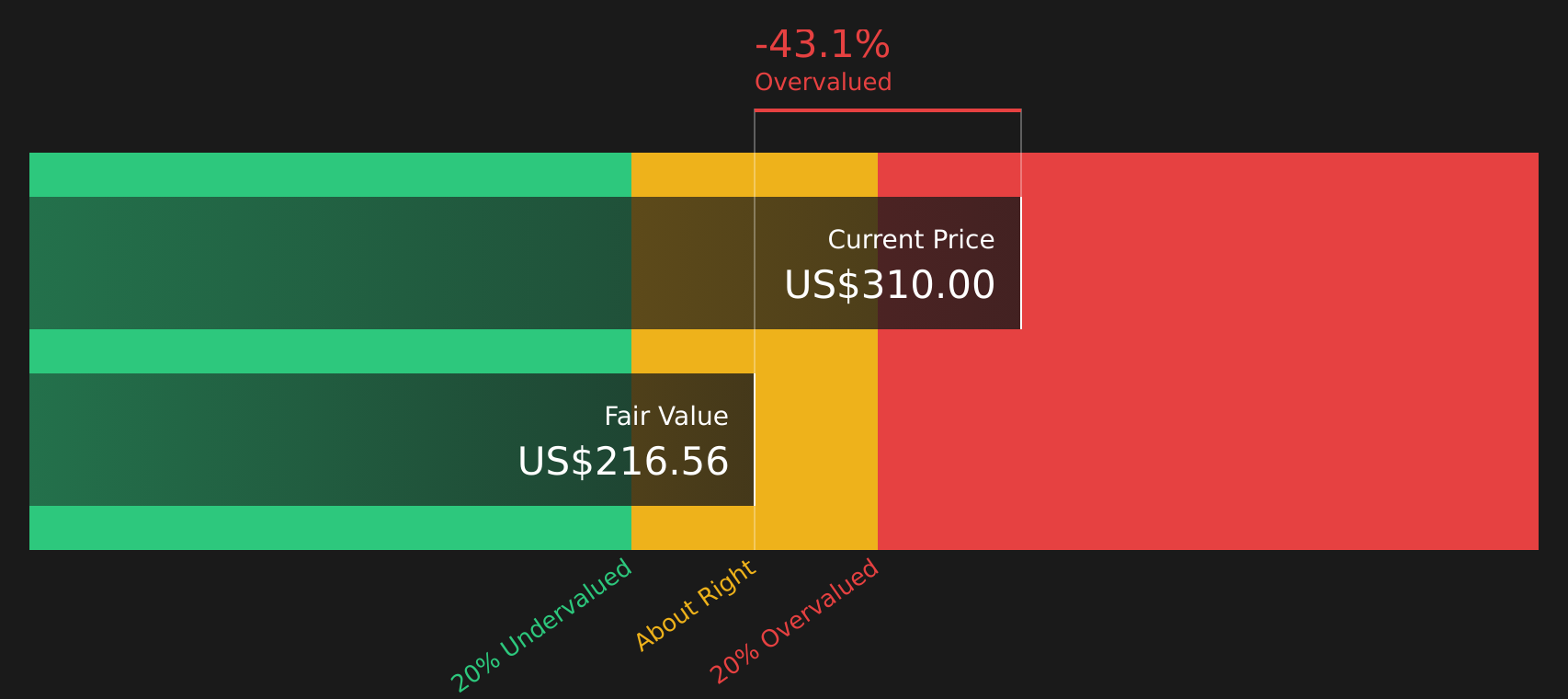
Putting these projections together, the model arrives at an estimated intrinsic value of $213.39 per share, compared with a current share price of about $303. This implies the stock is judged to be roughly 42.0% above the DCF estimate.
Result: OVERVALUED
Our Discounted Cash Flow (DCF) analysis suggests VeriSign may be overvalued by 42.0%. Discover 51 high quality undervalued stocks or create your own screener to find better value opportunities.
Approach 2: VeriSign Price vs Earnings
For profitable companies, the P/E ratio is a useful yardstick because it directly links what you pay for each share to the earnings that share currently generates. It is a quick way to see how much the market is willing to pay for today’s earnings.
What counts as a “normal” P/E will shift with investors’ expectations for future growth and their view of risk. Higher expected growth or lower perceived risk can support a higher P/E, while slower expected growth or higher risk usually points to a lower, more cautious multiple.
VeriSign trades on a P/E of 32.83x. That sits above the IT industry average of 21.21x but below the peer group average of 49.75x, which suggests investors are paying a premium to the broader industry but not as much as for some peers. Simply Wall St’s Fair Ratio for VeriSign is 23.26x, a proprietary estimate of what the P/E might be given factors such as earnings growth, industry, profit margin, market cap and risk profile.
The Fair Ratio can be more useful than simple peer or industry comparisons because it adjusts for these company specific characteristics. With the current 32.83x P/E sitting noticeably above the 23.26x Fair Ratio, the stock screens as more expensive than that framework would suggest.
Result: OVERVALUED

P/E ratios tell one story, but what if the real opportunity lies elsewhere? Start investing in legacies, not executives. Discover our 20 top founder-led companies.
Upgrade Your Decision Making: Choose your VeriSign Narrative
Earlier we mentioned that there is an even better way to understand valuation. Narratives are introduced here as a simple way for you to write the story you believe about VeriSign, link that story to explicit forecasts for revenue, earnings and margins, and then see the fair value that drops out of those assumptions.
A Narrative on Simply Wall St connects three pieces in one place: your view of the business, the financial model that flows from it, and the fair value estimate. This allows you to see how a story about VeriSign’s domain monopoly, legal risks or growth potential directly affects the numbers.
These Narratives live on the Community page of Simply Wall St, where millions of investors can explore them. They update automatically when new information such as earnings releases or news arrives, so your fair value view keeps in step with fresh data rather than staying frozen at one point in time.
For VeriSign, one investor might focus on governance concerns, regulatory risk and dependence on .com and .net and arrive at a fair value around US$165. Another might lean into contract renewals, domain demand and capital returns and land closer to US$305. By comparing each Narrative’s fair value with the current share price you can decide whether the stock looks close to your own estimate, above it or below it, and therefore whether it may be time to wait, to add, or to reduce exposure according to your plan.
For VeriSign however we will make it really easy for you with previews of two leading VeriSign Narratives:
Fair value: US$305.00
Distance from fair value at a US$303.00 share price: about 0.7% below this narrative’s fair value
Revenue growth assumption: 7.64% a year
- Sees global domain registrations and renewal activity, especially in Asia Pacific and emerging markets, as a key driver for higher revenue over time.
- Leans on exclusive .com and .net registry agreements, long uptime record and demand for secure DNS to support durable earnings and potential pricing power.
- Recognises meaningful risks around contract concentration, regulation, competition from alternative domain systems and rising security costs that could weigh on margins.
Fair value: US$165.00
Distance from fair value at a US$303.00 share price: about 83.6% above this narrative’s fair value
Revenue growth assumption: 2.46% a year
- Focuses on management quality and corporate culture concerns, including reported policy compliance issues that could raise legal and governance risk.
- Highlights dependence on the .com and .net registry contracts and suggests that any renewal or regulatory setbacks could directly affect the core business.
- Flags potential legal actions and reputational damage as key reasons why the current share price might not fully reflect these downside risks.
Putting these side by side shows how two groups of investors can look at the same stock and reach very different conclusions. You can use them as reference points, then adjust the story, growth assumptions and risk views until the fair value aligns with what you believe is realistic for your own portfolio and risk tolerance.
Curious how numbers become stories that shape markets? Explore Community Narratives.
Do you think there's more to the story for VeriSign? Head over to our Community to see what others are saying!

This article by Simply Wall St is general in nature. We provide commentary based on historical data and analyst forecasts only using an unbiased methodology and our articles are not intended to be financial advice. It does not constitute a recommendation to buy or sell any stock, and does not take account of your objectives, or your financial situation. We aim to bring you long-term focused analysis driven by fundamental data. Note that our analysis may not factor in the latest price-sensitive company announcements or qualitative material. Simply Wall St has no position in any stocks mentioned.
Have feedback on this article? Concerned about the content? Get in touch with us directly. Alternatively, email editorial-team@simplywallst.com