


A major divergence is happening in exchange-traded funds (ETFs) tracking the blue-chip S&P 500 Index. The Vanguard S&P 500 ETF (NYSE:VOO) has continued to achieve record inflows as the popular SPDR S&P 500 ETF (NYSE:SPY) shed billions of dollars in assets.
VOO ETF Inflows Are Soaring This Year
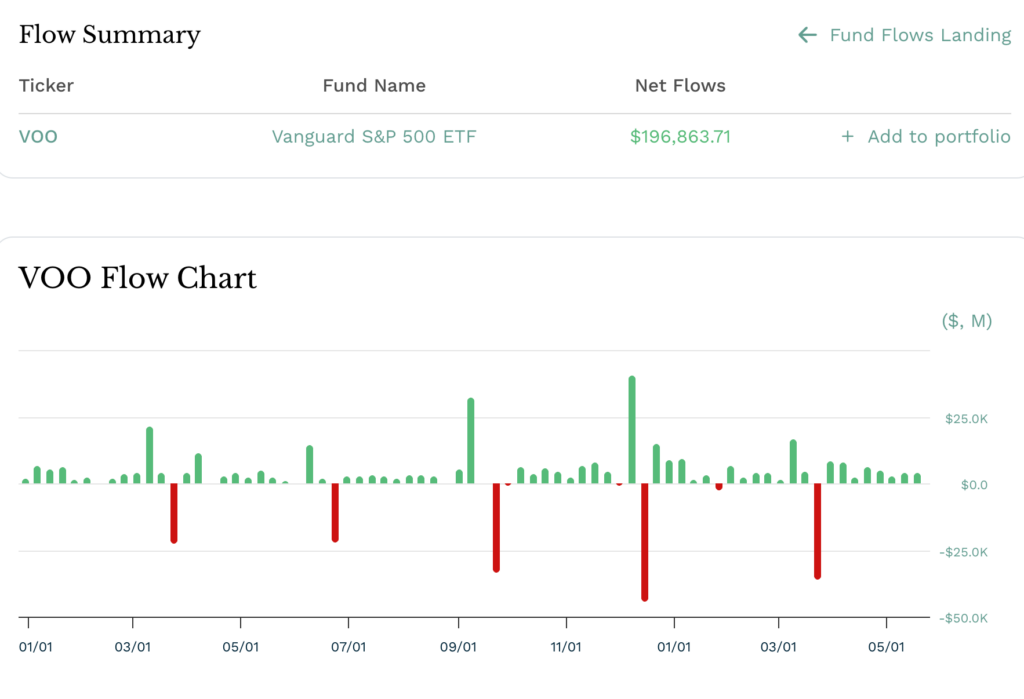
Data compiled by ETF.com shows that the VOO ETF has had over $59 billion in inflows this year, bringing its net assets to over $927 billion. This makes it the biggest ETF in the United States and one of the fastest-growing ones. VOO was started in 2010 and will be the first fund to hit a $1 trillion AUM milestone.
In contrast, SPY, which is one of the most common ETFs, has continued to shed assets this year. It has had almost $9 billion in outflows, giving it over $797 billion in assets. Data shows that it has shed $20 billion in assets since January last year, while VOO has added $196 billion in the same period.
SPY Has A Higher Expense Ratio Than VOO
The ongoing divergence is likely because of the fee differential between the VOO and SPY. VOO charges an expense ratio of just 0.03%, while SPY has a fee of 0.09%.
A $1 million investment in these two funds costs $300 and $945 annually. The $645 difference is notable given that both funds track the same index, and that gap compounds meaningfully over time. This fee differential explains why Morningstar (NYSE:MORN) has given VOO a gold star rating compared to SPY's silver.
Still, it is not all bad for State Street, which runs the SPY ETF. For one, the company launched the SPDR Portfolio S&P 500 ETF (NYSE:SPYM) in 2005. It has an expense ratio of 0.02% and has accumulated over $148 billion in assets under management. Its inflows have jumped by over $45 billion since January last year.
Investors have become increasingly sensitive to fees charged by companies like Invesco, BlackRock, and Vanguard. For example, the Invesco NASDAQ 100 ETF (NASDAQ:QQQM), which has an expense ratio of 0.15%, has had over $31 billion in inflows since January last year. Invesco QQQ Trust Series 1 (NASDAQ:QQQ), which costs 0.25% in assets, has added $24 billion in inflows in the same period.
Investors have increasingly turned to ETFs this year, with a report showing that they have added $725 billion. This growth is being driven by the ongoing stock market surge, with the top indices like S&P 500 and the Nasdaq 100 soaring to a record high.
Image: Shutterstock