

Corporate Actions - Rights Issue

What is a rights issue?
A rights issue is an offer made to existing shareholders, allowing them to subscribe for new shares in proportion to their current shareholding. If shareholders choose not to participate in the rights issue, their ownership rights may be diluted.
Shareholders can purchase a corresponding number of underlying shares at the subscription price based on the quantity of their existing holdings. Typically, the subscription price in a rights issue is set lower than the current market price.
What are rights?
Only eligible shareholders have the opportunity to participate in a rights issue. The specific requirements for participating in a rights issue are outlined in the announcement made by the listed company. The ex-date of a rights issue is typically disclosed by listed companies along with the announcement. Investors who hold the company's stocks on the trading day prior to the ex-date will be entitled to the rights and can participate in the rights issue. However, investors who purchase the stock on or after the ex-date will not be granted the rights.
Rights issue name and code
Underlying stock name + the word "equity"
Code characteristics:
For those that can be traded on the secondary market, the rights code is usually 29XX or 83XX;
If it cannot be traded in the secondary market, the rights code is usually 44XXX.
Options for investors holding the rights
1. Option one: Sell the rights in the secondary market. If the rights are transferable in the secondary market, investors can trade the rights in the secondary market starting from the second trading day after obtaining them.
2. Option two: Exercise the right. Leave sufficient funds in the account to purchase the underlying shares at the predetermined price.
3. Option three: Take no action. The rights will expire automatically.
Lifecycle of rights issue
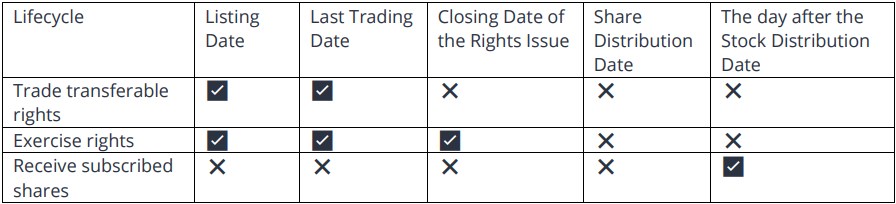
There are four important dates in the lifecycle of rights: listing date, last trading date, closing date of the rights issue, and share distribution date.
Transferable rights usually only have a trading window of approximately 5-7 trading days, spanning from the Listing Date to the Last Trading Date. In a transaction involving the transfer of rights, investors become the holders of the rights once the trade finishes. This means they gain the rights to subscribe for the corresponding quantity of underlying shares following the transaction.
Investors can apply to exercise the rights starting from the listing date till the closing date. When exercising the rights, investors should leave sufficient funds in the account to purchase the underlying shares at the predetermined price. Or, they can choose to exercise partial rights to buy the shares, or forfeit the shares. The shares purchased during the rights issue are credited to investors’ account on the day following the Stock Distribution Date.
Rules
When exercising the rights, investors should be aware that:
1. The subscription shares shall not exceed the number of rights shares.
2. The number of shares to be subscribed should be whole lots. (Under some circumstances, it's possible to subscribe non-whole board lots. For example, if one board lot is 4,000 shares and an investor has 6,000 rights shares, he/she can subscribe 6,000 shares.)
3. Investors can only subscribe once in a rights issue.
4. The purchase amount needs to be lower than the account balance.
5. In the case of pending acceptance, investors can cancel or modify the rights issue application.

All Comments