

US Market 101 - Beginner's guide for Australian Investors

1. US Market Overview
New York Stock Exchange (NYSE)
The NYSE is the world's largest stock exchange by market capitalisation, located on Wall Street in New York City. Established in 1792, there are more than 2,000 companies listed on NYSE, including major established corporations like Coca-Cola and JPMorgan Chase. Trading occurs through a hybrid system combining electronic trading with physical floor brokers, offering stability and prestige for blue-chip investments.
NASDAQ Stock Market
NASDAQ is America's second-largest exchange. Founded in 1971 as the world's first electronic stock market, it has more than 3,000 listed companies. Known for being a platform listed with technology giants including Apple, Microsoft, and Amazon, it operates electronically without a physical trading floor. NASDAQ attracts growth-oriented companies and offers Australian investors exposure to innovative, tech-focused businesses with high growth potential.
Webull offers ETFs, shares and options for US markets.
Reference:
10 Largest Stock Exchanges in the World by Market Cap in 2025
Market Structure and Electronic Trading
Modern US markets operate predominantly through electronic systems that match buy and sell orders automatically. This electronic infrastructure enables rapid trade execution, typically within milliseconds, and provides transparent price discovery.
Market Makers and Liquidity Providers
Market Makers are firms that provide liquidity and continuously quote bid and ask prices for securities. They facilitate smooth trading by ensuring shares are readily available in the market when other market participants want to trade. Market Makers earn revenue from the bid-ask spread (the difference between buying and selling prices), which compensates them for the risk of holding inventory. These entities help to ensure that investors can typically execute trades quickly, even in less actively traded securities.
Fractional Share Trading
Fractional shares allow you to purchase a portion of a share rather than a whole share, enabling you to invest in high-priced stocks with as little as USD $1.
Webull offers fractional trading for selected US stocks and ETFs, making expensive shares more accessible to investors with smaller investment amounts.
This helps reduce the barrier of entry into the stock market by allowing investors to participate in high-value stocks without needing to purchase a complete share. Fractional shares can only be traded during regular trading hours.
Reference:
24-Hour Trading
While traditional US market hours are 9:30 AM to 4:00 PM EST, extended trading sessions allow investors to trade outside this timeframe, translating to more convenient evening and morning hours for Australian investors.
Extended hours trading generally has lower liquidity, wider bid-ask spreads, and higher volatility compared to regular trading hours. Overnight trading hours are normally handled by ATS like Blue Ocean or Bruce Markets. Webull does offer 24-hour trading for eligible US stocks and ETFs. Please see Section 2 for detailed trading hours and session benefits.
Reference:
2. What You Need to Know to Trade
Minimum Investment Amounts
US markets do not impose minimum investment requirements for purchasing stocks, allowing investors to buy individual shares regardless of their price.
Webull offers fractional shares for selected stocks and ETFs that allow you to purchase a portion of a share rather than a whole share, enabling you to invest in high-priced stocks with as little as USD $1. This way will lower the barrier to entry in the stock market, providing opportunities for investors to diversity their portfolio.
Trading Hours
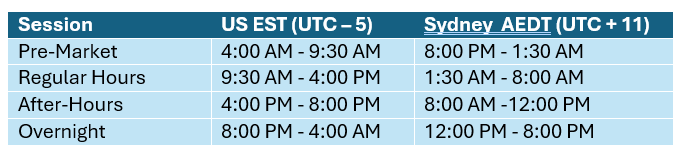

Please refer to Section 1 for 24-hour trading details and this FAQ for more details on trading hours.
More information on the extra session:
Pre-market session:
Traders can respond to international market shifts, corporate earnings announcements, and overnight news during this early trading window before standard market hours commence.
After-hours session:
Corporate earnings reports and significant announcements frequently occur after 4:00 PM when market closes. This extended trading period enables immediate market response to new information instead of delaying reactions until the following day's opening.
Settlement Period (T+1)
US equity trades settle on a T+1 basis, meaning the actual exchange of securities and funds occurs one business day after the trade execution date.
3. Order Types
Market Orders and Limit Orders
Market orders execute immediately at the best available current market price, ensuring execution without price certainty. Limit orders set a maximum buy price you are willing to pay or minimum sell price you will accept, providing price control but no guarantee of execution if the market does not reach your specified price.
Stop Orders and Stop-Limit Orders
Stop orders (or stop-loss orders) will become market orders once the stock reaches your specified stop price. It is triggered when the price falls to or below your stop price for sell orders or rises to or above for buy orders. These are commonly used to limit losses or protect profits. Stop-limit orders will convert to limit orders when the stop price is reached, combining the trigger mechanism of stop orders with the price control of limit orders.
Example:
Assume the current market price of a stock is USD $100:
BUY: If you submit a buy stop-limit order with a stop price at USD $110 and a limit price at USD $120, and later the market price rises to USD $110, the buy limit order will be triggered. As long as the order can be filled under USD $120, which is the limit price, the trade will be filled.
SELL: If you submit a sell stop-limit order with a stop price at USD $90 and a limit price at USD $80, and later the market price drops to USD $90, the sell limit order will be triggered. As long as the order can be filled above USD $80, which is the limit price, the trade will be filled.
Common applications:
- Stop loss: Placing a sell stop order below your entry price to automatically exit a losing position and cap your downside. For short positions, a buy stop above your entry price serves the same purpose.
- Take profit: Placing a sell limit order above the current price to automatically close a position once it reaches your target profit level. For short positions, a buy limit order below the current price applies instead.
Trailing Stop Orders
Trailing stop orders automatically adjust the stop price as the stock price moves favourably, helping to protect profits while allowing for continued upward movement. For example, a trailing stop set at 10% below the market price will move upward as the stock rises but remains fixed if the stock falls. The trailing amount can be set as a dollar amount or percentage, providing flexibility in risk management strategies.
Good Till Cancelled (GTC) and Day Orders
Day orders automatically expire at the end of the trading session if not executed, while Good Till Cancelled (GTC) orders remain active for 90 days until executed or manually cancelled.
Reference
4. Corporate Actions
Dividend Payments
US companies may distribute dividends to shareholders, typically on a quarterly basis. Australian investors will receive dividends in US dollars and should be aware of potential currency conversion impacts along with a 15% withholding tax applied on dividends for Australian tax residents.
Dividend payments follow specific dates:
- Declaration date (When the dividend is announced)
- Ex-dividend date (The cutoff for dividend eligibility – you must own shares before this date)
- Payment date (When dividends are distributed)
Webull clients will receive their dividend in their Webull account.
Stock Splits and Stock Dividends
Stock splits increase the number of shares while proportionally decreasing the share price, making stocks more accessible to investors. For example, in a 2-for-1 split, shareholders receive two shares for each share owned, with the stock price halving accordingly. Stock dividends distribute additional shares rather than cash, functioning similarly to splits but typically involving smaller percentages.
Reverse Splits
Reverse splits reduce the number of outstanding shares while increasing the share price proportionally. Companies typically implement reverse splits to meet exchange listing requirements or improve their stock's perception in the market.
Mergers and Acquisitions
When companies merge or are acquired, shareholders may receive cash, shares of the acquiring company, or a combination of both. These corporate actions can significantly impact investment portfolios and may trigger taxable events. During the transition period, shares may temporarily cease trading before being replaced or converted.
Proxy Voting
Shareholders receive proxy materials that enable them to vote on important corporate matters without attending annual meetings in person. These materials include a proxy statement detailing the issues for consideration and instructions for casting your vote. You may vote directly or authorize another person (the "proxy") to vote on your behalf.
Common proxy voting matters include:
- Electing or removing board directors
- Approving executive compensation packages
- Voting on mergers, acquisitions, or major corporate changes
- Deciding on significant policy proposals
- Webull clients will receive a digital communication from our partner - BetaNXT Inc
Reference FAQs
5. Announcements
Earnings Releases
Publicly traded US companies report financial results quarterly, providing insights into company performance and prospects. These earnings announcements can significantly impact stock prices and often include management guidance for future periods.
Regulatory Filings (10-K, 10-Q, 8-K)
Companies must file various reports with the Securities and Exchange Commission (SEC). Annual reports (10-K) provide comprehensive business overviews including audited financial statements, quarterly reports (10-Q) offer interim financial updates, and current reports (8-K) disclose material corporate events within 4 business days of a material event as they occur. All SEC filings are publicly accessible through the SEC's EDGAR database at no cost.
Webull's Vega AI feature provides daily summaries that combine market news and financial report analysis. It also provides instant answers to queries about financial report interpretations, offering 24/7 investment support to help Australian investors understand these comprehensive documents.
SEC 13F Reports
Institutional investment managers with over USD $100 million in qualifying assets under management must file quarterly 13F reports, disclosing their US equity holdings. While they provide insights into institutional investor positioning and can influence retail investors’ sentiment, 13F filings only disclose long equity positions and certain convertible securities and exclude short positions and many derivatives.
Webull Sage Tracker feature offers in-depth analysis of US institutional movements, monitoring the actions of more than 9,000 US institutions. It aids users in grasping the ownership patterns and trading practices of significant players such as asset managers, hedge funds, and managed funds. For example, you can view the trading strategies of famous investors such as Berkshire Hathaway and BlackRock.
Market-Moving Announcements
Various announcements can significantly impact market prices, including Federal Reserve policy decisions, economic data releases, geopolitical events, and industry-specific news. Understanding the potential impact of these announcements helps investors make informed decisions.
Earnings Calendar and Guidance
The earnings calendar shows scheduled company reporting dates, helping investors anticipate potential market volatility. Company guidance regarding future performance expectations often proves as important as actual earnings results for stock price movements.
6. Share Categories, Indices and Key Concepts
Ticker Symbols
US stocks are identified by unique ticker symbols, typically one to five letters (e.g. BULL for Webull Corp). These symbols provide a standardised way to identify and trade specific securities across all market platforms and systems. Different share classes of the same company may have letter suffixes (e.g. BRK.A and BRK.B for Berkshire Hathaway Class A and Class B shares).
Share Categories
- Common stock represents ownership in companies and typically includes voting rights.
- Preferred stock offers priority over common shareholders for dividends and liquidation but usually lacks voting rights.
- American Depositary Receipts (ADRs) are issued by US banks and allow trading of foreign companies on US exchanges in US dollars without needing to trade on foreign markets.
- Exchange-Traded Funds (ETFs) provide diversified exposure to various assets including stocks, bonds, and commodities.
- Real Estate Investment Trusts (REITs) are companies that own and typically operate income-producing real estate. They enable participation in the real estate markets without direct property ownership. They are legally required to distribute at least 90% of taxable income to shareholders as dividends to maintain tax status.
Key Market Indices
- The S&P 500 tracks 500 large-cap US companies selected by a committee based on market size, liquidity, and industry representation, serving as a broad market benchmark. It is market-cap-weighted.
- The Dow Jones Industrial Average follows 30 prominent blue-chip companies selected to represent the US economy. It is price-weighted.
- The NASDAQ Composite includes all stocks listed on the NASDAQ exchange, comprising over 3,000 securities with heavy weighting toward technology companies.
- The Russell 2000 represents small-cap companies, providing insight into smaller business performance.
Market Capitalisation Segments
Companies are categorised by market capitalisation:
- Large-cap (over USD $10 billion), mid-cap (USD $2-10 billion), and small-cap (USD $300 million to $2 billion).
- Companies below $300 million are sometimes classified as micro-cap. Note that these thresholds may vary slightly depending on the source.
Each segment exhibits different risks and return characteristics, with smaller companies typically showing higher volatility but potentially greater growth potential, while larger companies generally offer more stability.
7. Tax Considerations
Tax Treaties
The tax treaty between Australia and the United States helps prevent double taxation and reduces withholding tax rates on various income types. Australian investors should understand how this treaty affects their US investment returns and overall tax obligations.
Withholding Tax on Dividends for International Investors
The United States typically withholds 30% tax on dividends paid to foreign investors. However, Australian residents may benefit from reduced withholding rates under the US-Australia tax treaty, reducing this rate to 15% for qualifying dividends on common stock from US corporations. Note that REIT dividends are generally subject to the full 30% withholding rate regardless of treaty benefits, as they are classified as ordinary income rather than qualified dividends.
Form W-8BEN Requirements
Australian investors must complete Form W-8BEN (for individuals) or W-8BEN-E (for entities) to claim treaty benefits and establish their foreign status for US tax purposes. These forms are typically valid for three years from the date of signature and must be renewed upon expiry to continue receiving treaty benefits.
With a completed US Tax Form, the withholding tax is 15%. Without the form, the withholding tax is 30%. This withholding tax is only on dividends paid and not on capital gains.
As a Webull client, you will complete a pre-filled W-8BEN form during account opening. To maintain your eligibility for the reduced 15% withholding tax rate under the Australian-US tax treaty, you must renew and submit W-8BEN form every three years:
- W-8BEN form - for individual investors
- W-8BEN-E form - for entity investors (companies, trusts, etc.)
Investors should consult tax professionals to ensure compliance with both US and Australian tax obligations, as tax laws can be complex and subject to change.
8. Key Regulators and Operators
Securities and Exchange Commission (SEC)
The SEC serves as the primary federal regulator for US securities markets, enforcing securities laws and protecting investors. The SEC oversees public companies, investment advisers, and securities exchanges, ensuring market integrity and transparency through various regulatory requirements and enforcement actions.
Financial Industry Regulatory Authority (FINRA)
FINRA operates as a self-regulatory organisation overseeing broker-dealers and their registered representatives. This organisation establishes rules for market conduct, examines firms for compliance, and handles dispute resolution between investors and brokers.
Depository Trust and Clearing Corporation (DTCC)
The DTCC provides clearing and settlement services for US securities transactions, ensuring the efficient and secure transfer of securities and funds between market participants. This infrastructure supports the smooth functioning of daily trading activities and reduces settlement risk.
9. Market Characteristics
Trading Volume and Liquidity
US markets typically exhibit high trading volumes, providing substantial liquidity for most securities. This liquidity generally enables investors to buy and sell shares efficiently with minimal price impact, particularly for larger, well-established companies.
Market Volatility Patterns
US markets can experience varying volatility levels influenced by economic conditions, geopolitical events, and market sentiment. Historical patterns show increased volatility during earnings seasons, economic data releases (typically 8:30 AM EDT), Federal Reserve announcements, and periods of uncertainty.
The VIX Index (also known as the "fear gauge") measures expected market volatility and is commonly referenced as an indicator of market stress. The first and last hours of trading often see higher volatility compared to mid-day periods.
Sector Composition
The US market includes diverse sectors and provides numerous investment opportunities across different industries and economic cycles. Note that the US market has significant concentration in technology and healthcare sectors compared to other global markets, with technology companies representing a substantial portion of major indices like the S&P 500 and NASDAQ.
Currency Considerations (USD)
Australian investors face currency exposure when investing in US markets, as investments are denominated in US dollars. Currency fluctuations between the Australian dollar (AUD) and US dollar (USD) can significantly impact overall investment returns by adding an additional layer of risk and opportunity beyond the underlying securities' performance.
For example, if the USD strengthens against the AUD, Australian investors benefit from currency gains in addition to any investment returns. Conversely, a weakening USD reduces returns when converted back to AUD. Some investors choose currency-hedged investment products to eliminate this currency risk, though hedging involves additional costs.
10. How to trade in US market on Webull?
Opting into US Market
1. Navigate to Menu > Settings > Manage Brokerage Account > Stocks and ETFs
2. Select US Market
3. Review and accept the relevant terms and conditions
4. Submit your application and wait for approval
To trade in the US market you first need to:
Have funds upfront in your account and have ensured that you have read our relevant terms and disclosures regarding US markets.
Make sure you have USD in your account:
Deposit USD:
1. Webull Icon > Deposit
2. Select “USD”
3. Select “Pay to” or “Bank Transfer”
4. Follow the prompts on screen
If you select to use our PayTo service, you simply nominate the AUD amount you want to deposit, and Webull will automatically withdraw that amount from your linked Australian bank account, convert it to USD, and deposit the USD straight into your trading account all within 10 minutes.
Please see this article for more details: Introducing PayTo: Streamlined Deposits for US Markets
Converting AUD currency to USD
1. Tap the Webull logo at the bottom of the screen
2. Select an account if you have multiple accounts
3. Select “Transfers” from top navigation bar and then “Currency Exchange”
4. Select “USD”
5. Enter the amount you would like to exchange
6. Tap “Exchange Now”
7. Tap “Confirm”
Placing a trade in the US market:
1. Select Market icons -> Markets tab -> United States -> Select preferred stock (e.g. AAPL)
2. Select “Trade”
3. Select “Buy” or “Sell”
4. Select “Order Type” (Please see Section 3 on details of order types)
5. Input “Limit Price”, quantity (number of shares depends on lot size), trading hour and Time-In-force
6. Select “Buy” or “Sell” button

All Comments