

Trading with a Margin Loan

Example
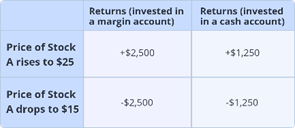
Suppose Jack believes Stock A will surge in two weeks, and he has $5,000 in his account. To increase his profits, he borrows another $5,000 from the broker (because of the funds or portfolio value in his account) and makes a total investment of $10,000 in Stock A (at $20 per share).
If Stock A surges to $25 as Jack expected, his returns could be $2,500. In this case, his returns are doubled compared with buying without a margin loan. However, if the stock tumbles to $15, his losses are also doubled.
When an investor is bearish towards a security, they may short a security.
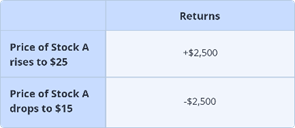
Unlike Jack, Jane decides to sell short 500 shares of Stock A (also at $20 per share).
If Jane is right and the stock drops to $15 a week later, she can close her short position by buying the shares back at $15. Her returns would be $2,500.
However, if Jane waits for a week, and the stock climbs up all the way to $25, she would have to buy back the shares at $25 per share to stop losses. Her losses would be $2,500.
*Note: Margin interest is not included in the calculation of profit/losses of the above two examples.

All Comments