


- Pitney Bowes recently reported first-quarter 2026 results showing revenue of US$477.41 million and net income of US$58.14 million, reaffirmed full-year 2026 revenue guidance of US$1.80 billion to US$1.86 billion, completed a large share buyback tranche, and declared a quarterly dividend of US$0.10 per share.
- Management also highlighted a focus on small “tuck-in” Presort acquisitions that are expected to be immediately accretive, signaling continued use of a strengthened balance sheet to expand higher-margin parts of the business.
- We’ll now examine how reaffirmed full-year revenue guidance, alongside ongoing tuck-in acquisition plans, affects Pitney Bowes’ existing investment narrative.
The latest GPUs need a type of rare earth metal called Neodymium and there are only 30 companies in the world exploring or producing it. Find the list for free.
Pitney Bowes Investment Narrative Recap
To own Pitney Bowes today, you need to believe management can use a high debt load and shrinking mail volumes to its advantage by boosting profitability in Presort and stabilizing earnings, even as the core market contracts. The reaffirmed 2026 revenue guidance and focus on small, accretive Presort acquisitions support this profitability-first story, but the most pressing risk remains execution: integrating deals and managing leverage without missteps that could quickly pressure margins and refinancing options.
The most relevant recent announcement is Pitney Bowes’ reaffirmed full year 2026 revenue outlook of US$1.80 billion to US$1.86 billion. This anchors the near term catalyst around whether the company can hold the top line roughly steady while layering in higher margin Presort volumes through tuck in acquisitions. For shareholders, how those deals translate into operating income, rather than pure revenue growth, will be critical to judging if the current investment case still holds.
Yet behind the buybacks and higher dividend, investors should be aware that refinancing needs and high fixed costs in Presort could still...
Read the full narrative on Pitney Bowes (it's free!)
Pitney Bowes' narrative projects $1.8 billion revenue and $239.7 million earnings by 2029. This requires a 1.8% yearly revenue decline and a $95.0 million earnings increase from $144.7 million today.
Uncover how Pitney Bowes' forecasts yield a $15.05 fair value, a 4% downside to its current price.
Exploring Other Perspectives
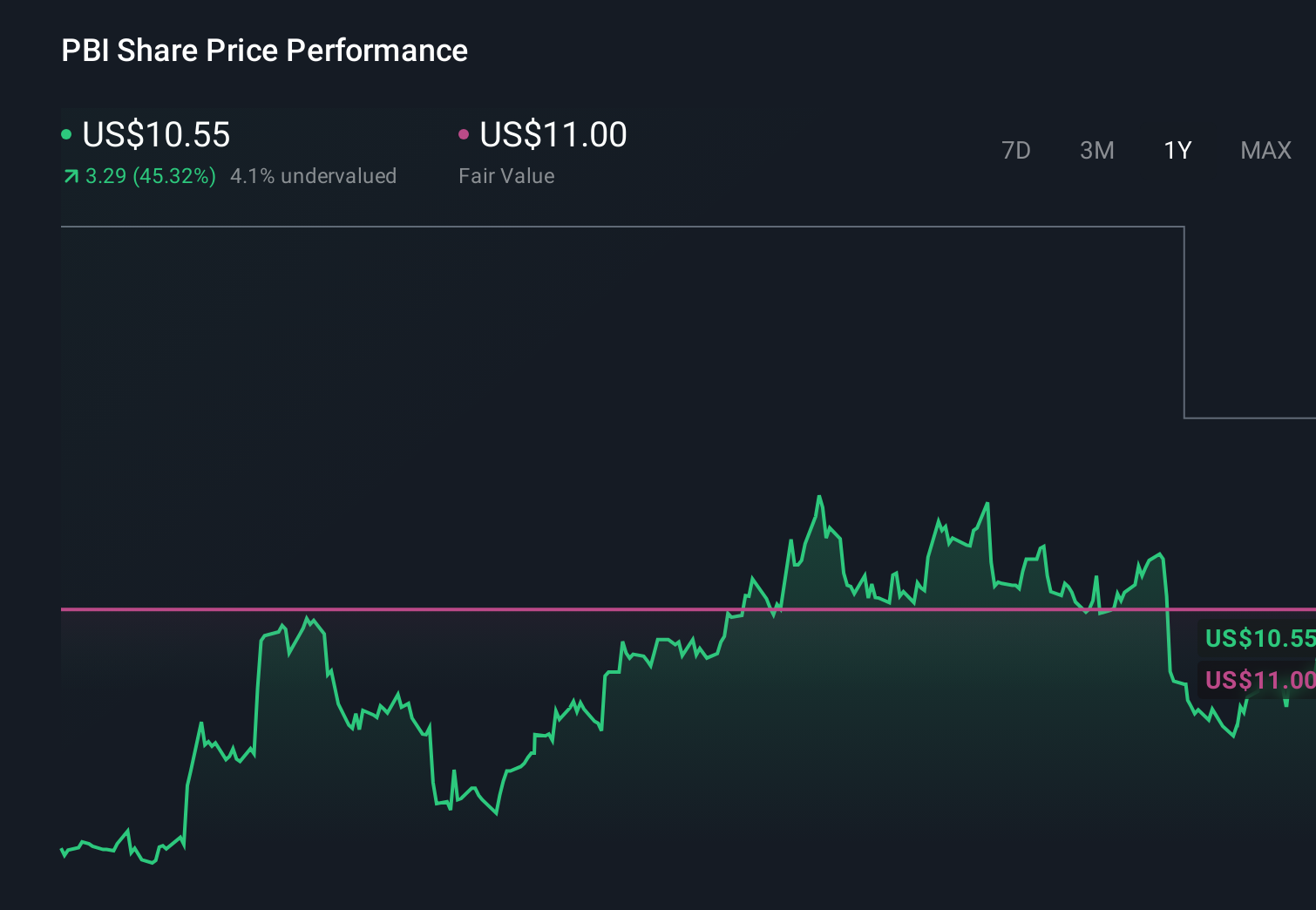
Some of the most optimistic analysts were already assuming earnings could reach about US$340 million by 2029, so if you believe Presort consolidation and cost savings really can offset mail decline, this latest tuck in acquisition push might support that stronger narrative, even though both that forecast and today’s news could still shift meaningfully from here.
Explore 5 other fair value estimates on Pitney Bowes - why the stock might be worth 8% less than the current price!
Form Your Own Verdict
Don't just follow the ticker - dig into the data and build a conviction that's truly your own.
- A great starting point for your Pitney Bowes research is our analysis highlighting 4 key rewards and 3 important warning signs that could impact your investment decision.
- Our free Pitney Bowes research report provides a comprehensive fundamental analysis summarized in a single visual - the Snowflake - making it easy to evaluate Pitney Bowes' overall financial health at a glance.
Seeking Other Investments?
Early movers are already taking notice. See the stocks they're targeting before they've flown the coop:
- We've uncovered the 14 dividend fortresses yielding 5%+ that don't just survive market storms, but thrive in them.
- The best AI stocks today may lie beyond giants like Nvidia and Microsoft. Find the next big opportunity with these 17 smaller AI-focused companies with strong growth potential through early-stage innovation in machine learning, automation, and data intelligence that could fund your retirement.
- AI is about to change healthcare. These 28 stocks are working on everything from early diagnostics to drug discovery. The best part - they are all under $10b in market cap - there's still time to get in early.
This article by Simply Wall St is general in nature. We provide commentary based on historical data and analyst forecasts only using an unbiased methodology and our articles are not intended to be financial advice. It does not constitute a recommendation to buy or sell any stock, and does not take account of your objectives, or your financial situation. We aim to bring you long-term focused analysis driven by fundamental data. Note that our analysis may not factor in the latest price-sensitive company announcements or qualitative material. Simply Wall St has no position in any stocks mentioned.
Have feedback on this article? Concerned about the content? Get in touch with us directly. Alternatively, email editorial-team@simplywallst.com