


- Kinder Morgan recently reported a first‑quarter 2026 earnings beat driven by its Natural Gas Pipelines segment, highlighted a US$10.10 billion project backlog, and reaffirmed 2026 guidance calling for US$3.10 billion in net income and US$8.60 billion in adjusted EBITDA.
- The quarter underscored how rising U.S. natural gas demand from power generation and data centers is increasingly flowing through Kinder Morgan’s fee‑based infrastructure network.
- We’ll now examine how this strong natural gas‑driven earnings beat and growing project backlog affect Kinder Morgan’s existing investment narrative.
Explore 27 top quantum computing companies leading the revolution in next-gen technology and shaping the future with breakthroughs in quantum algorithms, superconducting qubits, and cutting-edge research.
Kinder Morgan Investment Narrative Recap
To own Kinder Morgan, you have to believe in steady, fee based cash flows from its vast natural gas network, despite high leverage and energy transition pressures. The first quarter 2026 earnings beat and US$10.10 billion backlog reinforce the near term catalyst of data center and power driven gas demand, while not materially changing the key risk around Kinder Morgan’s sizable debt load and the flexibility it has in a downturn.
The most relevant update here is Kinder Morgan’s reaffirmed 2026 guidance for US$3.10 billion in net income and US$8.60 billion in adjusted EBITDA, which anchors expectations around how effectively that growing backlog might translate into earnings and support capital allocation decisions such as dividends and maintenance spending, especially as the company balances aging infrastructure needs with growth projects.
Yet against this constructive earnings story, investors should still be aware of how Kinder Morgan’s US$32.3 billion debt pile could...
Read the full narrative on Kinder Morgan (it's free!)
Kinder Morgan's narrative projects $19.1 billion revenue and $3.5 billion earnings by 2029. This requires 2.9% yearly revenue growth and about a $0.2 billion earnings increase from $3.3 billion today.
Uncover how Kinder Morgan's forecasts yield a $35.33 fair value, a 5% upside to its current price.
Exploring Other Perspectives
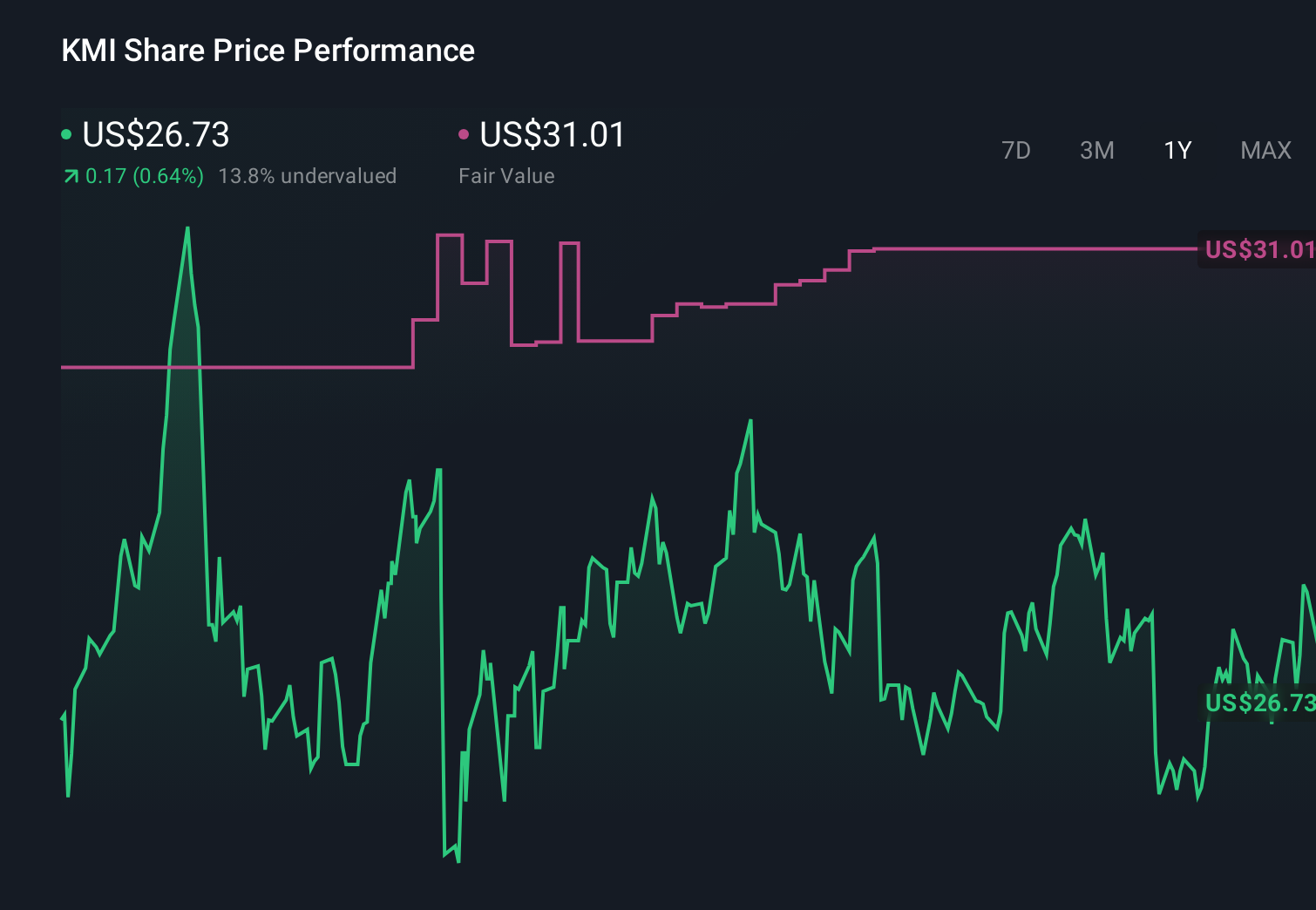
Four members of the Simply Wall St Community estimate Kinder Morgan’s fair value between US$34.82 and US$52.21, underscoring how far opinions can diverge. You should weigh those viewpoints against Kinder Morgan’s reliance on long term natural gas demand flowing through its fee based pipelines, and consider how that exposure might shape the company’s resilience and returns over time.
Explore 4 other fair value estimates on Kinder Morgan - why the stock might be worth just $34.82!
Decide For Yourself
Don't just follow the ticker - dig into the data and build a conviction that's truly your own.
- A great starting point for your Kinder Morgan research is our analysis highlighting 3 key rewards and 2 important warning signs that could impact your investment decision.
- Our free Kinder Morgan research report provides a comprehensive fundamental analysis summarized in a single visual - the Snowflake - making it easy to evaluate Kinder Morgan's overall financial health at a glance.
Contemplating Other Strategies?
Our top stock finds are flying under the radar-for now. Get in early:
- Capitalize on the AI infrastructure supercycle with our selection of the 46 best 'picks and shovels' of the AI gold rush converting record-breaking demand into massive cash flow.
- The best AI stocks today may lie beyond giants like Nvidia and Microsoft. Find the next big opportunity with these 14 smaller AI-focused companies with strong growth potential through early-stage innovation in machine learning, automation, and data intelligence that could fund your retirement.
- The future of work is here. Discover the 35 top robotics and automation stocks leading the charge in AI-driven automation and industrial transformation.
This article by Simply Wall St is general in nature. We provide commentary based on historical data and analyst forecasts only using an unbiased methodology and our articles are not intended to be financial advice. It does not constitute a recommendation to buy or sell any stock, and does not take account of your objectives, or your financial situation. We aim to bring you long-term focused analysis driven by fundamental data. Note that our analysis may not factor in the latest price-sensitive company announcements or qualitative material. Simply Wall St has no position in any stocks mentioned.
Have feedback on this article? Concerned about the content? Get in touch with us directly. Alternatively, email editorial-team@simplywallst.com