


- Highwoods Properties, Inc. recently recast a US$150,000,000 unsecured bank term loan, extending its maturity from May 2027 to June 2031 and resetting interest on this and other key credit facilities to SOFR plus 85–95 basis points, with small adjustments tied to greenhouse gas emissions targets.
- This refinancing not only lengthens Highwoods’ debt runway but also embeds sustainability-linked incentives into its capital structure, potentially influencing both financing costs and investor perception of its environmental commitments.
- Now we will examine how extending this US$150,000,000 term loan to 2031 could influence Highwoods’ investment narrative and risk profile.
The future of work is here. Discover the 33 top robotics and automation stocks leading the charge in AI-driven automation and industrial transformation.
Highwoods Properties Investment Narrative Recap
To own Highwoods, you need to be comfortable with a Sunbelt office landlord that leans on leasing momentum and disciplined balance sheet management in a challenged office market. The recent recast of the US$150,000,000 term loan modestly strengthens near term financing visibility, but it does not change the central catalyst around leasing and occupancy, nor the key risk that office demand and cash flows may struggle to cover interest and capital needs.
The most relevant recent announcement here is Highwoods’ US$300,000,000 at the market equity program filed in February 2026. Together with the extended bank term loan, it underlines how management is keeping multiple funding channels open while it executes on portfolio upgrades and development. For investors, these steps frame the near term story around how effectively Highwoods can balance growth projects, ongoing dividends and its existing debt load.
Yet behind the longer debt maturity, investors should be aware of how weaker interest coverage could interact with any prolonged softness in office demand...
Read the full narrative on Highwoods Properties (it's free!)
Highwoods Properties' narrative projects $921.8 million revenue and $91.9 million earnings by 2029.
Uncover how Highwoods Properties' forecasts yield a $26.22 fair value, a 6% downside to its current price.
Exploring Other Perspectives
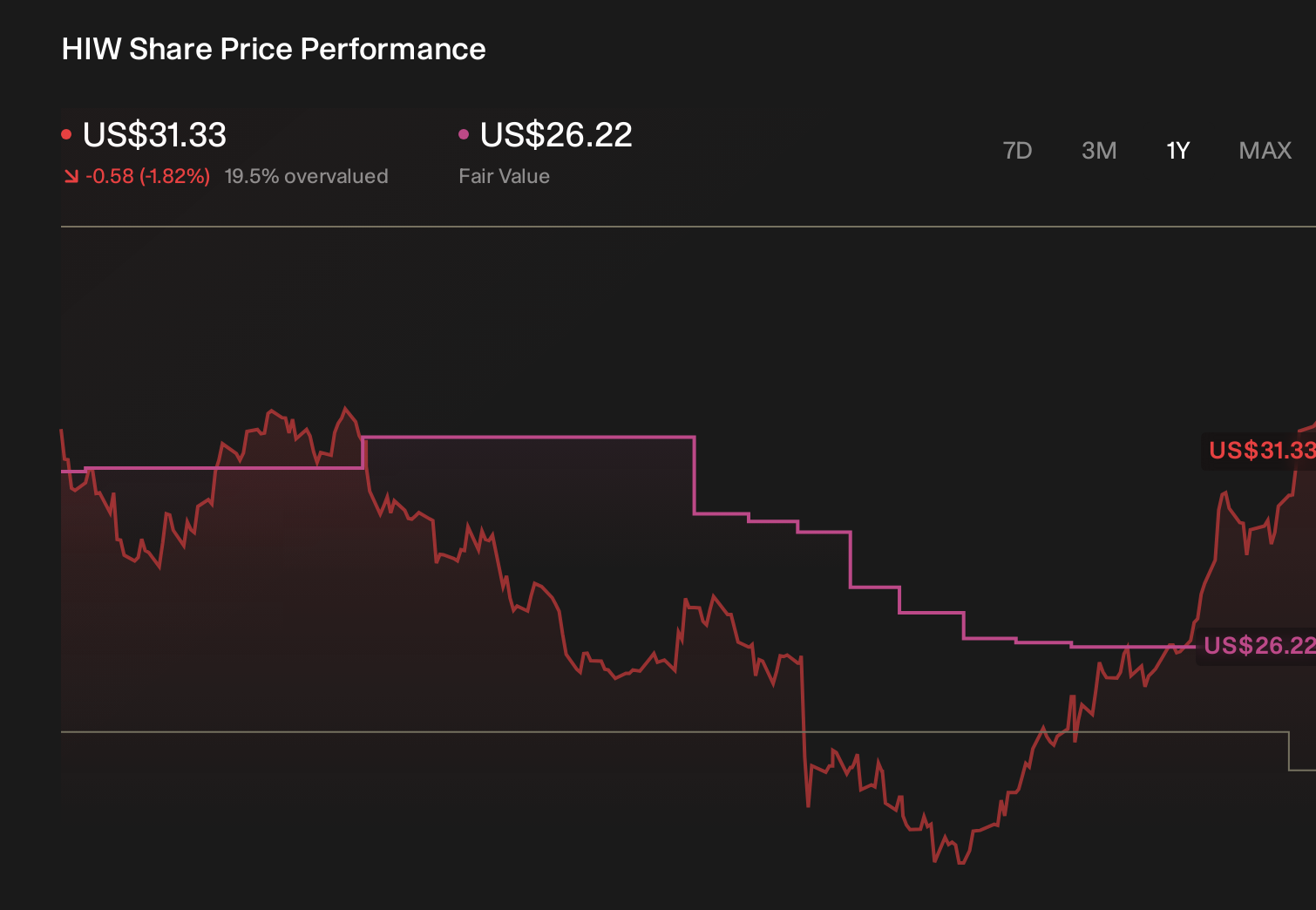
Before this refinancing, the most pessimistic analysts were already assuming earnings drift to about US$96.8 million by 2029, so you should expect that their focus on risks like asset sales execution and elevated leasing costs might evolve further in light of the new debt runway.
Explore 3 other fair value estimates on Highwoods Properties - why the stock might be worth 14% less than the current price!
The Verdict Is Yours
Disagree with existing narratives? Extraordinary investment returns rarely come from following the herd, so go with your instincts.
- A great starting point for your Highwoods Properties research is our analysis highlighting 2 key rewards and 4 important warning signs that could impact your investment decision.
- Our free Highwoods Properties research report provides a comprehensive fundamental analysis summarized in a single visual - the Snowflake - making it easy to evaluate Highwoods Properties' overall financial health at a glance.
No Opportunity In Highwoods Properties?
Markets shift fast. These stocks won't stay hidden for long. Get the list while it matters:
- AI is about to change healthcare. These 39 stocks are working on everything from early diagnostics to drug discovery. The best part - they are all under $10b in market cap - there's still time to get in early.
- Explore 30 top quantum computing companies leading the revolution in next-gen technology and shaping the future with breakthroughs in quantum algorithms, superconducting qubits, and cutting-edge research.
- Invest in the nuclear renaissance through our list of 88 elite nuclear energy infrastructure plays powering the global AI revolution.
This article by Simply Wall St is general in nature. We provide commentary based on historical data and analyst forecasts only using an unbiased methodology and our articles are not intended to be financial advice. It does not constitute a recommendation to buy or sell any stock, and does not take account of your objectives, or your financial situation. We aim to bring you long-term focused analysis driven by fundamental data. Note that our analysis may not factor in the latest price-sensitive company announcements or qualitative material. Simply Wall St has no position in any stocks mentioned.
Have feedback on this article? Concerned about the content? Get in touch with us directly. Alternatively, email editorial-team@simplywallst.com