


BancFirst (BANF) is back on investor radar after reporting year over year revenue growth of 10.30% and net profit growth of 12.27%, alongside a high financial score and strong operating efficiency.
See our latest analysis for BancFirst.
Despite the solid financial update, BancFirst’s recent share price movement has been more muted, with the stock roughly flat over the past month, but posting a 3.91% 90 day share price return and a 32.59% three year total shareholder return.
If BancFirst’s profile has you thinking about where else quality and resilience might be hiding in the market, this is a good moment to broaden your search through 20 top founder-led companies
With BancFirst posting solid revenue and profit growth, a high financial score and relatively modest recent share price moves, the key question is whether the current valuation still leaves room for upside or if the market is already pricing in future growth.
Price-to-Earnings of 15.1x: Is it justified?
On a headline valuation check, BancFirst is trading on a P/E of 15.1x, which looks expensive relative to both peers and an internally estimated fair level.
The P/E ratio compares the company’s share price with its earnings per share, so a higher P/E means you are paying more for each dollar of current earnings. For banks like BancFirst, this often reflects what the market expects for future profit growth, balance sheet strength and the reliability of earnings.
Here, the signals are mixed. On one hand, BancFirst is assessed as trading at a 39.7% discount to an estimate of its future cash flow value of $184.69 based on the SWS DCF model, and earnings have grown by 10.4% per year over the past 5 years with current profit margins of 35.4%. On the other hand, the 15.1x P/E is higher than the US Banks industry average of 11.9x, higher than a peer average of 13.3x, and well above an estimated fair P/E of 11.1x, a level the market could move closer to if expectations cool.
Explore the SWS fair ratio for BancFirst
Result: Price-to-Earnings of 15.1x (OVERVALUED)
However, BancFirst’s relatively high P/E and total shareholder return decline of 5.31% over the past year both leave the narrative sensitive to shifts in investor sentiment and earnings quality.
Find out about the key risks to this BancFirst narrative.
Another View: What the SWS DCF Model Says About BancFirst
The earlier P/E check hinted that BancFirst might be priced generously, but the SWS DCF model points the other way. With an estimated future cash flow value of $184.69 per share versus a current price of $111.31, the stock screens as significantly undervalued.
For investors, that gap cuts both ways. It could signal potential upside if cash flows unfold as expected, or it could highlight that the model is assuming more than the market is willing to pay for a regional bank with 3.5% forecast earnings growth and 6.3% forecast revenue growth. Which side of that trade-off feels more realistic to you?
Look into how the SWS DCF model arrives at its fair value.
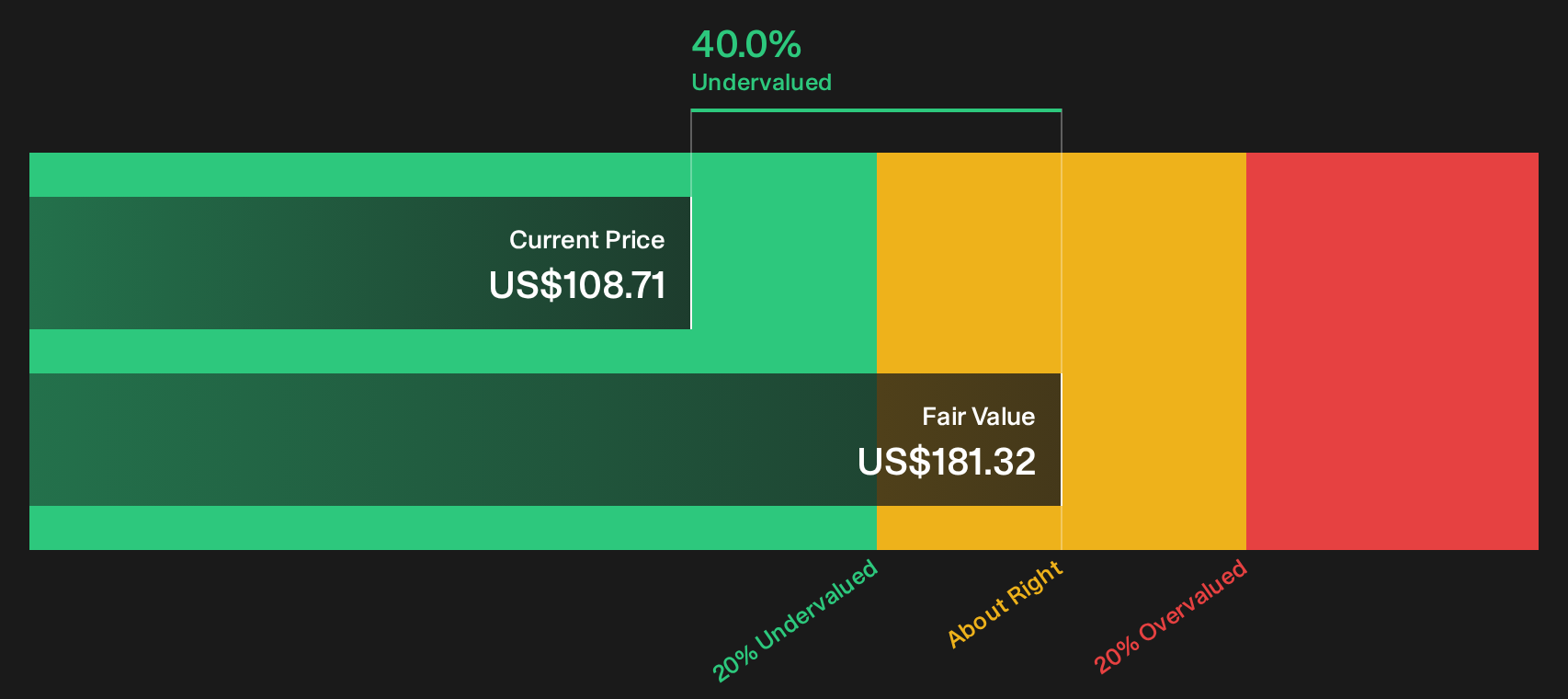
Simply Wall St performs a discounted cash flow (DCF) on every stock in the world every day (check out BancFirst for example). We show the entire calculation in full. You can track the result in your watchlist or portfolio and be alerted when this changes, or use our stock screener to discover 45 high quality undervalued stocks. If you save a screener we even alert you when new companies match - so you never miss a potential opportunity.
Next Steps
With BancFirst’s mix of supportive metrics and lingering questions, sentiment is clearly split. Now is a good time to review the underlying data, balance the positives and negatives, and weigh the 4 key rewards and 1 important warning sign
Looking for more BancFirst sized opportunities?
If BancFirst has sharpened your focus on quality, do not stop here. The wider market is full of other stocks with different strengths that could complement your portfolio.
- Target dependable growth potential by reviewing companies our system flags as screener containing 19 high quality undiscovered gems that still sit off most investors’ radar.
- Strengthen your downside protection by checking out 65 resilient stocks with low risk scores that score well on resilience, stability and risk controls.
- Prioritize financial sturdiness by scanning the solid balance sheet and fundamentals stocks screener (48 results) for companies with healthier balance sheets and fundamentals than the broader market.
This article by Simply Wall St is general in nature. We provide commentary based on historical data and analyst forecasts only using an unbiased methodology and our articles are not intended to be financial advice. It does not constitute a recommendation to buy or sell any stock, and does not take account of your objectives, or your financial situation. We aim to bring you long-term focused analysis driven by fundamental data. Note that our analysis may not factor in the latest price-sensitive company announcements or qualitative material. Simply Wall St has no position in any stocks mentioned.
Have feedback on this article? Concerned about the content? Get in touch with us directly. Alternatively, email editorial-team@simplywallst.com