


- VeriSign, Inc. recently completed a registered offering of US$550 million of 5.100% senior unsecured notes due 2031, issued under its existing indenture and featuring covenants on liens, sale-leasebacks, and change-of-control repurchase rights.
- This new debt financing framework, alongside flexible early redemption options, could influence how investors view VeriSign’s balance sheet resilience and capital allocation plans.
- We’ll now examine how this new 5.100% senior notes issuance might reshape VeriSign’s investment narrative around earnings, pricing power, and capital structure.
The future of work is here. Discover the 29 top robotics and automation stocks leading the charge in AI-driven automation and industrial transformation.
VeriSign Investment Narrative Recap
To own VeriSign, you need to be comfortable with a government-backed monopoly on .com and .net, recurring cash flows, and management’s habit of returning capital through dividends and buybacks. The new US$550 million 5.100% senior notes add leverage but do not appear to alter the key near term catalyst, the November 1, 2026 .com price increase, or the central risk around regulatory or contractual pressure on that pricing power.
The most relevant backdrop to this debt issuance is VeriSign’s ongoing capital return program, including recent share repurchases and a higher quarterly dividend of US$0.81 per share. Taken together, the new notes and these payouts frame how the company is balancing higher financial obligations with continued distributions, which matters if domain growth, renewal trends, or pricing flexibility were to soften.
Yet beneath this seemingly secure position lies a risk that investors should be aware of, especially if future oversight of .com pricing or contract renewals were to...
Read the full narrative on VeriSign (it's free!)
VeriSign's narrative projects $2.0 billion revenue and $971.1 million earnings by 2029. This requires 5.5% yearly revenue growth and about a $130 million earnings increase from $840.9 million today.
Uncover how VeriSign's forecasts yield a $312.00 fair value, a 22% upside to its current price.
Exploring Other Perspectives
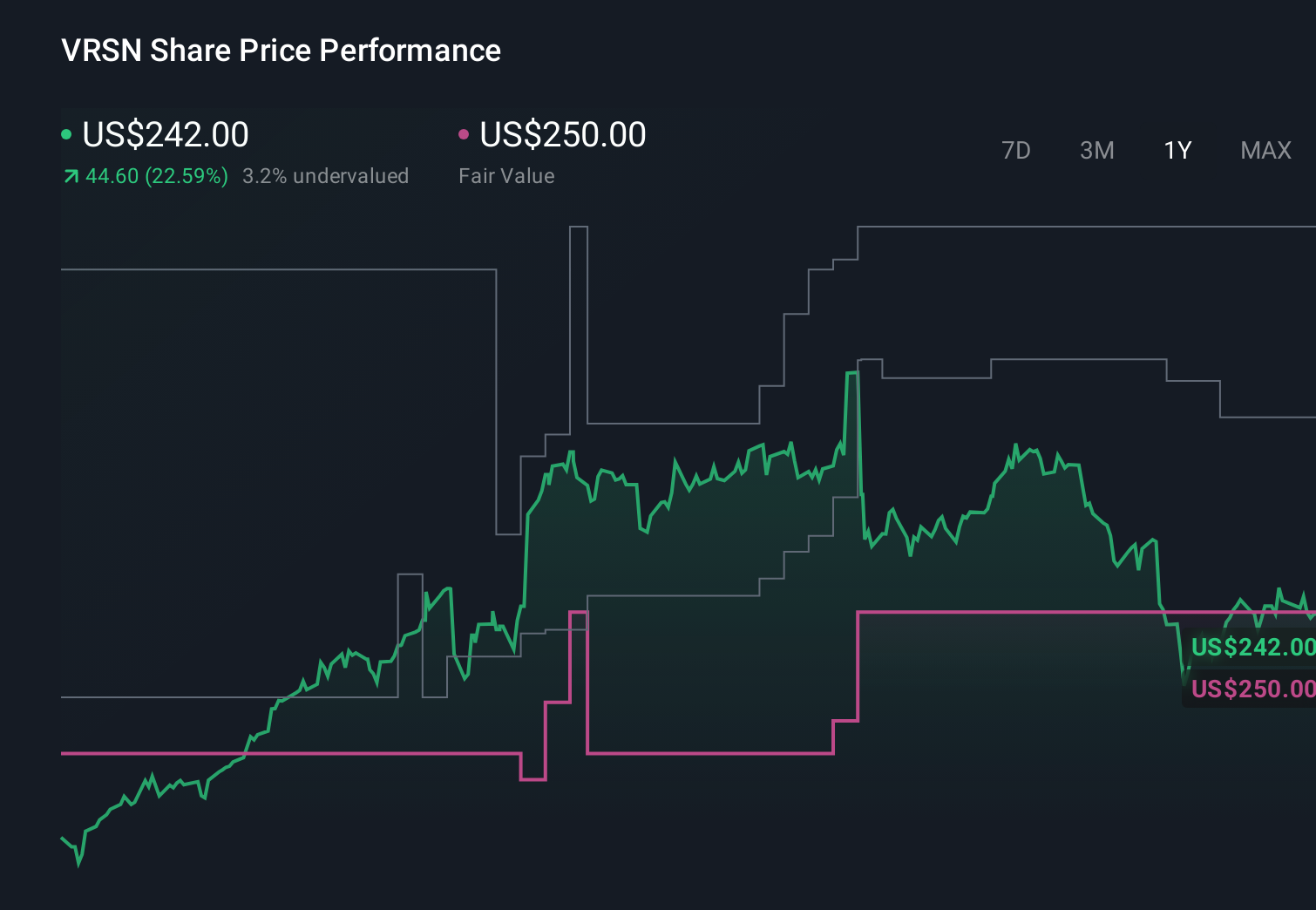
While consensus focuses on steady domain trends, the most optimistic analysts were already modeling about US$2.1 billion of revenue and US$962.5 million of earnings by 2029, so this new debt deal could either reinforce or challenge that more optimistic view depending on how it ultimately affects VeriSign’s costs, flexibility, and exposure to long term contract and regulatory risks.
Explore 6 other fair value estimates on VeriSign - why the stock might be worth as much as 38% more than the current price!
Form Your Own Verdict
Disagree with existing narratives? Extraordinary investment returns rarely come from following the herd, so go with your instincts.
- A great starting point for your VeriSign research is our analysis highlighting 3 key rewards and 3 important warning signs that could impact your investment decision.
- Our free VeriSign research report provides a comprehensive fundamental analysis summarized in a single visual - the Snowflake - making it easy to evaluate VeriSign's overall financial health at a glance.
Ready To Venture Into Other Investment Styles?
Our daily scans reveal stocks with breakout potential. Don't miss this chance:
- Uncover the next big thing with 20 elite penny stocks that balance risk and reward.
- Outshine the giants: these 16 early-stage AI stocks could fund your retirement.
- We've uncovered the 7 dividend fortresses yielding 5%+ that don't just survive market storms, but thrive in them.
This article by Simply Wall St is general in nature. We provide commentary based on historical data and analyst forecasts only using an unbiased methodology and our articles are not intended to be financial advice. It does not constitute a recommendation to buy or sell any stock, and does not take account of your objectives, or your financial situation. We aim to bring you long-term focused analysis driven by fundamental data. Note that our analysis may not factor in the latest price-sensitive company announcements or qualitative material. Simply Wall St has no position in any stocks mentioned.
Have feedback on this article? Concerned about the content? Get in touch with us directly. Alternatively, email editorial-team@simplywallst.com