


- In late June 2026, RPC, Inc. amended and restated its revolving credit agreement with Bank of America and other lenders, extending the up to US$100 million facility’s maturity to June 30, 2031 and removing the SOFR pricing adjustment while keeping existing covenants and subsidiary guarantees in place.
- This longer-dated, potentially more cost-efficient credit line could meaningfully influence how RPC funds equipment upgrades, acquisitions and working capital over the next several years.
- Now, we’ll examine how RPC’s extended revolving credit facility to 2031 may reshape its investment narrative and perceived financial flexibility.
We've uncovered the 9 dividend fortresses yielding 5%+ that don't just survive market storms, but thrive in them.
RPC Investment Narrative Recap
To own RPC, I think you have to believe that its specialized oilfield services, technology upgrades, and balance sheet strength can offset pricing pressure, cyclical shale activity, and volatile margins. The extended US$100 million revolver to 2031 modestly supports that case by reinforcing liquidity for capex and acquisitions, but it does not, by itself, change the near term risk around margin pressure and capital intensity.
The upcoming Q2 2026 results on July 30 matter more for the short term story, because they will show how RPC is handling weaker recent profitability and capital demands in practice. Against that backdrop, the refreshed credit facility reads as a supporting tool for funding potential fleet upgrades or bolt on deals, rather than a standalone catalyst that alters the earnings trend or competitive pressure in key basins.
Yet behind the comfort of extra liquidity, investors should still pay close attention to how increased capital spending could affect free cash flow resilience in the face of...
Read the full narrative on RPC (it's free!)
RPC’s narrative projects $1.9 billion revenue and $116.0 million earnings by 2029.
Uncover how RPC's forecasts yield a $6.54 fair value, a 16% upside to its current price.
Exploring Other Perspectives
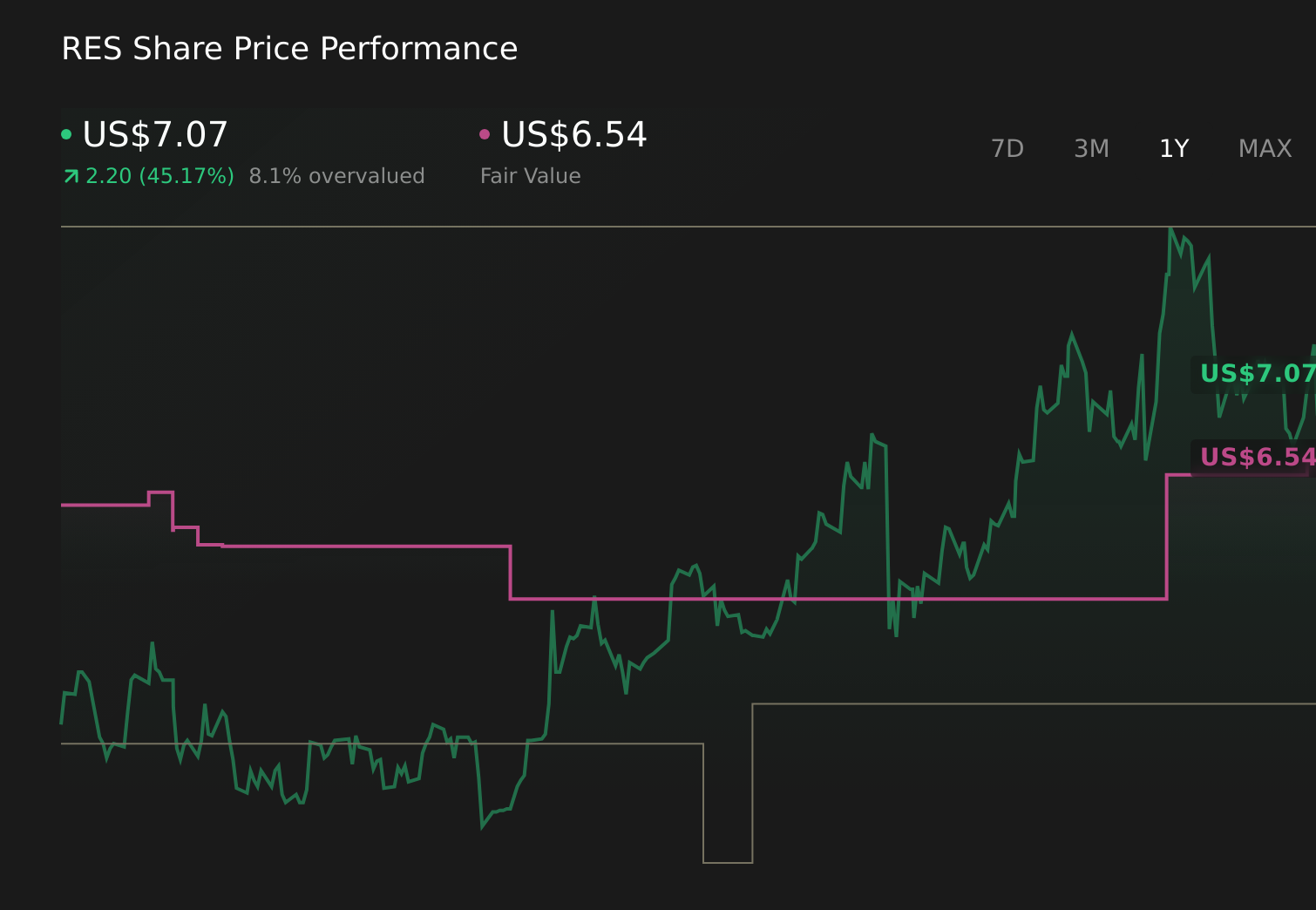
Some of the lowest estimate analysts see a harsher path, even before this new credit line, with earnings potentially reaching about US$116 million by 2029 but only if margins improve and the stock rerates lower, so as you weigh this fresh financing move it is worth remembering how widely opinions can diverge and why you might want to compare several scenarios before deciding what you believe.
Explore 3 other fair value estimates on RPC - why the stock might be worth as much as 60% more than the current price!
The Verdict Is Yours
Don't just follow the ticker - dig into the data and build a conviction that's truly your own.
- A great starting point for your RPC research is our analysis highlighting 2 key rewards and 3 important warning signs that could impact your investment decision.
- Our free RPC research report provides a comprehensive fundamental analysis summarized in a single visual - the Snowflake - making it easy to evaluate RPC's overall financial health at a glance.
Ready To Venture Into Other Investment Styles?
Our daily scans reveal stocks with breakout potential. Don't miss this chance:
- The best AI stocks today may lie beyond giants like Nvidia and Microsoft. Find the next big opportunity with these 16 smaller AI-focused companies with strong growth potential through early-stage innovation in machine learning, automation, and data intelligence that could fund your retirement.
- The future of work is here. Discover the 30 top robotics and automation stocks leading the charge in AI-driven automation and industrial transformation.
- Invest in the nuclear renaissance through our list of 89 elite nuclear energy infrastructure plays powering the global AI revolution.
This article by Simply Wall St is general in nature. We provide commentary based on historical data and analyst forecasts only using an unbiased methodology and our articles are not intended to be financial advice. It does not constitute a recommendation to buy or sell any stock, and does not take account of your objectives, or your financial situation. We aim to bring you long-term focused analysis driven by fundamental data. Note that our analysis may not factor in the latest price-sensitive company announcements or qualitative material. Simply Wall St has no position in any stocks mentioned.
Have feedback on this article? Concerned about the content? Get in touch with us directly. Alternatively, email editorial-team@simplywallst.com