


Zhitong Finance App learned that at the same time as the AI application leader OpenAI officially launched the GPT-5.6 series model, it also launched a new artificial intelligence agent tool — the new AI agent ChatGPT Work Agent, which supports continuous multi-hour work across applications. The AI agent aims to handle a wider range of more complex artificial intelligence workload tasks for several hours, further promoting its strategic layout to attract more business professionals. OpenAI has now jointly launched the GPT-5.6 series of large model products and the ChatGPT Work agent. The core meaning is not simply to improve model parameter capabilities, but to strive to move artificial intelligence from “content generation tools” to “efficient productivity transformation infrastructure that performs tasks independently.”
In the past few years, the market's focus was mainly on parameter scale, reasoning ability, and benchmark ranking, and GPT-5.6 now places more emphasis on token efficiency, task completion ability, and enterprise workflow automation, which means that the commercial value of AI is shifting from “answering questions” to “completing tasks independently.” The core highlight of ChatGPT Work is that by connecting to enterprise systems such as files, applications, emails, calendars, and CRM, AI gradually evolves from an auxiliary tool to a proxy workflow AI digital employee that can execute large-scale blueprint projects such as complex processes and engineering design.
From the perspective of technological competition, the biggest signal released by GPT-5.6 is that the AI industry is entering a stage of intense competition with the double level of “intelligence level+unit cost efficiency”. The GPT-5.6 series of large-scale models released this time includes the flagship SoL, balanced Terra, and the cost-effective Luna. Among them, Sol targets complex reasoning, intelligent programming, cybersecurity, and scientific research tasks. Terra emphasizes the ability of enterprises to balance daily applications, while Luna targets large-scale low-cost deployment. OpenAI CEO Altman emphasized that GPT-5.6 increases token efficiency by 54% in intelligent programming tasks, which means that enterprises can complete more proxy workflow AI tasks under the same computing budget.
The launch of OpenAI GPT-5.6 and ChatGPT Work agents, and the latest analysis by research institute SemiAnalysis shows that ANTHROPIC is moving from long-term losses to a stage of rapid overall profit growth, and is actually sending an important signal to the global stock market: the AI computing power industry chain has gradually moved from the “AI capital expenditure supercycle for training AI big models” to a new stage of “exponential expansion of AI inference demand driven by large-scale applications of smart devices”. These latest signals can be described as shocking recent signs that have led to AI computation The topic of power, in particular, is the pessimistic argument of “excess computing power,” which has plummeted in the AI semiconductor sector.
Nomura, a well-known investment institution on Wall Street, released a research report to refute the “semiconductor peak theory,” and the latest research report released by Bank of America (BofA) this week shows that by 2027, against the backdrop of a strong trend where AI inference computing power continues to surge under the big wave of AI agents, global capital expenditure on cloud computing and artificial intelligence related infrastructure will reach 1.5 trillion US dollars, and points out that the current summer correction of AI semiconductors, including memory chip stocks, is a healthy reset trajectory, rather than any structural changes at the level of AI computing power requirements.
According to Goldman Sachs, the AI bull market is far from over. Instead, it has moved from the “AI chip purchase frenzy” to the second stage of “large-scale AI factory construction” — that is, the next round of excess alpha revenue will no longer only belong to the list of the strongest leaders in the AI GPU/AI ASIC field, but will also spread systematically to data center high-performance CPUs, DRAM/NAND/HBM storage, AI PCBs, liquid cooling systems, data center optical interconnection systems, ABF carrier boards/glass substrates, MLCC, electronic cloth, and extensive wafer foundry Facility level.
GPT-5.6 detonates the age of AI agents: OpenAI moves from a “chatbot” to an enterprise-level digital employee platform
According to test data released by OpenAI, GPT-5.6 Sol has reached an industry-leading level in multiple agent coding, long-term tasks, and security field evaluations, and enhances complex task execution capabilities through the “Sol max” deep reasoning model and the “Sol Ultra” multi-agent collaboration model.
At the same time, its core business logic revolves around reducing inference costs: less token consumption, fewer tool calls, and shorter execution times mean a reduction in the marginal cost of AI adoption by enterprises, which will directly expand the speed of commercial penetration of AI software. Compared with competitors such as Anthropic, OpenAI is trying to occupy the complete market chain from large enterprises to developers to ordinary office users through a combination strategy of “leading flagship model performance+low- and middle-end model price decline”.
OpenAI's latest tool, called ChatGPT Work, is designed to help users create files, spreadsheets, presentations, and web apps. ChatGPT Work is fully driven by the GPT-5.6 model. The company's latest artificial intelligence model was officially released on Thursday; the launch of the model had previously been delayed due to regulatory interference from the Trump administration.
OpenAI and Anthropic PBC, the strongest competitor in AI applications for a long time, have been racing to develop more advanced artificial intelligence agents (i.e. AI agent products) to streamline workflows in a wider range of fields. Previously, the two companies had achieved remarkable success with AI development tools that can automate code writing and complete debugging and actual deployment processes. Earlier this year, Anthropic launched a similar product, called Claude Cowork, with the goal of attracting a wider user base to join the unprecedented superwave of AI agents.
Both OpenAI and Anthropic have secretly submitted listing applications. An agency previously reported that Anthropic is expected to enter the US stock market as early as the fall of this year. OpenAI is considering launching next year.
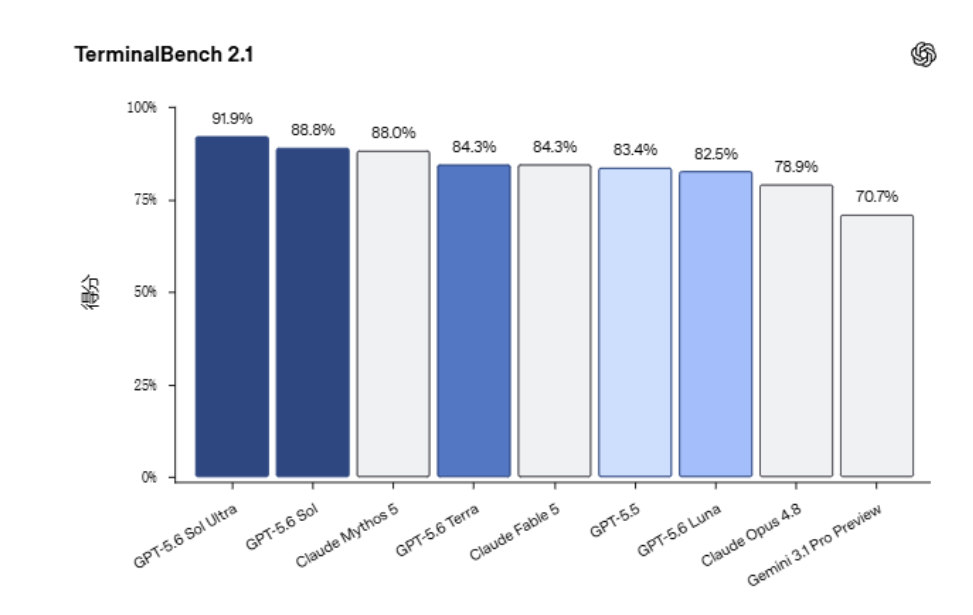
From the perspective of the coding benchmark Terminal-Bench 2.1 test indicators, GPT-5.6 Sol Ultra ranked first with a score of 91.9%, followed by GPT-5.6 Sol with 88.8%, and competitor Claude Mythos 5 ranked third with 88.0%, with a gap of about 0.8 percentage points. Gemini 3.1 Pro Preview finished at 70.7%, a clear gap with the first tier.
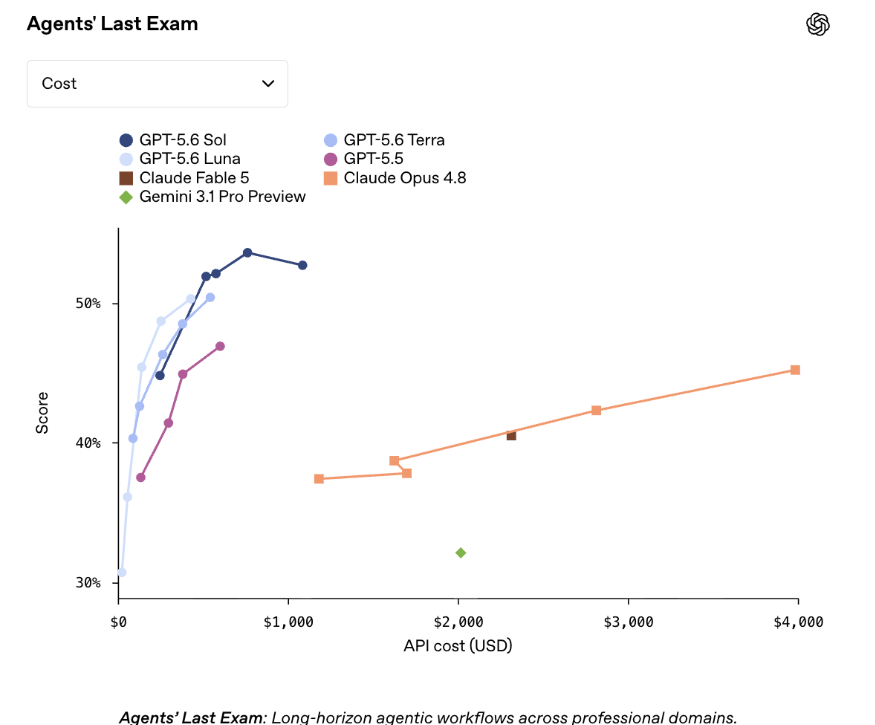
For enterprise users and developers, the core impact of this release is an overall improvement in the price-performance dimension. GPT-5.6 Sol surpassed Claude Fable 5 by 13.1 percentage points by 53.6 points in the Aggregated Last Exam test for professional workflows, and its cost was about one-quarter of Fable 5 even with a moderate inference setting.
In terms of cost efficiency, GPT-5.6 Sol continued to get the highest score at the same API cost, ranking first in the series in terms of cost performance, and even internal tests showed that the cost performance ratio far surpassed Claude Mythos 5. GPT-5.5 and GPT-5.6 Luna present a clear “cost bottleneck” — the increase in performance due to increased investment is very limited. In terms of reasoning ability, as the number of output tokens increases, GPT-5.6 Sol's score improvement slope is the steepest, which is enough to show that it can make the most effective use of complex inference processes to improve output quality.
The flagship version of Sol strengthens competitiveness in the fields of complex programming, intelligent tasks, and scientific reasoning, while reducing actual deployment costs through higher token utilization efficiency. This directly challenges the premium space that competitors such as Anthropic rely on high-performance models. The future core competition of the AI industry may no longer be who has the highest single-point capability, but who can replicate model capabilities on a large scale into hundreds of millions of workflows with the lowest inference costs.
OpenAI CEO Sam Altman said in an interview with the media on Thursday that GPT-5.6 Sol, one of the company's latest artificial intelligence model series products, has greatly increased token efficiency by 54% in agent programming tasks, and that its performance is “as good or even better than competitive models of the same type on the market.”
“Today, every business is thinking about spending and the return on value they get from artificial intelligence, and this is exactly what we really want to achieve.” Altman said.
Ultraman said the company participated in the approval process with Secretary of Commerce Howard Lutnick, Treasury Secretary Scott Bessent, and US National Network Director Sean Keyncross. He described the collaboration between OpenAI and the government as a “collaborative round-trip process,” where the government tests and asks questions, and the company is responsible for solving these issues.
“If you want to achieve widespread use (and that's our goal) while having a strong model, then you really want to be confident in your safety claims, because otherwise the world will fall into an uneasy state very quickly.” Altman said.
Altman said he hopes that regulatory methods can be globalized and that people can use artificial intelligence in the future without having to worry about safety issues all the time. “Everyone will get the right to use it.” He said in an interview. “It's not that America will have a disproportionate advantage here.”
If AI agents can continue to reduce enterprise R&D, operation, sales, financial analysis, and administration costs, it may drive a new round of labor productivity improvement and further expand the contribution of cutting-edge artificial intelligence technology to global economic growth.
The competition between OpenAI, Anthropic, Google, Microsoft, Amazon, Meta, and Musk's AI systems is essentially evolving into a war for the next generation of enterprise digital infrastructure. OpenAI is currently valued at around $852 billion by private investors, and Anthropic is also preparing for a potential listing, indicating that the capital market is pre-pricing the long-term cash flow value brought about by commercializing AI smart devices.
OpenAI is trying to establish an ecosystem similar to the operating system-level portal in the mobile Internet era: models provide intelligent capabilities, agents perform tasks, and enterprise data becomes the fuel for continuous optimization. If this closed loop is formed, AI competition will no longer be just a competition between models, but a competition around “who can become the digital labor infrastructure for global enterprises.”
Overall, the significance of GPT-5.6 is that it further confirms that the AI industry is moving from a “model competition” to a new stage of “AI employees, AI software platforms, and enterprise productivity revolution,” and that companies that have mastered the entrance to the intelligent ecosystem are expected to become core assets in the next round of technology capital cycle.
Money may continue to flock to the “silicon-based inflation” theme! The summer pullback for AI semiconductors is a good opportunity for a low layout
In the past, the market feared that AI infrastructure investment might be overdrawn ahead of schedule, and the 54% smart programming token efficiency improvement shown by GPT-5.6, and the ability of ChatGPT Work to automatically execute tasks across applications, and the penetration of ChatGPT Work into corporate office scenarios meant that improved AI model capabilities would not simply reduce computing power requirements; on the contrary, it could create larger long-term reasoning requirements by reducing the cost of unit tasks, expanding the size of users, and increasing the frequency of enterprise calls. OpenAI launched the three price gradient models SOL, Terra, and Luna. Essentially, it also increases the scale of token consumption by lowering the AI usage threshold, providing greater demand certainty for future AI computing power infrastructure.
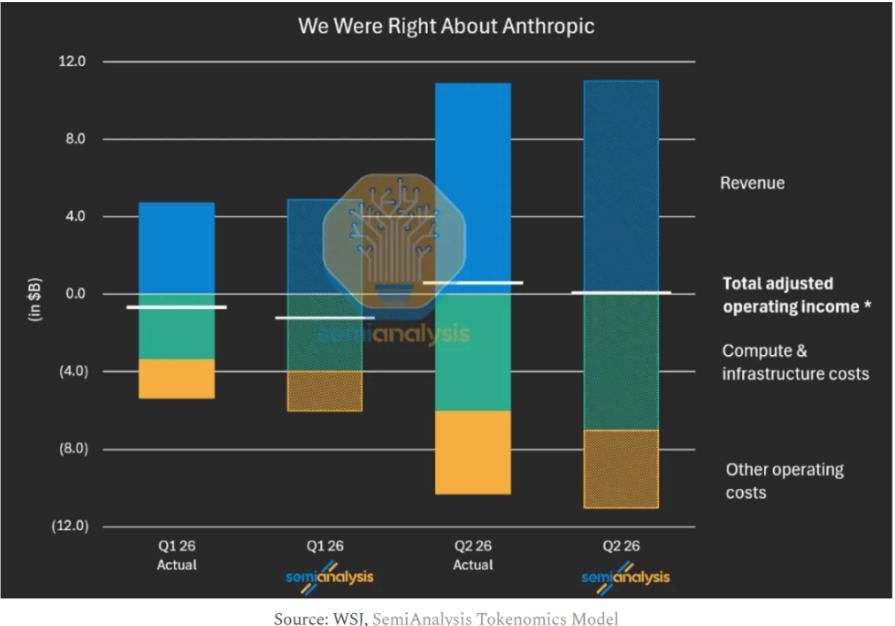
Recent analysis by research firm SemiAnalysis reveals that Anthropic is reshaping the AI commercialization pattern by far exceeding the profitability and growth rate of its competitors. With a high-margin business model centered on APIs, Anthropic has become a leader in the B2B AI market. According to an in-depth report released by SemiAnalysis, the agency expects ANTHROPIC to achieve a profit of 1 billion US dollars before GAAP interest and tax in the third quarter of 2026, corresponding to a profit margin of about 6%. Meanwhile, its annual recurring revenue (ARR) has soared from $9 billion at the end of 2025 to over $60 billion now. The agency predicts that if Anthropic maintains a net ARR (NNARR) rhythm of about $15 billion per month, ARR is expected to reach 300 billion US dollars by the end of 2027, corresponding to a corporate value of 6 trillion US dollars, making it the company with the highest market capitalization in the world.
Anthropic's inflection point stemmed from the explosive popularity of Claude Code. According to statistics compiled exclusively by SemiAnalysis, Claude Code currently accounts for more than 7% of all code submissions on GitHub, directly driving the company's ARR increase in a single month in the first quarter to a crazy jump from $3 billion in January to $11 billion in March. Furthermore, according to SemiAnalysis estimates, Anthropic's current comprehensive gross margin has risen to the mid-60% range, while in 2024 this figure is negative 94%; of these, the gross margin of the API business exceeds 80%.
Since this year, the global capital's grand investment narrative of “seeking silicon-based inflation and weakening the carbon base” is essentially a shift of capital from “carbon-based assets” that rely on population, resources, and linear economic growth, such as traditional manufacturing, automobiles, consumption, real estate, and energy, to a high-end manufacturing chain around silicon wafers related to AI computing power infrastructure. Therefore, GPT-5.6, along with the arrival of ChatGPT Work and Anthropic commercialization data, have strengthened a core investment judgment: the unprecedented AI computing power infrastructure demand cycle is not over, but rather from the AI big model training drive stage to the AI inference application driven stage. The real AI computing power infrastructure supercycle may come from global companies deploying AI agents on a large scale as a new generation of digital employees. This also means that the current correction in the AI semiconductor sector is a healthy adjustment, not a sharp decline in the bear market driven by “excess computing power.”
The unparalleled initial Q2 results that Samsung Electronics, headquartered in South Korea, has just revealed are almost the most intuitive profit sample of this round of memory chip super cycle. From April to June this year, operating profit soared about 19 times year on year, and is expected to reach 89.4 trillion won (about 58.4 billion US dollars), once again breaking the quarterly record record, increasing 56% month-on-month from the strong base of the previous quarter. Revenue expectations for the same period reached 171 trillion won, exceeding market estimates of 169.2 trillion won, and an increase of about 129% over the same period last year. The company plans to release the full financial report on July 30. At that time, it will disclose net profit and classification data for each business division. Samsung Electronics' quarterly operating profit has surpassed Nvidia's operating profit of 53,536 billion US dollars (about 82 trillion won) in the previous quarter, making it the company with the highest quarterly operating profit in the world.
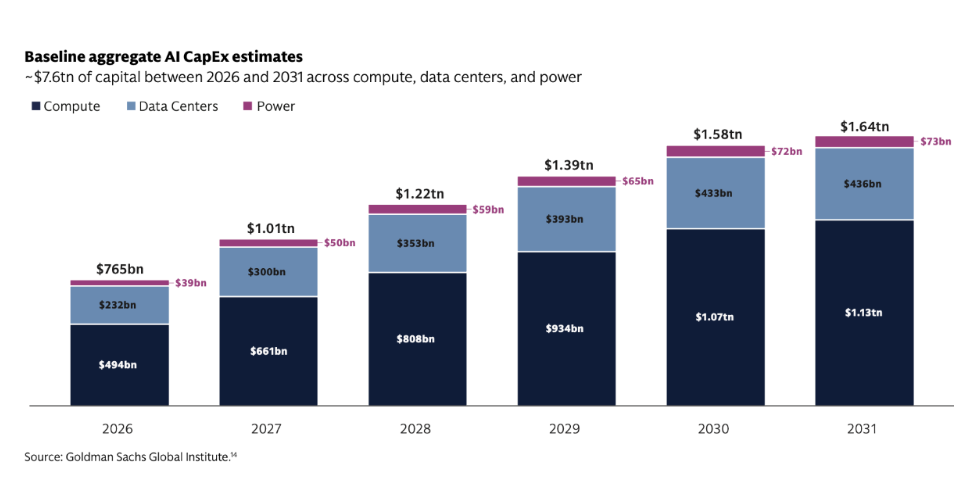
According to Goldman Sachs, the global bull market surrounding the AI computing power chain is far from over. The main line of the market has been upgraded from the long-term “programming/code-driven software asset-light software valuation expansion” in 2008 to “AI computing power infrastructure repricing around a range of physical assets.” Wall Street financial giant Goldman Sachs's latest estimates show that the total AI infrastructure-related investment of hyperscale cloud computing vendors may exceed 6 trillion US dollars by 2030; the global AI capital expenditure benchmark model is expected to grow from 765 billion US dollars per year in 2026 to 1.65 trillion US dollars per year in 2031, the cumulative capital expenditure from 2026 to 2031 is estimated to be about 7.6 trillion US dollars, and the power demand for data centers in the US is expected to rise from 31 GW in 2025 to 66 GW in 2027.
Nomura, a well-known investment agency on Wall Street, recently released a research report refuting the “semiconductor peak theory.” Nomura's key to refuting the “semiconductor peaking theory” is not simply saying that AI chips will rise, but rather pointing out that demand for AI cloud infrastructure is spreading from a shortage of single-point GPUs to a mismatch of systemic components. According to the Nomura Research Framework, AI server revenue is expected to increase by 78% and 76% respectively in 2026 and 2027, with global data center projects increasing from 240 to 280, including about 50 gigawatt-class projects, 32 GW of additional computing power deployment in 2027, and 23 GW of visibility in 2028; however, the real bottleneck is moving from Nvidia AI GPUs and Google TPU production capacity, TSMC CoVos advanced packaging to storage chips, wafer-level substrates, AI PCBs, copper-clad boards (CCL), electronic cloth, MLCC, glass/ Overflow of ABF substrates, IC carrier boards, high-end capacitors, power management chips, and data center optics high-speed optical interconnect components.
A team of Bank of America analysts led by senior Wall Street strategist Vivek Arya said, “The stock market boom driven by AI semiconductors is still not over. After a record 88% rise in the second quarter, the Philadelphia Semiconductor Index (SOX) pulled back 11% in the third quarter, in line with the weakest seasonal period in its history. We believe the current pullback is a round of health reset rather than any structural change in artificial intelligence requirements. This pullback is expected to be reset in the summer and is expected to rebound in the fall; short-term leadership may be biased towards Nvidia (NVDA.US), Texas Instruments (TXN.US), ADI.US (ADI.US), and low-beta stocks such as CDNS.US and SNPS.US (SNPS.US), two major chip design EDA leaders, but historical experience shows that after the consolidation period, new momentum will often emerge as investors regain strong confidence in the next round of profit and capital expenditure growth cycles.”
Arya and her team of analysts said, “We expect global cloud and artificial intelligence computing infrastructure capital expenditure to be close to $1.5 trillion by 2027, which means that it is expected to increase by another 40% to 50% year over year, and is strongly supported by continued growth in token scale, surge in enterprise AI agent adoption, and limited infrastructure supply. Importantly, hyperscale cloud computing vendors remain focused on maximizing utilization and AI-driven performance growth trajectories rather than optimizing depreciation.”