


The Zhitong Finance App learned that according to Counterpoint Research's latest report, global retail Wi-Fi CPE market shipments fell 6% year-on-year in the first quarter of 2026. Previously, 2025 was the fourth consecutive year of decline in the market, and the overall size fell by nearly 34% compared to its peak during the pandemic in 2021. In 2021, global home isolation during the COVID-19 pandemic drove a rapid increase in demand for home networks. Remote work, online education, and at-home entertainment are becoming more common, and consumer demand for wider coverage and more stable home wireless networks is increasing, so retail Wi-Fi CPE products, including mesh Wi-Fi systems, are being purchased in large quantities to improve the home networking experience.
Share of global retail Wi-Fi shipments
Q1 2026 vs Q1 2025
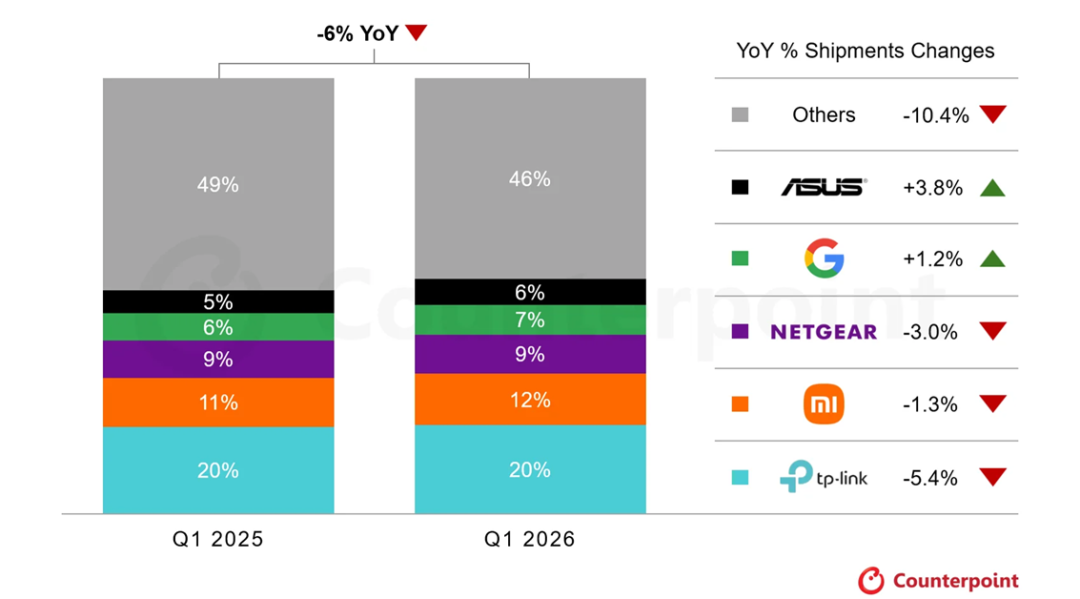
Source: Counterpoint Research Retail Wi-Fi CPE Tracking, Q1 2026
Counterpoint Research said that in recent years, internet service providers (ISPs) have vigorously improved their broadband CPE devices to prevent control of the home network from being taken over by retail equipment manufacturers. Today, broadband terminals provided by carriers not only have significantly improved performance, but can also meet the needs of the vast majority of home users; at the same time, people's dependence on home networks has declined, further reducing the need for consumers to buy their own retail Wi-Fi devices.
The global retail Wi-Fi CPE market is mainly dominated by TP-Link and Xiaomi, accounting for nearly 33% of global shipments. Netgear, ASUS (ASUS), and Google (Google) are in the second place, making up the top five global manufacturers. Among them, only Asus, Google, and Amazon's Eero achieved year-over-year growth in the first quarter of 2026.
Tina Lu, chief analyst at Counterpoint Research, said, “The retail Wi-Fi CPE market continues to be under pressure as ISPs are able to meet most consumer needs. More and more ISPs are starting to offer mesh Wi-Fi solutions, not only improving wireless coverage at home, but also actively deploying the latest generation of Wi-Fi technology to further reduce the technology gap with retail products. For the average consumer, the devices provided by ISPs are sufficient, while the retail market is more aimed at high-end users who want to further enhance their home networking experience.”
Despite the continued decline in the overall market, mesh Wi-Fi systems have continued to grow, mainly because the number of connected home devices continues to increase and consumer demand for wireless coverage throughout the house continues to rise. With its high brand influence and mature smart home product ecosystem, Google and Amazon's Eero are the main beneficiaries of this trend.
At the same time, gaming routers have also become an important market segment for growth. A large number of enthusiast-level gamers want to reduce the latency of online competitive games through higher-performance network devices, and the development of cloud gaming has further increased the market's demand for low-latency, high-bandwidth network devices.
Taimur Zafar, senior analyst at Counterpoint Research, said, “Against the backdrop of the overall decline in the retail Wi-Fi CPE market, mesh Wi-Fi systems continue to grow, reflecting changing demand for home networks. Consumers are increasingly concerned about whole-house coverage and the high-performance networks needed to support more smart home devices with high data traffic. Continuously stable connectivity and high reliability are critical for these devices, and Mesh Wi-Fi is the best solution for these needs.”
Referring to the gaming router market, Zafar added, “Gaming has become one of the most important application scenarios in the retail Wi-Fi CPE market, and many mainstream manufacturers are actively developing this enthusiast user base. Gamers familiar with network performance requirements continue to seek high-performance hardware that provides ultra-low latency, higher reliability, and faster transmission speeds. As online gaming and cloud gaming continue to grow in popularity, retailers will continue to target this high-end consumer group.”