


The Zhitong Finance App learned that in the past week, the global AI industry ushered in a rare “price war” climax. OpenAI, Elon Musk's SpaceXAI, and Meta Platforms (META.US) have successively released next-generation AI models — their common selling point is not how powerful they are, but how low the fees are. From GPT-5.6 to GroK 4.5 to Meta Muse Spark 1.1, the three major players all shared “cost efficiency” as the core narrative.
A “price-performance war” surrounding token pricing has begun in full swing. Behind this wave of collective price cuts is a comprehensive review of AI spending by enterprise customers — when an AI bill can reach tens of millions of dollars, even cutting-edge technology must answer a fundamental question: is it worth the price?
“Token bill” crisis
The trigger for this price war is collective anxiety on the corporate side that AI spending is out of control. Earlier this year, many companies were also encouraging employees to use AI as much as possible, and a competitive culture called “tokenmaxxing” (tokenmaxxing) flourished. However, in recent months, the style of painting has taken a sharp turn — some AI developers have switched to usage-based pricing models (rather than fixed subscription fees), and corporate bills have begun to get out of control.
Gautier Cloix, CEO of the Parisian AI startup H Company, revealed that he had conversations with a number of business executives. These companies used OpenAI and Anthropic models and then billed huge amounts of money — according to an invoice shown to him by one CEO, the AI model cost millions of dollars a month.
Uber is the most typical example. The company used up its AI budget for the full year 2026 in April, then limited employees' monthly token spending on individual AI tools to less than $1,500. Furthermore, it is rumored that the company received a $500 million Claude fee notice because it forgot to set usage limits for employees.
Gil Luria, head of technical research at DA Davidson & Co., said, “Businesses are spending much more now than before. As costs got out of control, they began to question efficiency.”
According to Ramp's token spend management data, the median AI token fee paid by companies in April 2026 was $2,246 per month, but the average was as high as $140,842 per month — a huge gap indicating that a small number of “superusers” are consuming the vast majority of AI budgets.
Gartner predicts total global AI spending will reach $2.52 trillion in 2026. IDC, on the other hand, predicts that global AI spending will exceed 300 billion US dollars in 2025. As companies' investment in AI moves from “experimental” to “large-scale,” the rate of expansion of bills far exceeds expectations.
The three AI giants are simultaneously shifting to a “price-performance first” strategy
OpenAI GPT-5.6: Benchmarking Anthropic with “1/16” cost
On July 10, Beijing time, OpenAI officially launched the full range of GPT-5.6 products, launching three versions at once — Sol (flagship version), Terra (balanced version), and Luna (affordable version). CEO Sam Altman made it clear that the new model's strategic position is to do more work with fewer tokens, thereby drastically reducing customer costs.
The GPT-5.6 series includes three models:
Sol (Ultimate Edition): Input $5 and output $30/million tokens. Token usage efficiency is 54% higher than the previous generation;
Terra (mid-tier): input $2.5 and output $15/million tokens. The performance surpasses Anthropic Fable 5, and the cost is about one-sixteenth of the latter;
Luna (entry-level): Input $1, output $6/million tokens, and use less than half of the estimated cost to approach GPT-5.5's peak performance.
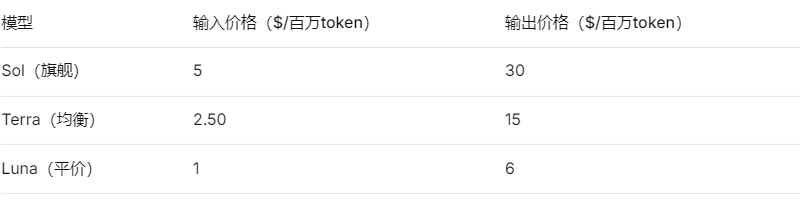
Among them, SOL's token efficiency increased by 54% in terms of AI programming, and the performance is directly comparable to Anthropic's Claude Fable 5. According to the Artificial Analysis Programming Index quoted by OpenAI, Sol set a new industry benchmark with 80 points, which is 2.8 points higher than Fable 5, while outputting tokens takes less than half the time, and the cost is reduced by about one-third. Terra's price is directly lower than GPT-5.5 of the previous generation, while Luna is suitable for batch lightweight tasks at the lowest cost.
Altman admits, “Every business is now thinking about what they're spending on AI and the value they're getting from it, and that's what we really want to do.”
This statement is quite different from a year ago — OpenAI executives were also publicly discussing the possibility of one day charging thousands of dollars of monthly subscription fees for top AI models. Last month, OpenAI also launched a credit limit usage analysis function and an updated spending control mechanism to help companies manage AI expenses.
Musk Grok 4.5: “Opus Level Performance, Quarter Token”
Musk is no slouch either. SpaceXAI (formerly XAI) first released Grok 4.5 on July 8. This is the company's first new model since its launch. Musk made a high-profile statement on X: “This is an Opus level model, but it's faster, the token is more efficient, and the cost is lower.”
Technical data shows that in the SWE Bench Pro mission, Grok 4.5 solved the problem by only outputting an average of 15,954 tokens, while Claude Opus 4.8 required 67,020 tokens — Grok 4.5 used less than a quarter of the opponent's tokens.
In terms of pricing, the Grok 4.5 API costs $2 per million input tokens and $6 for output tokens, which is more than 60% cheaper than Claude Opus and GPT-5.5. Internal evaluations show that its comprehensive capabilities are roughly comparable to Opus 4.7, but “much faster”.
SpaceXAI claims that the GROK 4.5 token is twice as efficient as similar products from other companies. Grok 4.5 ranked first among the three new models with a score of 64.7 in the SW-bench Pro (Real Project Code Repairing Capability) evaluation. However, Grok 4.5's high score was accompanied by a higher illusion rate — a potential cost of its price-performance strategy.
Meta's “price butcher” hits the programming circuit: the first paid model, priced at only one-quarter of the rival
Meta, on the other hand, came up with a more aggressive offer. On July 10, Meta launched Muse Spark 1.1, and Zuckerberg returned to the X platform after a lapse of three years to personally endorse it.
In terms of pricing, the Muse Spark 1.1 input is only $1.25 per million tokens, and the output is $4.25 per million tokens. In contrast, Anthropic Fable 5 is priced at around $15 per million tokens and $75 output—Muse Spark 1.1 is only one-tenth of Fable 5. It's also more competitive than OpenAI's entry-level GPT-5.5.
Muse Spark 1.1 is designed for AI agents and programming tasks, supports a contextual window of 1 million tokens, and has achieved the industry's best public performance (SOTA) in terms of professional competencies such as medical documents (MedScribe), tax evaluation (TaxEval), and legal work (Harvey's Legal Agent Bench).
Zuckerberg put it bluntly: “Some of the other labs have very high pricing and huge profit margins. We believe we are well placed to provide cutting-edge or very high levels of intelligence at a more affordable price. ” Meta's strategy is clear: it relies on extremely low prices to attract customers to try it out, and then increase the price after stabilizing the market. Meta's willingness to be “aggressive” comes from its lucrative online advertising business.
Meta AI director, Alexandr Wang, said that the new pricing is “very aggressive and attractive,” and each new API account will also receive a $20 free credit.
The pangasius effect: the double clash between the Chinese model and “routing services”
Behind the collective price reduction of America's big models, there is also a force that cannot be ignored — the impact on the cost performance ratio of the Chinese AI model.
In June 2026, the cryptocurrency trading platform Coinbase set the Chinese model as the default tool for engineers; US startup Lindy completely switched to DeepSeek because “API fees exceeded the salary of all employees.” According to each reporter's interview, the deduction cost of European and American companies after replacing the Chinese model reached 30% to 95%; compared to the US competitor, the performance gap of the Chinese big model was only 1% to 4%, but the price was 60% to 90% lower.
Since February 2026, the share of tokens used by US companies using the Chinese AI model on OpenRouter has stabilized at over 30% every week, reaching a maximum of 46% — compared to 4.5% in the first half of 2025.
DA Davidson's Luria said that as businesses increasingly focus on cost control, they are “looking for other solutions.” Model routing service provider OpenRouter raised more than $100 million in May to meet companies' demand for cross-model cost optimization.
The pricing strategy of Musk's Grok 4.5 is considered by market observers to be highly consistent with the intelligent spectrum GLM-5.2's “82% lower pricing to reduce the cutting edge model”. Leading Silicon Valley labs are moving closer to the cost-effective play style of Chinese open source vendors.
At the same time, model routing services are becoming a new tool for enterprises to control AI costs. Platforms like OpenRouter allow users to seamlessly choose from hundreds of AI models to assign different tasks to the most cost-effective models. According to the Citibank report, the share of open source model tokens processed on the OpenRouter platform increased dramatically from 34% in January to 65% in June. In May of this year, OpenRouter completed Series B financing of 113 million US dollars, with a valuation of 1.3 billion US dollars.
Anthropic under pressure: the most expensive model is under “siege”
By emphasizing cost efficiency, the three players are concentrating the pressure on to Anthropic — a company viewed by many as the current AI frontrunner, and its Opus and Fable models rank among the most expensive in terms of cost per mission.
Musk directly named Anthropic when promoting Grok 4.5: “This is an Opus level model.” OpenAI, on the other hand, uses data — GPT-5.6 Terra and Luna both surpass Claude Fable 5 in performance, but the cost is only one-sixteenth of the latter. Meta's Muse Spark 1.1 is only one-tenth the price of Fable 5.
Meanwhile, Anthropic itself is under pressure. According to the data, Anthropic has spent 2.3 times its salary expenditure on computing power — based on the full cost of a senior engineer of $224,000, the corresponding computing power expenditure per engineer is approximately $515,000 per year. The company has recently switched Claude Enterprise from a fixed subscription model to a usage-based billing model. This shift itself reflects the transmission of AI cost pressure from customers to suppliers themselves.
AI's “Token Efficiency Era” has arrived
A year ago, OpenAI executives were also publicly discussing the possibility of charging thousands of dollars per month subscription fees for top AI models. Today, the entire industry is moving in the opposite direction — cheaper, more efficient, and more transparent.
Zuckerberg has made it clear that Meta will adopt an “aggressive” strategy. OpenAI, on the other hand, helps enterprises manage AI costs by introducing credit limit usage analysis and expenditure control mechanisms. Musk, on the other hand, announced to the market with a “quarter token, 60% lower price” method: the “era of token efficiency” of AI has arrived.
For corporate customers, this price war is certainly beneficial — lower costs, more choices, and greater bargaining power. However, for AI developers, how to maintain a healthy business model and recover hundreds of billions of dollars in chips and data centers in the “wave of price cuts” will be a more severe test than the technology competition.
“Businesses are spending a lot more now than before... they're starting to question efficiency,” Luria said. When “token bills” change from experimental expenses to core enterprise costs, whoever can help customers save money can win the market—this is probably the biggest turning point the AI industry is currently experiencing.
But how long this price war will last is still an open question. As one analyst said, token pricing is just a “marketing variable”; the real story lies in infrastructure capital expenditure, GPU utilization, and computing power monetization capabilities.