


When the ban on a newly listed growth stock is lifted and thrown out of a “valuation depression”, can the left-hand layout bring room for a higher premium?
This question has already been answered in the investment community. The originator of the investment community. Graham's investment philosophy was to “invest in bargains,” while Munger's investment philosophy was to buy growth stocks at fair prices. The investment method was to hold large amounts and for a long time. Munger called it the “sit and wait investment method.” In fact, good companies also come with good prices. This kind of target is extremely difficult to find. The market is full of temptations, and undervaluation traps are everywhere.
The Zhitong Finance App learned that Hong Kong stocks are an investment depot for growth value stocks. When resuming all listed new stocks, basically all of the targets will face a sharp decline in valuation for 1-2 months before the ban is lifted. This has nothing to do with fundamentals. The core reason is market concerns or the sell-off of original shareholders, and the profitable exit of short-term customers. But in reality, this gives value investors an opportunity to pick up growth stocks.
Under the wave of ban lifting, the robotics sector showed the strongest “fall resistance”
Looking at the performance cases of the day the ban was lifted one year after listing, take different sectors, such as popular AI models and application sectors, representing such as YunZhisheng and Zhipu, with an average decline of more than 20% on the day the ban was lifted; the same was true for the pharmaceutical sector, which represented a 59.7% drop on the day the ban was lifted; the robotics sector, which represented a decline of more than 10% on the day the ban was lifted.
Obviously, the robotics sector is more resistant to falling and is more favored by capital. Some individual stocks quickly recovered their losses even when they plummeted. For example, crossing the border, they returned to the price before the ban was lifted two days after the ban was lifted. Preferably, it continued to rise sharply after two weeks of contraction, recovering the decline within a month. As a leader in the AI+ robot segment, Jizhijia-W (02590) fell by only 4.9% on the day the ban was lifted. The performance was even more stable, indicating that the original shareholders did not reduce or sell their holdings, and that there were also valuable investment funds being strongly accepted.
The valuation depression brought about by the lifting of the ban is just a window to pick up omissions
There are three main reasons why Gizhijia maintained a relatively stable trend during the period when the ban was lifted, rather than fluctuating as sharply as other individual stocks: first, valuations fell into a “golden pit” before the ban was lifted, which absorbed negative risks to a certain extent; second, compared to other targets, cornerstone investors and old shareholders promised not to reduce their holdings and had no actual selling pressure; and third, value investors based on the left-hand layout actively poured in to take over. As mentioned above, good companies and good prices are the favorites of value investors. Gizhijia not only has strong fundamentals and is profitable, but also has growth expectations, causing value capital to “siphon” at the bottom of the valuation.
As an industry leader, Jizhijia has been number one in the world for seven consecutive years in the AMR field. Customer stickiness and single customer value have continued to increase, and it has taken the lead in verifying the profit model.
The company broke the curse of “increasing revenue without increasing profit” in the robotics industry and entered an era of high balanced profit growth. In 2025, it grew by 31.9%. New orders of 4.137 billion yuan were signed, accounting for nearly 80% of overseas orders. Among them, the American market grew by more than 50%, and the global growth momentum is strong and sustainable. At the same time, under the effect of scale, the company's adjusted profit turned loss into profit, and operating cash flow was drastically corrected, achieving a virtuous cycle of revenue, profit and cash flow.
From an industry perspective, according to Huaxi Securities Research Report, the global AMR solutions market is expected to grow to RMB 162.1 billion in 2024-2029, with a compound annual growth rate of 33.1%. The penetration rate of AMR solutions in the overall warehousing automation field will rise from 4.4% in 2020 to 8.2% in 2024, and is expected to reach 20.2% in 2029. Jizhijia's combination of “good track+leading position+ability to make money” is a scarce allocation target in the capital market.
As such, the company received unanimous recognition from shareholders and institutional investors. Xiangfeng Investment said that in 2025, the company achieved a profit correction under the adjusted caliber, and operating cash flow also corrected at the same time. This is rare in the current Hong Kong stock robotics sector. Hongwei Capital believes that Gizhijia has a clear path to implementation in a scenario where it takes the direction of intelligence. Years of accumulated robot operation data, deep understanding of scenarios, and continuous refinement of solutions will help the company to quickly transform effective industrial orders for specific products. Combined with the company's deep layout in the global market, we are optimistic about the possibility that it will deliver results in the wave of intelligent industrialization.
Industry PS 17 times vs Wishijia 3.7 times, the left-hand layout locks in the growth premium
From a valuation perspective, Jizhijia has plenty of room for valuation to rise. Referring to the robot targets already on the market, judging from the PS valuation, the industry average is 17 times, the highest minimally invasive is 41 times, and Jizhijia is only 3.7 times. One is a surgical robot racetrack leader and an AMR racetrack leader, which also has growth potential. Obviously, Gizhijia is seriously underestimated. Yamato Research gave Jizhijia a target price of HK$38, which is more than 3 times the premium from the current price.
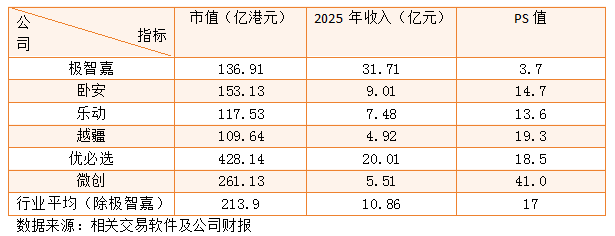
Gizhijia is also actively repurchasing to show the market that the current stock price seriously deviates from intrinsic value, there is an obvious value mismatch, and also conveys confidence in long-term growth. On June 22, a repurchase plan was announced. Within the next 24 months, no more than HK$2 billion of H shares will be repurchased on the open market, and the repurchase amount will not exceed 10% of the total number of issued shares. As one of the uses to repurchase shares, the company deeply binds the company's talents through a share reward program. The total number of Class B common shares that can be issued must not exceed a total of about 124 million Class B common shares to lock in long-term sustainable development.
Munger's “sit back and wait investment method” filters good prices for companies and exchanges time for space. Although the layout on the left has a certain cost of time, it can lock in premium space for growth. For a scarce high-quality target such as JiZhijia, it is undoubtedly a “tailor-made” investment strategy. The retracement in valuation caused by the lifting of the ban caused the company's valuation to fall into a golden pit and ushered in an excellent left-hand layout opportunity.