


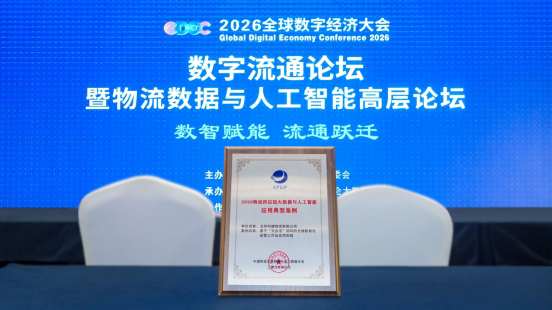
On July 3, the 2026 Global Digital Economy Conference Digital Distribution Forum and Logistics Data and Artificial Intelligence Conference was held in Beijing. At the conference, the Big Data Branch of the China Federation of Logistics and Purchasing released the “2026 Typical Case for the Application of Big Data and Artificial Intelligence in the Logistics Supply Chain”, and Kejie, a subsidiary of Shenzhou Holdings (00861), successfully selected a closed-loop warehouse digital intelligent operation workbench application practice based on the “five-step method”. This case focuses on pain points such as long-standing empirical dependency in the warehousing and logistics industry, poor coordination and multi-warehouse management standards. Through the construction of a digital operation workbench, first-line operation experience, operation data, and management rules are settled into intelligent operation capabilities that can be replicated, executed, and evolved. At the same time, this case is also a successful practice of the enterprise-level intelligent cluster “Xiaojin”, which Kejie Logistics has made every effort to build.
In this case, Kejie built a matrix-like operating structure with “1 data lake, 6 major workbenches, and multiple job roles”, covering key roles such as warehouse supervisors, warehouse managers, customer service, transportation, industry account managers, and management decision makers. The core innovation of the case is the “five-step” closed-loop design that runs through all large screens, that is, “look at the current situation, look at trends, find positions, identify causes, and execute in one step”. Unlike traditional large screens that only show results, Kejie Logistics's workbench places more emphasis on closed-loop transformation from data discovery to business operations. More importantly, the project transforms warehouse management capabilities that have long relied on personal experience into digital assets that enterprises can deposit. Through rule engine, visual diagnosis, and dynamic threshold configuration, Kejie Logistics encodes the hidden experiences of order production experts, gold medal pickers, and senior warehousing supervisors into system rules. The project has now established more than 200 management rules, enabling the experience of outstanding managers to be replicated across warehouses and supporting the standardized operation of the national multi-warehouse network.
In the context of Kejie's comprehensive AI transformation, this case also provided an important scenario foundation for the implementation of Xiaojin Smart. Problem identification, cause analysis, task assignment, execution tracking, and reprocessing in warehousing operations is a natural ability chain for corresponding job intelligence. With the further introduction of AI models, predictive algorithms, and automated linkage capabilities, the workbench will move further from “being able to see and control” to “being able to predict, suggest, and execute”, promoting the real integration of Xiaojin job intelligence into specific job processes such as warehouse supervisors, customer service, transportation scheduling, and business analysis.
According to relevant data, Kejie has built more than 40 visual workbenches around key players such as warehouse supervisors, warehouse managers, customer service, transportation, industry and operation, serving nearly 10,000 people in core positions every day. Among them, the intelligent picking heat map workbench for warehouse supervisors can identify congestion in the storage area in real time, automatically suggest frequency adjustments, and optimize product positions to reduce the picking path by 15% and the waiting time for review by 40%; the inventory management workbench for warehouse managers, AI automatically drills down to analyze sluggish inventory and generate a clean list for push execution, which has helped beauty customers reduce the number of inventory turnover days from 45 days to 30 days, reducing the proportion of stuck materials by 25%.
In terms of operational efficiency, the investigation of warehousing abnormalities was upgraded from a delay of more than half an hour to Xiaojin's real-time warning, and the response speed was increased by 80%; queries on various business indicators were retrieved in seconds, and the query time was reduced by 90%; the training cycle for new warehouse management personnel was reduced from 2-3 months to 1 month, and manpower training costs were greatly reduced.
At the cost and service level, relying on the intelligent management and control capabilities of Xiaojin's assets and packaging materials, the capital occupation of packaging materials was reduced by 15%, the equipment failure rate was reduced by 20%; the 24-hour transit fulfillment rate of the beauty business increased to more than 99%. At the same time, Xiaojin opened up a customer service desk to actively predict and push delayed information. The customer service experience was significantly improved, and the labor efficiency gap across warehouses narrowed from 20% to less than 5%, achieving unified and standardized management of warehouses across the country.
This case has been recognized by the industry. It is an affirmation of Kejie Logistics's digital intelligence practices. It also indicates that under the position of “technology-driven industry supply chain expert”, Kejie is continuing to advance the transformation of capabilities from empiricism to digital intelligent operation, from internal efficiency improvement to customer empowerment, and from system tools to AI agents. Facing the future, Kejie will continue to focus on the construction of Xiaojin smart devices and industry digital intelligence solutions, promote the deep integration of AI capabilities with core links such as warehousing, transportation, fulfillment, customer service and management decisions, provide customers with more agile, transparent and intelligent supply chain services, so that AI can truly enter processes, assist decision-making, improve execution efficiency, and provide replicable practical samples for the digital transformation of the logistics industry.