


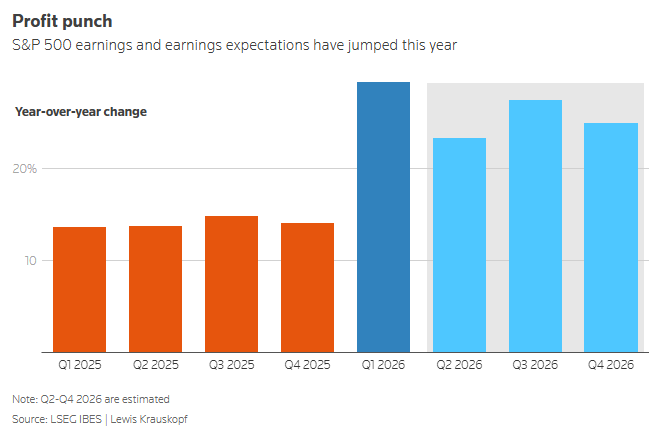
The Zhitong Finance App learned that with Wall Street banks taking the lead in handing over report cards this week, the US stock market is about to enter the second quarter earnings season. However, unlike previous years, this earnings season is facing extremely high performance expectations — S&P 500 companies are expected to record a profit increase of more than 23%, the strongest level since the post-pandemic recovery.
In a context where stock indexes are approaching historic highs, an abnormally steep profit “pass line” means that the room for fault tolerance is shrinking sharply, and any wind and shine could trigger sharp fluctuations.
Profit growth “at full power”: technology is no longer alone
According to LSEG IBES aggregated analysts' forecast data, the overall profit of the Q2 S&P 500 index is expected to increase by 23.4% year-on-year, a sharp increase from the 15.2% forecast at the beginning of the year. After surpassing expectations of 29.4% profit growth in Q1, analysts continued to raise expectations throughout the year. HSBC Global Investment Research described this round of growth as “the strongest profit expansion in the post-pandemic era.”
Meanwhile, a number of top Wall Street institutions sent a common signal on the eve of the earnings season: strong growth in corporate profits is spreading outward from tech giants, providing healthier and broader support for the rise in the stock market.
The team of Michael Wilson (Michael Wilson), chief strategist at Morgan Stanley, pointed out that the current median earnings per share growth of S&P 1500 composite stocks has exceeded 10%, which is the best performance since the post-pandemic recovery. Wilson stressed that industries highly related to economic sentiment, such as non-essential consumer goods and transportation, are continuing to receive profit increases from analysts. “We expect that as the profitability resilience of most constituent stocks continues to show, the diffusion effect of the gains is expected to continue.”
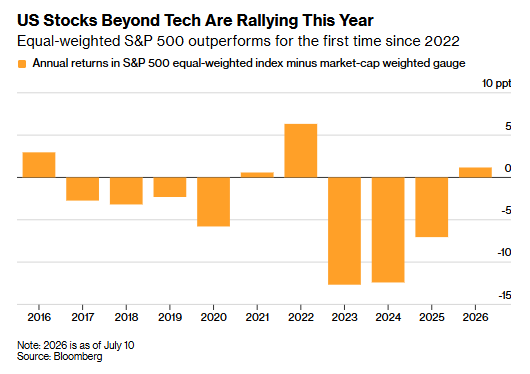
In fact, this judgment has been confirmed by the index's performance — the equal-weighted S&P 500 index surpassed the market-capitalization-weighted S&P 500 index for the first time since 2022. The weighting index has weakened the influence of large technology stocks, and its relative strength means that more ordinary stocks are participating in this round of growth.
However, there are also institutions that continue to be optimistic about the profitability of the technology sector. Lori Calvasina (Lori Calvasina), a capital market strategist at the Royal Bank of Canada, upgraded the tech sector's rating to “overrated” because the sector's revenue and profit forecasts have both improved strongly, and at the same time, the trend of capital return is once again showing.
“The tech sector really isn't cheap to value, but in our latest estimates, whether it's the absolute price-earnings ratio or the relative price-earnings ratio, the sector is only slightly above the long-term average,” said Carvassina.
Nicole Inui (Nicole Inui), head of American equity strategy at HSBC Global Research, predicts that the three major sectors of energy, information technology and materials will lead this earnings season, with the energy and technology sectors expected to achieve impressive growth of three and two digits, respectively.
According to LSEG IBES data, the energy sector is benefiting from soaring oil prices, and profits are expected to soar by about 115%; the highly weighted technology sector is expected to increase profits by 65.5%, driven by artificial intelligence (AI) investment; and the materials sector is also expected to hand over 32.5% growth.
Subtle changes in valuation and a “higher threshold”
On the positive side, one change brought about by rising profit expectations is that strong growth is “passively” relieving high valuation pressure. As profit growth rarely outperformed stock price increases, the forward price-earnings ratio of the S&P 500 index has fallen back to 20.1 times from 22.2 times at the end of 2025. According to LSEG Datastream data, since 2026, the S&P 500 index has increased by 9% cumulatively, while the market's profit forecast for the next 12 months has increased by as much as 21%.
Mark Hackett (Mark Hackett), chief market strategist at Nationwide, said, “It is rare for the market to perform so strongly, and profit growth is stronger than the market, and there is very little.”

The other side of the coin, however, is that extreme optimism has pushed the profit threshold to dangerous heights.
An anomaly confirms the harshness of the market: Normally, analysts lower expectations before the earnings season to make it easier for companies to “exceed expectations.” But this time, no seasonal decline is expected, driven by strong macro fundamentals and AI fanatical demand. In the words of Yardeni Research (Yardeni Research), the risk is that “the first quarter was unusually strong, causing analysts to spend the next three quarters optimistic.”
Chris Fasciano (Chris Fasciano), chief market strategist at Commonwealth Financial Network, said, “Profit growth and rising expectations are certainly beneficial to investors, because this itself is the driving force behind the market. But it's undeniable that this has actually raised the bar for meeting the standards.”
Such high expectations have begun to trigger selective penalties in the market. The recent performance of the semiconductor sector is a lesson from the past: although some companies (such as Samsung Electronics) handed over good results, they failed to significantly surpass the already promoted consensus, which triggered a profit settlement.
Furthermore, the market's concerns about profit-driven sustainability have not subsided. Nationwide's Hackett pointed out that he is closely monitoring whether some of the drivers, such as AI-related earnings and fiscal stimulus, are sustainable. “Many of these events themselves are unsustainable, which is what I'm most concerned about.” Especially for “large-scale” companies that are spending huge sums on AI infrastructure this year, investors are eager to see signs of real money returns in this earnings season. Otherwise, even strong capital expenditure data would be difficult to support further strengthening of their stock prices.
Jack Ablin (Jack Ablin), chief investment officer at Cresset Capital, said bluntly that the decline in the market's forward price-earnings ratio itself reflects investors' caution in the face of insufficient visibility of emerging technology (AI) profits. “Because we can't see the prospects clearly, we need to rely more on this earnings season to find a direction — we'll know more clearly where the future is headed.”
Joe Mazzola (Joe Mazzola), head of trading and derivatives strategy at Carson Wealth Management, cautioned: “We are entering the Q2 earnings season with higher expectations. The volatility of this earnings season is likely to be even more intense as earnings forecasts continue to be revised.”