


The Zhitong Finance App learned that the US semiconductor sector's performance was sluggish at the beginning of July, causing the market to worry about whether the AI market could continue. Analysts believe that after experiencing a sharp rise this year, chip stocks are facing multiple tests such as high valuations, whether AI capital expenditure growth can continue, and profit growth is slowing down, and sector volatility may increase further in the future.
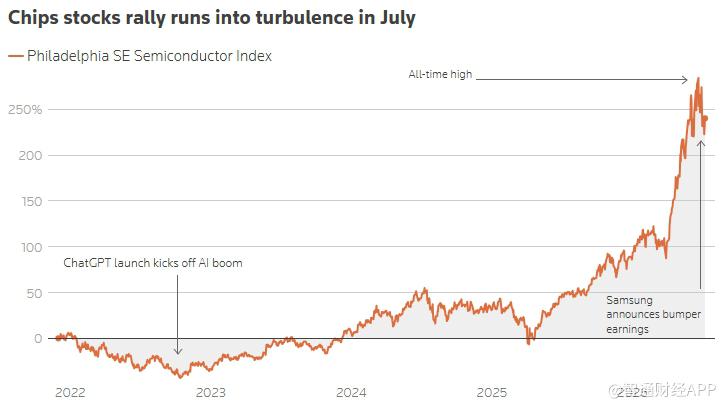
According to the data, the Philadelphia Semiconductor Index has accumulated a cumulative decline of more than 11% since reaching a record high in June, but it still rose by about 83% during the year. Steve Sosnick, chief market analyst at Interactive Brokers, said that the chip industry has achieved unprecedented profit growth in recent years, but what the market is more concerned about is how long this growth will last.
Capital flows fluctuated sharply, and AI investment enthusiasm was divided
The flow of capital also reflects clear fluctuations in investor sentiment. According to LSEG Lipper data, as of June 24, the net outflow of US semiconductor-themed funds was about 11 billion US dollars, setting the record for the largest weekly capital outflow in a century; in the previous two weeks, such funds had just recorded a net inflow of about 12 billion US dollars.
However, most institutions are still optimistic about AI infrastructure investment prospects. Bank of America expects global cloud computing and AI infrastructure capital expenditure to be close to US$1.5 trillion by 2027, an increase of 40% to 50% over the previous year.
Brokerage firms are still generally bullish, but some room for growth has been overdrawn
Despite the intensification of short-term adjustments, many Wall Street institutions have raised the target prices of chip companies, believing that AI demand will continue to support the industry's profit growth.
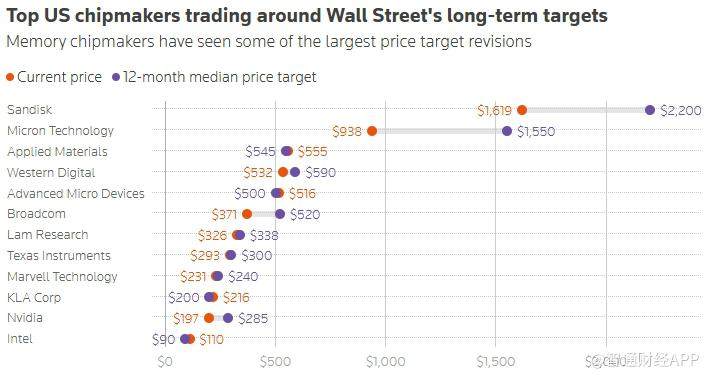
According to LSEG statistics, among S&P 500 semiconductors, Micron Technology (MU.US) still has a potential increase of more than 60% compared to the market's consistent target price, the highest in the industry; memory chip maker SNDK.US (SNDK.US) has more than 30% potential increase; and Nvidia (NVDA.US)'s target price for the next 12 months is still more than 40% higher than the current stock price.
Recently, the South Korean memory chip giant SK Hynix (SKHY.US) listed on the NASDAQ after completing the issuance of the US$26.5 billion American Depositary Receipt (ADR). The stock price rose more than 10% on the first day of listing, which also shows that the market remains optimistic about AI storage demand.
However, analysts pointed out that the stock prices of many large chip companies, including AMD (AMD.US), Intel (INTC.US), and Mwell Technology (MRVL.US), are close to the consistent market target prices, and there may be relatively limited room for further growth in the short to medium term.
Alexander Lis, chief investment officer of SD Ventures, said that the continuous increase in target prices by brokerage firms is more a reflection of the previous strong rise in the semiconductor sector, and does not necessarily mean that there is still room for a similar increase in the future.
Short positions hit a three-year high, and financial reports will face a critical test
At the same time, short capital has also begun to rearrange the semiconductor sector. According to data analysis agency ORTEX, short positions in major chip stocks have risen to the highest level in the past three years. The average short selling scale of the industry has nearly doubled in the past three years. Among them, Maywell Technology, Micron, and Qualcomm (QCOM.US) have increased the most significantly.
Peter Hillerberg, co-founder of Ortex, said that currently, the market is more about re-adding hedging positions after the rise, rather than large-scale consistent bearishness, so there is no extreme short trade that could trigger a “shortening market.”
Next, corporate financial performance will become the focus of market attention. According to LSEG data, the profits of S&P 1500 semiconductor and equipment index companies are expected to more than double year-on-year this year, mainly driven by the performance of Nvidia and Micron; however, the industry's profit growth rate is expected to slow to 46.1% in 2027.
Furthermore, macroeconomic factors such as the Federal Reserve's future interest rate path and changes in the Middle East situation may also influence the market's judgment on the profit prospects of the industry.
Valuation pressure is beginning to show that the industry cycle is still difficult to disappear
Despite experiencing a sharp rise, the valuations of some leading companies have actually declined somewhat. According to the data, Nvidia's current expected price-earnings ratio is about 19 times, a record low in more than 10 years; Micron's projected price-earnings ratio once fell 5.4 times in May, the lowest in nine years.
Chris Maxey, chief market strategist at Wealthspire Advisors, said that the main reason for the decline in chip stock valuations in the past two years is not that stock prices have declined, but that corporate profits have grown faster than stock prices have risen.
However, for companies such as Intel, AMD, and Mywell Technologies, their expected price-earnings ratio is still significantly higher than the long-term average, which means that the market has high expectations for future profit growth. If results are not realized, investors may refocus on the highly cyclical characteristics of the semiconductor industry, especially in the field of memory chips.
Marija Veitmane, head of stock research at State Street Global Markets, said that the cyclicality of the semiconductor industry will not disappear, but the industry's boom cycle may become longer in the future.