


The Zhitong Finance App learned that the US stock market will usher in intense and major events on Tuesday, with all kinds of key data and agendas coming one after another, yet stock traders don't seem to agree. This indifferent attitude leaves the market in a delicate state of fragility — after all, US stocks are currently hovering near historical highs.
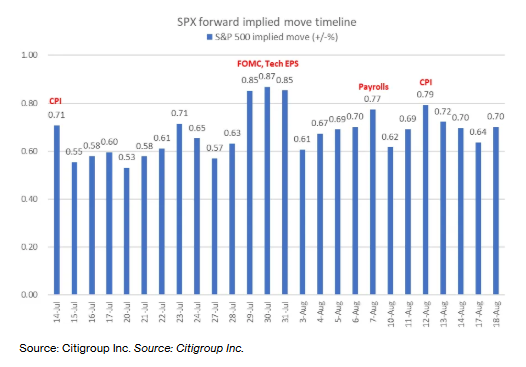
According to data compiled by Citigroup, the implied fluctuation of the S&P 500 index this Tuesday was about ± 0.7%. For such a heavy trading day, such fluctuations in expectations are moderate — not only will the critical consumer price index (CPI) be released on the day, but it will also usher in the first batch of major bank reports of the earnings season, as well as the Federal Reserve Chairman's congressional testimony, not to mention the geographical risks brought about by the re-heating situation in the Middle East. Notably, this level of implied fluctuation also largely coincides with the average fluctuation over the past 12 CPI release days.
According to Piper Sandler's data, this calm expectation will continue at least until this Friday: based on cross-option pricing on the S&P 500 index, the market is expected to fluctuate around ± 1.1% this week, which is the smallest expected weekly fluctuation since December last year.
The reason behind this phenomenon is probably the traditional “summer off-season” effect — major trading desks are understaffed and market trading is light. However, the risk of insufficient liquidity is that once events fall short of expectations, market fluctuations may be dramatically amplified.
Stuart Kaiser (Stuart Kaiser), head of US stock trading strategy at Citigroup, said: “The current implied volatility is likely to be low. Considering that the banking sector weighs less than 4% in the S&P 500, the market generally believes that in a context where financial expectations are already quite strong, the impact of bank stocks on the market is relatively limited; at the same time, the influence of CPI data is not as significant as before. However, once the CPI data rises above expectations, the market will still not escape punishment.”
The prelude to this trading day, which has been filled with major events, will be announced by large banks such as JPMorgan Chase (JPM.US), Goldman Sachs (GS.US), and Bank of America (BAC.US) before the market.
Afterwards, the June CPI data will be revealed at 20:30 Beijing time. If inflation readings heat up again, it may exacerbate market concerns that the Federal Reserve will be forced to raise interest rates as soon as possible. Immediately after 22:00, Federal Reserve Chairman Kevin Walsh will appear in Congress for the first time as Federal Reserve Chairman to testify. Considering that the S&P 500 index has accumulated a market capitalization of about 11 trillion US dollars since late March, investors will pay close attention to any hint of the policy interest rate path in its statement.
Earnings season kicks off
Over the next few weeks, a new earnings season will provide Wall Street with a clear picture of the profitability of US companies — covering the three-month performance up to June. According to compiled data, earnings of S&P 500 companies in the second quarter are expected to increase 24% year over year, which is almost one of the best readings outside of the recovery period after a major recession.
However, high performance expectations are facing multiple headwinds of stubborn inflation, rising energy costs, and rising probability of the Federal Reserve's interest rate hike. These factors may erode corporate profit margins and thus suppress stock prices. Currently, the expected price-earnings ratio of the S&P 500 index for the next 12 months is 20.2 times, which is 19.2 times higher than its 10-year average.
J.P. Morgan Chase, Goldman Sachs, Bank of America, Wells Fargo Bank (WFC.US), and Citigroup (C.US) all released pre-market results on Tuesday, while Morgan Stanley (MS.US) will take over on Wednesday.
Inflation data test
The CPI report will follow. Investors chose to turn a blind eye to the three-year high inflation for most of June, but if price pressure persists, it may force policymakers to shift to a more aggressive austerity stance to suppress inflation.
Economists surveyed expect the year-on-year increase in CPI in June to be 3.8%, down from 4.2% in May. The core CPI (excluding food and energy items that fluctuate a lot and is regarded as a more accurate basic inflation indicator than the overall index) is expected to rise 2.8% year over year and 0.2% month over month.
Andrew Tyler (Andrew Tyler), head of global market intelligence at J.P. Morgan Chase, listed the most likely scenario: the core CPI rose between 0.2% and 0.25% month-on-month, and the S&P 500 index may rise by up to 0.75% as a result.
Taylor wrote in Monday's report: “As the market sees the end of the US-Iran conflict — or at least no longer substantially restricts energy supply — inflation expectations have declined somewhat. This may reflect the market's view that as the earnings season starts on Tuesday, micro factors are replacing macro factors as the main driving force of the index.”
Walsh Congress Testimony
Walsh will submit a semi-annual monetary policy report to the Senate Banking Committee on Tuesday and the House Financial Services Committee on Wednesday. His speech is expected to provide clues about the outlook for the US economy, particularly in terms of inflation, wage pressure, and employment. Traders will also look for signs of additional measures the Federal Reserve may take to curb high prices.
However, the appearance of the chairman of the Federal Reserve in Congress often had strong political overtones, rather than a pure market-driven event. Walsh has previously sent a signal that it will avoid providing clear interest rate forward guidance to the market, while lawmakers are likely to put pressure on him to question the trend of interest rates.
After the June employment report fell slightly short of expectations, traders believe that the probability of interest rate hikes this month is close to May 5, and prices are still reflecting expectations for the September rate hike.
Thomas Carroll (Thomas Carroll), CEO of Ballast Rock Asset Management, said in an interview: “The market focus has shifted back from concerns about inflation to corporate profits, as strong profits have driven this round of gains. However, traders may have underestimated the risk of continued stubborn inflation, which may force the Federal Reserve to maintain high interest rates for a longer period of time.”