The Zhitong Finance App learned that Bank of America (BAC.US)'s second-quarter earnings report was released. With record transaction revenue and a strong rebound in investment banking business, profits greatly exceeded market expectations.
On Tuesday, Bank of America announced results showing that net profit for the second quarter reached 9.1 billion US dollars, or 1.21 US dollars per share, which is significantly higher than the same period last year of 7.2 billion US dollars (0.90 US dollars per share). According to compiled data, analysts previously expected average earnings per share of 1.13 US dollars; total revenue of 31.6 billion US dollars, an increase of 15% over the previous year.
The trading business set a historical record
Market fluctuations have become a profitable opportunity for large bank trading desks. The tension between the US and Iran continues to raise concerns about global crude oil supply, driving up oil prices, increasing uncertainty about interest rates and inflation prospects, and prompting investors to adjust their portfolios frequently. Bank of America's sales and trading division benefited as a result. Total revenue for the quarter soared 34% to a record $7.1 billion, far higher than the $5.3 billion in the same period last year. Previously, CEO Brian Moynihan's expectations were only 15% growth.
Among them, the performance of the stock trading business was particularly impressive. Revenue soared 70% year over year to reach 3.6 billion US dollars, the best quarterly performance in history. Revenue from fixed income, foreign exchange and commodity transactions also increased by nearly 9%, reaching US$3.5 billion, which also exceeded general market expectations. This indicates that the bank's sales and trading department recorded record revenue in the first half of 2026.
Strong recovery in investment banking
The global boom in mergers and acquisitions and initial public offerings (IPOs) is adding fuel and salary to an unprecedented active investment banking business. According to LSEG data, the number of global mega-mergers and acquisitions worth more than $10 billion surged to record levels in the first half of 2026, driven by a more relaxed regulatory environment.
Bank of America played a key role in this wave. Its wholly-owned subsidiary Bank of America Securities acted as joint bookkeeper for SpaceX (SPCX.US)'s record $2 trillion IPO. This historic listing has greatly boosted the US IPO market. At the same time, the bank also acted as a financial advisor and participated in a huge transaction for the US power company NEE.US (NEE.US) to acquire Dominion Energy for 66.8 billion US dollars. The deal was announced in May of this year.
Boosted by these factors, Bank of America's total investment banking revenue during the quarter increased by 50% to US$2.1 billion, and M&A advisory fees soared by nearly 68% to US$558 million. Equity capital market revenue of $535 million and debt underwriting revenue of $1.1 billion were significantly higher than analysts' expectations.
Stephen Bigall, director of financial services research at Argus Research, commented: “The capital expenditure supercycle, which is driven by artificial intelligence (AI), favors stock issuance, mergers and acquisitions, and debt financing, while geopolitical fluctuations associated with Iran have fully boosted the trading of various types of assets. The amount of global mergers and acquisitions announced in the first half of the year was as much as $2.5 trillion. This will be a dividend that continues to be unleashed — banks will continue to earn revenue as deals are settled within the next 6 to 9 months. At the same time, reserves for large-scale IPOs remain sufficient in the second half of the year.”
Steady interest income and cost pressure
Despite macroeconomic uncertainty, strong consumer spending has supported the resilience of the US economy, providing banks with a stable basis for interest income. The bank's net interest income for the second quarter — that is, interest income on loans minus interest payments to depositors — rose 9% year over year to nearly $16 billion, exceeding market expectations of 8.5% growth. The average loan and lease size also increased slightly by 1% compared to the same period last year, reaching US$321 billion.
However, like other major Wall Street banks, Bank of America is also under pressure to increase costs. Non-interest expenses for the quarter rose 8% year over year to reach $18.6 billion, slightly higher than analysts' expectations of $18.35 billion. J.P. Morgan Chase (JPM.US), which announced results on the same day, also further raised its annual cost guidance to about US$107.5 billion, exceeding the increase revealed by CEO Jamie Dimon at the beginning of the year.
“Our strategy is working,” Chief Financial Officer Alastair Borthwick said during a media call. “We are making disciplined investments to achieve organic growth, increase market share, maintain strong operating metrics, and drive higher levels of growth and profitability.”
Moynihan concluded in an earnings statement: “In a healthy economic context, resilient consumers and businesses are turning to Bank of America to spend, borrow, and invest. In the short term, the business pipeline is still strong, and commercial borrowing has picked up.”
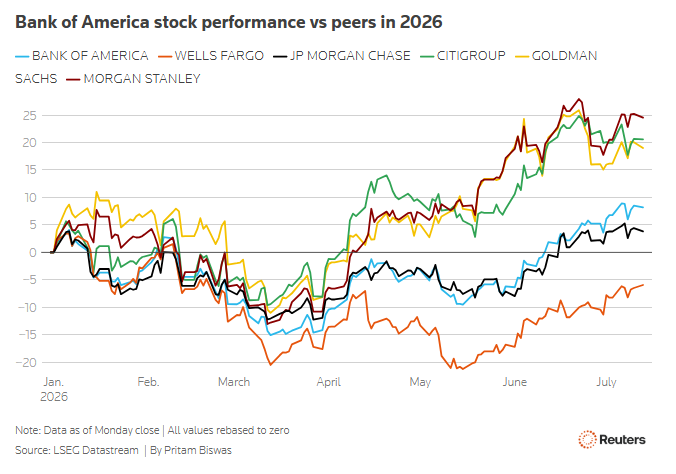
After the financial report was announced, Bank of America's stock price rose by more than 2% during pre-market trading, but then regained the increase and fell by about 1%. Since the beginning of 2026, the stock has accumulated an increase of about 8%, outperforming competitors such as J.P. Morgan Chase and Wells Fargo Bank (WFC.US); in the past 12 months, the stock has risen 27%, far exceeding the 7.4% increase in the S&P 500 financial index over the same period.