


The Zhitong Finance App learned that Federal Reserve Chairman Kevin Walsh will attend the US House Financial Services Committee's “Federal Reserve Semi-Annual Monetary Policy Report” hearing at 10 o'clock tonight, but his testimony was released ahead of schedule. In his testimony, he said that the policy makers at the Federal Reserve have “zero tolerance” for high inflation and reaffirmed their pledge to curb the high price growth that has continued for five years.
“The members of our committee will never tolerate continued high inflation,” Walsh said in his statement. “And we share a resolve commitment to achieving price stability (we share a strong commitment to restore price stability).”
Since taking office in May this year, the new chairman of the Federal Reserve has emphasized policymakers' commitment to dealing with inflation and stated that the primary goal is to ensure the correctness of monetary policy. “If we get the policy right — and we will do — then the last five years of soaring inflation will be a thing of the past,” Walsh said.
However, the dramatic reversal came to an end at 20:30. Just an hour and a half before Walsh prepared to publish this hawkish testimony, which is full of “zero tolerance,” the US Bureau of Labor Statistics smashed out the June Consumer Price Index (CPI) report. This completely shocking data is like a deep-water bomb, directly disrupting the Federal Reserve's previous tough pace.
According to the data, the US CPI grew by 0.4% month-on-month in June, which was not only far below market expectations of -0.1%, but it was also the first time in six years that the US experienced negative month-on-month growth; the year-on-year growth rate also exceeded expectations and fell to 3.5%. What made Wall Street even more excited was that after excluding food and energy, the core CPI recorded 0.0% month-on-month (flat, expected +0.2%), and the year-on-year growth rate also fell to 2.6% (expected 2.8%).
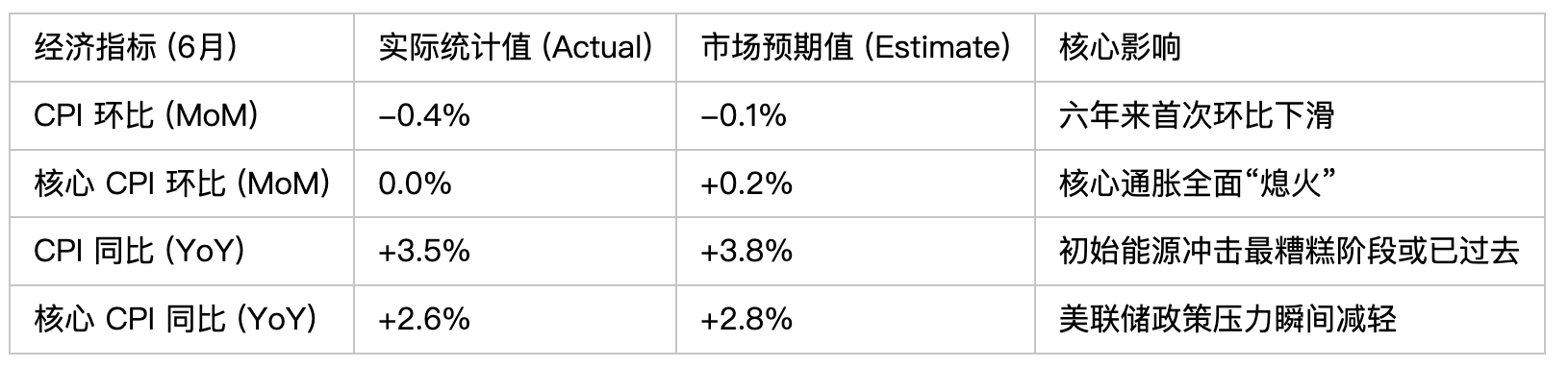
After the data was released, the global financial market instantly defected: US stock index futures skyrocketed, US Treasury yields plummeted, and investors began frantically cutting their bets on the Federal Reserve's surprise rate hike in July. The report suggests that as President Trump's previous steps showed results, fuel prices at gas stations fell sharply, and the initial energy shock caused by the US-Iran war is fading away.
As Walsh is about to make these remarks, several other Federal Reserve policymakers are issuing warnings that higher interest rates may be needed to curb inflation. But as specifically stated in the article: Walsh's hearing testimony was “prepared prior to (prepared prior to)” before this batch of shocking CPI data was released. This batch of sudden “feverish” data directly removed the hawkish camp's original plan to talk about interest rate hikes.
In terms of the economic outlook, Walsh was previously optimistic, describing the labor market as generally stable, with few signs of layoffs, and strong nominal wage growth. But Federal Reserve officials must also face up to the potential pitfalls — although the data suggests that the worst shocks may be over, if new hostilities between the US and Iran break out again in the near future, the risk of a second rebound in oil prices may still prolong the inflationary sequelae of this geopolitical conflict.
Furthermore, the head of the Federal Reserve is more cautious about the artificial intelligence (AI) boom. He said that AI is driving a sharp rise in commercial investment, but it has also brought uncertainty to the economy.
“We don't know to what extent the economy can benefit from the construction of AI,” Walsh said. “New opportunities for economic development also present new challenges for policy makers. We at the Federal Reserve are closely monitoring its impact on inflation and the labor market.”
The minutes of the Federal Reserve Open Market Committee (FOMC) meeting from June 16 to 17 showed that policymakers' concerns about inflation are growing. Officials voted unanimously at that meeting to keep the benchmark interest rate within the 3.5% to 3.75% range.
According to the interest rate forecast (bitmap) released along with the resolution, nine officials predicted that interest rates would be raised by at least 25 basis points this year. Six of them expected to raise interest rates at least twice; the other nine officials expected to stay on hold or cut interest rates. However, Walsh, who has always been critical of the so-called “forward-looking guidelines” that provide clues to the market on interest rate paths, directly declined to submit personal predictions this time.
This series of hardcore data bombardment before the hearing will directly burn Wash, who appeared at 10 o'clock, on the fire. In the next question and answer session, in the face of this batch of new evidence of the first month-on-month decline in inflation in six years, this chairman who “rejects forward-looking guidance” and refuses to fill out a bitmap will inevitably be pressured by lawmakers on the spot: Will the Federal Reserve continue to stick to the previous trend of interest rate hikes?