


The Zhitong Finance App learned that options market data shows that in a context where the yen exchange rate is approaching its lowest level in 40 years, the Japanese government may still tolerate further depreciation of the yen until it intervenes. Traders are currently willing to increase the USD/JPY to 165 in the pricing, which means that the yen still has room to depreciate by about 1.6% compared to the current level.
The dollar fell back to around 162.15 against the yen during the Asian trading session on Thursday. Japan's Finance Minister Katayama Satsuki reiterated on the same day that the authorities are ready to take appropriate action on the foreign exchange market if necessary, and that officials will closely monitor market trends and economic data to ensure fiscal sustainability. Traders are waiting for the US retail sales data for June to be released later on Thursday to find fresh impetus.
Options market signals
Several options indicators suggest that the Japanese government may be willing to tolerate a further weakening of the yen, but only to a certain extent.
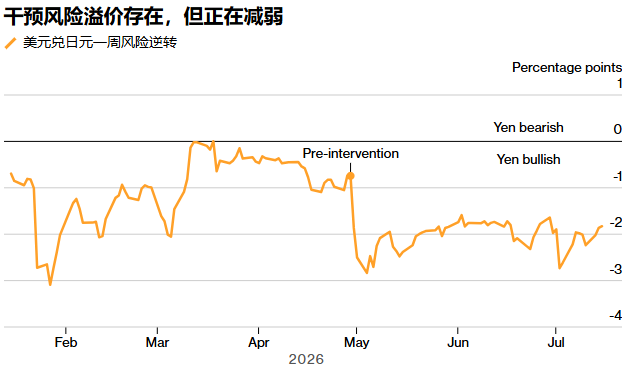
The one-cycle risk reversal indicator shows that the premium of the yen's bullish option over the bearish option is currently 176 basis points. This shows that the market still believes that as long as there is a possibility of intervention by the Japanese authorities, there is a risk of a sudden rebound in the yen. However, this premium is already significantly lower than the extreme level seen in May.
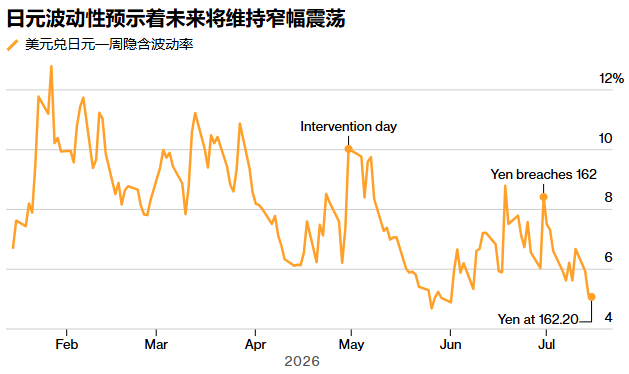
Implied volatility sends a similar signal — the current USD/JPY one-cycle hedging cost is less than half of the level after the April intervention, and is close to the four-year low set at the end of May. This suggests that traders do not think there is a high probability that the Japanese authorities will intervene immediately in the next few days.
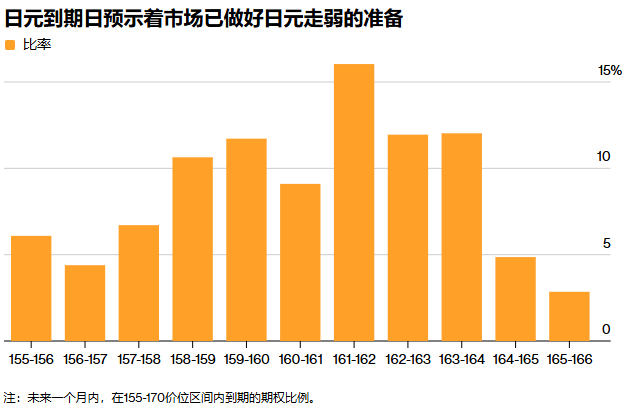
The options expiration structure also shows that the market is ready for a further weakening of the yen. Over the next month, a large number of options contracts are concentrated in the 162 to 164 range, which means that traders believe that the rise of the dollar to around 165 against the yen may be an important trigger for the Japanese authorities to act.
165 became the Wall Street Consensus intervention target
The 165 level also appears in the predictions of several agencies. Goldman Sachs strategists recently raised the USD/JPY forecast for the next 12 months from 155 to 165, making it one of the most pessimistic predictions for the yen in the Bloomberg survey. Goldman Sachs believes that factors such as the high interest rate spread between the US and Japan, the continued increase in fiscal pressure on Japan, and the slow pace of interest rate hikes by the Bank of Japan will continue to suppress the performance of the yen.
In addition to the one-year forecast, Goldman Sachs also raised the USD/JPY exchange rate forecast for the next 3 and 6 months to 162 and 163, respectively. The previous forecasts were 160 and 158, respectively. Foreign exchange traders expect the probability that the dollar will rise to 165 against the yen by June next year is about 72%.
As for the Japanese government's possible intervention in the foreign exchange market, Goldman Sachs believes that the effect is likely to be only temporary — in the current situation where macroeconomic fundamentals have not changed, it is difficult to fundamentally reverse the depreciation of the yen.
The spread between the US and Japan: the core driver of the weak yen
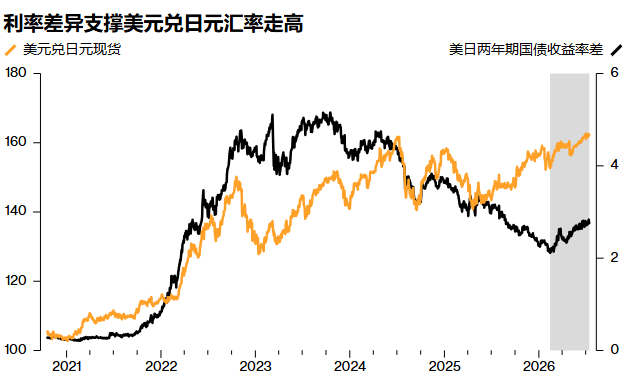
The core factor supporting the rise of the dollar against the yen remains the spread between the US and Japan. Higher US interest rates encourage investors to borrow in low-interest yen and switch to higher-yielding dollar assets.
Since the beginning of May, interest rate spreads on two-year treasury bonds between the US and Japan have widened again, and the dollar has also risen at the same time against the yen. This phenomenon is also reflected in the long-term options market — a one-year risk reversal indicator that excludes the impact of short-term intervention, to a moderately bullish dollar for the first time since the end of 2022.
The US June PPI data released on Thursday was lower than expected — 5.5% per annum, lower than 6.0% in May, and lower than market expectations of 6.2% — putting pressure on the dollar in the short term. The probability of interest rate hikes in July has dropped sharply to 9.6% from 45% in the previous week. However, Federal Reserve Chairman Walsh reiterated in his congressional testimony that high inflation will not be tolerated, and the market still believes that the probability of raising interest rates in September is close to May 5.
The Japanese authorities' “dilemma”
The Japanese authorities are in a delicate policy dilemma. At the end of April this year, the Japanese government used nearly 74 billion US dollars to interfere in the foreign exchange market to support the yen and push for a brief rebound in the exchange rate, but the effect was short-lived. Since then, Japanese officials have repeatedly issued verbal warnings, indicating that they will act again if necessary.
Even though Japan is about to enter a public holiday, and some strategists previously thought that the holiday period might be a window for the authorities to interfere in the foreign exchange market, the market did not significantly increase their bets on the yen's rebound. Short-term options indicators are still far below the extreme levels previously seen when the market strongly speculated that the government would intervene.
Analysts pointed out that the Japanese government faces a deep contradiction: raising interest rates too fast will increase the debt burden already exceeding 200% of GDP and put pressure on the economy, while raising interest rates too slowly will allow the yen to depreciate and push up import costs. Japan's Finance Minister Katayama Satsuki's statement on Thursday — which emphasizes “fiscal sustainability” — reflects this dilemma.