


Pre-market market trends
1. Before the US stock market on July 16 (Thursday), futures for the three major US stock indexes had mixed ups and downs. As of press release, Dow futures were up 0.17%, S&P 500 futures were down 0.26%, and NASDAQ futures were down 0.93%.

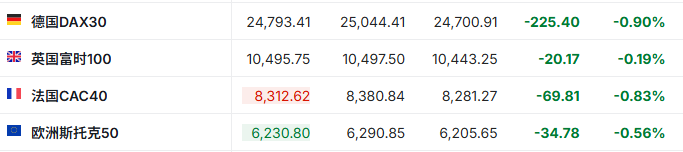
2. As of press release, the German DAX index fell 0.90%, the UK FTSE 100 index fell 0.19%, the French CAC40 index fell 0.83%, and the European Stoxx 50 index fell 0.56%.
3. As of press release, WTI crude oil rose 0.18% to $79.74 per barrel. Brent crude oil fell 0.08% to $84.88 per barrel.

Market news
Is extreme optimism the opposite of shackles? The perfect “blonde girl” has arrived, yet US stocks have not been able to rise. Bullish stock market investors are already indulging in the beautiful “blonde girl,” and risk appetite has been pushed to an extreme high level, so it is becoming more and more difficult to determine where the market's next upward momentum actually comes from. Richard Privorotsky, partner at Goldman Sachs Group, said, “Whether the stock market can continue to rise depends ultimately on performance guidelines and position levels, not the headlines themselves. Energy is still a key macro risk factor, but for now, the inflationary environment is improving.” Privorotsky pointed out that the current earnings season is likely to deliver good results. The banking industry has basically passed the performance threshold, while ASML.US (ASML.US) earnings report shows that semiconductor capital expenditure demand is still healthy. “As with most AI-related individual stocks, the question is no longer limited to the data itself, but rather whether this data is impressive enough compared to current positions,” he added. According to the Bank of America fund manager survey released this week, the cash holding ratio of professional investors has dropped to a very low level, while the bank's “Bull and Bear Index” also sends warning signals. Furthermore, data from Deutsche Bank shows that the systemic strategy currently holds extremely large positions, leaving little room for further incremental purchases. Trend-tracking CTA positions in stocks have been pushed to the upper end of the historical range, at the 72nd percentile; while the positions of volatility control funds are more extreme and are already at the 91st percentile.
The Bank of Korea raised interest rates for the first time in three and a half years: the AI chip boom driven the policy shift to an austerity cycle officially began. On July 16, the Bank of Korea raised the policy interest rate by 25 basis points from 2.50% to 2.75%, the first rate hike since January 2023, in line with market expectations. This move marks the official end of four consecutive interest rate cuts since the end of 2024, and a new cycle of austerity begins. The root cause of this rate hike is a structural economic transformation driven by artificial intelligence. Economic growth far exceeded expectations, and on July 14, the South Korean government raised the 2026 GDP growth forecast sharply to 3.0% from 2.0% at the beginning of the year. If realized, this will be the fastest growth rate since 2021. The nominal GDP growth rate is expected to reach 12.3%, the highest in 30 years since 1996. The International Monetary Fund has previously raised South Korea's 2026 growth forecast to 2.6%, leading the increase among the 30 major economies. The Bank of Korea clearly stated that the current chip cycle is completely different from the past. The central bank stated in its report to the National Assembly that the current expansion cycle began in March 2023 and has continued for 40 months, far exceeding the historical average of 29 months between 2000 and 2020. Its fundamental driving force comes from competitive investment by global technology companies to meet changes in the AI industry ecosystem rather than traditional cyclical demand.
South Korean regulators offer a “combo punch” to cool down the market! The margin was raised and the listing of single-share leveraged ETFs was suspended as a matter of urgency. South Korea will temporarily suspend the listing of individual leveraged exchange-traded funds (ETFs) to curb market fluctuations. Previously, funds linked to Samsung Electronics and SK Hynix surged in popularity, causing significant market fluctuations. The Korea Financial Services Commission (FSC) said in a statement on Thursday that the ban will continue until market conditions stabilize. The regulators will also raise the minimum margin requirement for trading leveraged ETFs (that is, the minimum balance required for a cash account) from 10 million won to 30 million won (about 20,300 US dollars), which is expected to be implemented starting August 5. These measures mark the South Korean government's most comprehensive effort to quell retail trading frenzy so far. Previously, this trading frenzy had turned the $4.1 trillion stock market into one of the hottest and most volatile stock markets in the world. These rules were announced after a meeting between regulators, Ministry of Finance officials, and central bank governors, after concerns were growing that leveraged ETFs linked to Samsung and SK Hynix were causing excessive market fluctuations.
The IEA director issued a “few weeks” ultimatum: if the Strait of Hormuz continues to close, the global economy will face new shocks. International Energy Agency (IEA) Director Fatih Birol (Fatih Birol) issued a stern warning at the Aspen Colorado Safety Forum on Wednesday: if transportation disruptions in the Strait of Hormuz cannot be resolved within a few weeks, the global economy will once again face serious challenges. Birol pointed out that the escalation of the US-Iran conflict has made the “market tense and uneasy” and is facing “huge uncertainty,” and that the transportation of crude oil, fertilizer, natural gas, and other goods on this critical waterway is seriously threatened. “If the Strait of Hormuz continues to be closed, the global economy, including the economies of the Middle East, developing countries, and Asia, may once again face some difficulties,” Birol stressed. “The time window for resolving the crisis is not calculated in months, but in weeks,” and the strait must be “fully opened and unconditionally opened.”
Following the release of local investment signals last week, Japan's finance minister said economic growth may support GPIF's reassessment of asset allocation. Japan's Finance Minister Katayama Satsuki made a key statement in the Diet on Thursday. She said that the government's current policy transformation is significantly increasing the potential growth rate of the Japanese economy, and this positive change will provide a strong and reasonable basis for the National Public Pension Fund (GPIF) to adjust its asset allocation and increase its holdings of local assets in future annual evaluations. Katayama Satsuki pointed out that as the world's largest public pension fund, GPIF evaluates its investment portfolio in a timely and appropriate manner every fiscal year based on changes in macroeconomic assumptions. In particular, she emphasized that as government policies focus heavily on expanding investment, the Japanese economy is entering a key structural turning point. The increase in the potential growth rate of the economy should naturally become a core consideration factor for GPIF to re-evaluate its domestic and foreign asset allocation ratios.
Individual stock news
“Buy Expectations, Sell Facts” is on again! TSM.US (TSM.US)'s Q2 net profit surged 77% to a new high, yet its stock price plummeted by nearly 5%. Thanks to strong global demand for artificial intelligence (AI) chips, TSM.US on Thursday reported second-quarter profits that far exceeded expectations. According to the data, TSMC's Q2 revenue was NT$1.27 trillion (US$39.45 billion), up 36% year on year, with market expectations of NT$1.264 trillion; net profit of NT$706.562 billion, up 77.4% year on year, up 23.4% month on month, with market expectations of NT$632.64 billion. The net profit of the world's largest chip foundry hit a record high for the fifth consecutive quarter. This performance was mainly due to the explosive growth in global demand for AI infrastructure, which led to strong orders for advanced manufacturing processes and advanced packaging technology. According to TSMC, advanced process technology at 7 nm and below accounts for 77% of total wafer revenue. TSMC currently expects capital expenditure to reach 60 billion to 64 billion US dollars in 2026, which is higher than the previous forecast of 52 billion to 56 billion US dollars. The company also expects revenue growth in US dollars to be slightly above 40%, higher than the previous forecast of more than 30%. However, after the financial report was announced, TSMC's stock price plummeted by nearly 5% before the market, and some investors chose to settle the profits after the benefits were realized.
LLY.US (LLY.US) spent $3.8 billion to break into the psychedelic drug circuit! Acquire ATAIBeckley (ATAI.US) at a premium of 26%. LY.US (LLY.US) has agreed to acquire AtaiBeckley Inc. (ATAI.US) for up to $3.8 billion, which highlights the growing interest of large pharmaceutical companies in hallucinogenic drugs (psychedelic medicine), which was once a marginal field. Eli Lilly will pay $6.75 per share in cash and up to $2.50 per share if drug development milestones are reached. The underlying price was 26% higher than ATaiBeckley's close on Wednesday.
Japan wants to build a “robotics national team” and plans to purchase 27,500 Nvidia (NVDA.US) Rubins! The AI computing power supercycle is moving from the cloud to “physical AI.” An alliance between the Japanese government and large Japanese companies — that is, the newly founded company Noetra Corp plans to purchase 27,500 next-generation AI GPUs from Nvidia. It plans to build a very large AI computing power infrastructure cluster through large-scale procurement of NVIDIA Rubin-architecture AI GPUs, the most advanced AI computing power product, to accelerate the construction of basic artificial intelligence models for robots in Japan, as well as accelerate the construction of a large robot cluster led by the Japanese government and policy support, and gather top companies.
The AI boom has sparked demand for lithography machines! Asma wants to take the opportunity to raise prices to TSMC and say “no.” According to media reports, citing people familiar with the matter, Asmack plans to raise the price of its chip manufacturing equipment. This move may disagree with its biggest customer, TSMC. The report said that TSMC has expressed opposition to the Dutch equipment manufacturer's price increase plan. According to the news, Asma has recently discussed with TSMC to raise the price of its extreme ultraviolet (EUV) lithography system. Also, in recent weeks, Asmack has told some customers that it plans to increase the price of its deep ultraviolet (DUV) lithography systems by 10%. However, TSMC has stated that Asmack's most advanced high numerical aperture (High NA) extreme UV engraving machine sells for more than 350 million euros (about 410 million US dollars). The cost is too high and not suitable for large-scale production, but TSMC does currently use it for research and development purposes.
Prices for hardware and services are increasing one after another! Apple (AAPL.US) raised the AppleCare+ monthly subscription price by 50 cents. Apple has slightly raised the cost of the AppleCare+ service subscription. This is another round of price increases launched by the company under the global shortage of memory chips and pressure from multiple industries. The price of the AppleCare+ monthly plan for Mac and iPad has increased by 50 cents, while the price of the annual plan has increased by $5. This price increase is for new users only, and old users will keep the original pricing unchanged. This price adjustment continues the tech giant's trend of continuing price increases. Last month, Apple raised prices for iPads, Macs, Vision Pro headsets, HomePod smart speakers, and TV set-top boxes. The market expects that when Apple launches a new generation model in September this year, it will also take price increases for its most profitable iPhone product line.
Premium 28% “family robbery”! Stripe and Anhong Capital made a $53.4 billion cash deal to acquire PayPal (PYPL.US). According to confirmation, digital payments giant Stripe and private equity firm Advent International (Advent International) have jointly proposed a takeover offer to PayPal, with a transaction valuation of about US$53.4 billion. According to people familiar with the matter, the buyer proposed to buy the payment company for 60.50 US dollars per share in cash. The above sources said that Stripe, Anhong Capital and Block provided a total equity contribution of 17 billion US dollars for this offer. People familiar with the matter said that PayPal's board of directors will meet on July 20 as soon as possible to discuss the offer. According to reports, the offer was submitted earlier this month and includes about $50 billion in promised bank loan financing, which is about 28% premium over PayPal's closing price on Tuesday.
UnitedHealth (UNHUS) raised its full-year guidance sharply, and the earnings report, which exceeded expectations, sounded the trumpet of recovery. UnitedHealth raised its full-year earnings outlook and reported that its quarterly profit far exceeded Wall Street expectations, helping to consolidate the company's profit recovery after a historic crash. According to financial reports, the company's second-quarter revenue was US$112 billion, up 0.3% year on year, exceeding expectations of US$1.14 billion; adjusted earnings per share were US$6.38, exceeding expectations of US$1.46. The healthcare giant currently expects adjusted earnings per share of $19.50 to $20 this year, a significant increase from the previous forecast of $18.25 or more, and higher than analysts' expectations. As a key measure of healthcare costs, it performed far better than Wall Street analysts' predictions in the Bloomberg survey, and profits for the quarter exceeded the highest estimates. Group Chief Financial Officer Wayne Devitt said the new outlook will be the starting point for achieving profit growth at the company's historical target rate next year. UnitedHealth has long sought to increase annual earnings per share by 13% to 16%. In an interview, he said that the more favorable medical cost data for the first half of this year gave the company confidence to increase its forecast.
GE Aerospace (GE.US) Q2 performance exceeded expectations, orders grew strongly, and guidance for the whole year was raised again. According to the second-quarter earnings report released by GE Aerospace, earnings per share reached 2.02 US dollars and revenue of 12.6 billion US dollars, both exceeding Wall Street expectations of 1.86 US dollars and 11.9 billion US dollars. The total number of new orders added during the period reached US$16.5 billion, exceeding revenue for the same period, and increased 17% over the same period last year, demonstrating strong market demand for its products and services. Looking ahead to the full year of 2026, the company expects revenue growth to rise from 10% to 12% to the “ten-digit high” range; the annual earnings per share forecast is also raised from $7.10-7.40 to $7.65-7.85.
Multiple businesses went hand in hand, and Abbott (ABT.US) Q2 performance exceeded expectations and raised profit expectations. Abbott delivered a report card that exceeded expectations in the second quarter. Thanks to continued improvements in the performance of most business segments, the company immediately raised its 2026 profit guidance. Abbott said in a statement on Thursday that sales for the second quarter were $12.6 billion, higher than the market forecast of $12.5 billion; adjusted earnings per share for the second quarter were $1.31, higher than the market forecast of $1.28. Looking ahead, the company expects adjusted earnings per share to be between $5.45 and $5.60 this year, up 5 cents from the previous guidance.
Key economic data and event forecasts
20:30 Beijing time: The number of US jobless claims for the week ending July 11, the US Philadelphia Federal Reserve Manufacturing Index for July, and the monthly rate of retail sales in the US for June.
22:00 Beijing time: Monthly rate of the US existing home contract sales index after the June seasonal adjustment.
At 00:30 Beijing time the next day: 2026 FOMC voting committee and Dallas Federal Reserve Chairman Logan delivered a speech.
At 01:25 Beijing time the next day: 2028 FOMC voting committee and Kansas Federal Reserve Chairman Schmid delivered a speech.
07:00 Beijing time the next day: Federal Reserve Vice Chairman Jefferson delivered a speech on economic and monetary policy.
09:00 Beijing time the next day: US President Trump delivered a national address.
Performance Forecast
Friday morning: Netflix (NFLX.US), Alcoa (AA.US)