


The Zhitong Finance App learned that retail sales in the US increased slightly in June. Although falling gasoline prices dragged down a sharp drop in gas station revenue, it freed up household budget space and boosted consumption in various fields such as e-commerce and automobiles.
According to data released by the US Department of Commerce's Census Bureau on Thursday, retail sales increased 0.2% month-on-month in June, in line with market expectations. The previous May data was revised up from an initial 0.9% increase to a 1.0% increase. These non-inflation-adjusted retail sales figures mainly reflect commodity spending.
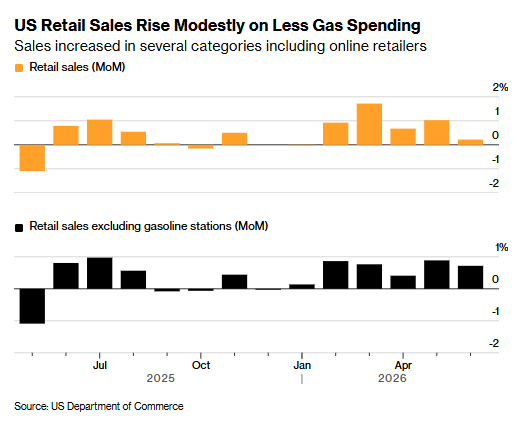
Although the overall increase was moderate, the “breathing effect” brought about by the drop in gasoline prices gave consumers more spare time to switch to other products and overshadowed a stronger potential spending trend.
“The drop in gasoline prices means that the June retail sales data actually underestimates the true intensity of demand,” economist Elisa Winger pointed out in a report. “Under the apparent appearance of weak data, temporary factors actually boosted sales to a certain extent.”
Of the 13 retail categories, sales increased in 7 categories.
Among them, gas station sales revenue fell sharply by 5.3% in the same month, the biggest monthly decline since 2022. According to data from the US Energy Information Administration, the average price of gasoline across the US fell to $4.18 per gallon in June, a drop of about 50 cents. The reason behind this is that oil prices fell due to the tentative cease-fire between the US and Iran at the time. After deducting gas station sales, overall retail spending actually increased by 0.7% last month.
Core demand is progressing steadily, and multiple categories have performed well
Excluding highly volatile items such as automobiles, gasoline, construction materials, and food services, control group retail sales — the closest indicator of commodity consumption expenditure in GDP — grew 0.5% month-on-month in June. Although it was lower than 0.8% after an upward revision in May, it was higher than 0.4% expected by the market, confirming that the consumer base market did not stall.
Looking at the breakdown, sales of non-physical retailers (e-commerce) surged 1.9% month-on-month, the biggest increase in nearly a year, driven largely by the Amazon (AMZN.US) Prime Day promotion at the end of the month and competitive promotions of other retailers. Auto and parts dealer sales also increased by 1.9%, the biggest increase since July 2025, while discretionary spending categories such as sporting goods, musical instruments and bookstores, electronic products, and home appliances also generally strengthened.
However, the FIFA World Cup, which attracted visitors from around the world, did not significantly boost dine-in consumption. Restaurant and bar sales increased only slightly by 0.1%, while department stores also increased slightly by 0.1%. Sales in health and personal care stores declined by 0.8%.
“K-type” differentiation is intensifying, and the low oil price window may be difficult to sustain
Although the reduction in gasoline prices in June freed up some spending space for households, the structural differentiation in consumption behavior is still deepening. According to a report by the Bank of America Research Institute, spending on discounted clothing and value grocery stores has rebounded again since the beginning of this year, and “price-sensitive consumers are increasingly turning to general merchandise stores to find deals.” Since the beginning of the year, spending by low-income households at discount clothing stores has increased five times that of high-income households. The Beige Book released by the Federal Reserve this week also confirmed this trend: consumer spending rose slightly in early July, but “several jurisdictions reported a decline in discretionary spending, or consumers switching to more affordable alternatives.”
This “K-shaped” recovery is further highlighted by the Matthew effect: high-income households continue to benefit from the wealth effect brought about by rising stock markets, while low-income groups are more likely to bear the high price squeeze caused by import tariffs and geopolitical conflicts.
There is also a temperature difference between companies' perception of heat and cold in terminal demand. J.P. Morgan Chase (JPM.US) Chief Financial Officer Barnum and Wells Fargo Bank (WFC.US) CEO Schalf both emphasized on recent earnings calls that consumers and businesses are still stable, and that a stable labor market and higher tax rebates support spending; while PEP.US (PEP.US) CEO LaGuata bluntly stated that “consumer performance is worse than expected, mainly due to gasoline prices.” General Mills (GIS.US) Chief Operating Officer McNabb also warned that consumers are becoming more cautious and rely more on daily promotions to reduce price purchases.
Also worth noting is that the short window of low oil prices may be closing quickly. Earlier this month, the once shaky cease-fire between the US and Iran broke down, hostilities in the Middle East resumed, shipping in the Strait of Hormuz was threatened again, and international oil prices and terminal gasoline prices have regained their upward trend. If energy costs continue to rebound, the budget pressure faced by households in the latter half of the summer will increase again. The breathing space previously brought about by promotions, tax rebates, and lower oil prices may disappear, further strengthening the structural rift in the consumer sector.
The Atlanta Federal Reserve's GDPNow model currently predicts an annualized GDP growth rate of only 1.3% in the second quarter, down from 2.1% in the first quarter, which suggests that overall economic expansion momentum is weakening.