


The past year should have been very beneficial to cryptocurrency price trends such as Bitcoin. For example, the US Congress has been actively discussing new legislation on the cryptocurrency sector to push cryptocurrency assets to obtain a more stable legal position; at the same time, the industry has also avoided major bankruptcy scandals and forced liquidations that have cyclically knocked down the price of digital tokens in the past.
However, the first cryptocurrency, which was born, has lost about half of its value since October last year, when it hit an all-time high of more than $126,000 in Bitcoin's price, falling to a slump not seen since September 2024. The Zhitong Finance App noticed that the previous “cryptocurrency winter” decline was even more severe, with a peak to bottom drop of 80%. However, for Bitcoin's staunch believers, the recent round of decline was particularly painful, as it was not a sudden sell-off turmoil that was driving the decline, but rather the continued and steady loss of investor interest in cryptocurrency asset allocation.
Unlike previous “eventful winters” triggered by cryptocurrency exchange bankruptcies, extreme leverage bursts, or project fraud, this round of cryptocurrency decline is closer to a slow and deep decline in demand: Bitcoin fell sharply from a high of more than $126,000 in October last year and is currently around $63,200; Ethereum's performance is weaker, reflecting not only the withdrawal of capital from “digital gold,” but also a reduction in the overall allocation of volatile crypto betas to the smart contract ecosystem.
Continued outflows of ETFs, rising real interest rates, slow regulation, deleveraging corporate coin storage models, and the migration of venture capital to AI leaders all show that the core problems facing the crypto market are no longer short-term liquidity shocks, but rather the absence of marginal buyers and declining narrative returns: Bitcoin has failed to perform a stable safe-haven function in the midst of war and the impact of inflation, and cryptographic smart contracts such as Ethereum seriously lack independent cash flow anchors sufficient to offset macro-austerity. Therefore, even without a new “Lehman moment”, the market may still complete low transactions, weak rebounds, and continuous redemptions for a longer time Clearance and continued sell-off .
Here are some of the key factors that are still popular in this round of intense sell-offs to exert a buying effect:
But just another asset class? “Digital gold” fades: after institutionalization, Bitcoin became a zero-interest risk asset in the era of high interest rates
Bitcoin was initially shaped as a payment system independent of banks and governments, and later turned to the “anti-inflation, safe-haven, and value storage” narrative; however, after ETFs and traditional asset management institutions became important marginal buyers, their demand was increasingly subject to asset allocation discipline. When high inflation boosts interest rates and actual returns, the opportunity cost of Bitcoin with zero interest rates rises, and the market weakens at the same time as high-beta technology assets; capital is also diverted by new types of risk assets such as AI stocks, perpetual contracts, and prediction markets.
Wall Street financial giant Citi recently lowered its 12-month Bitcoin forecast from $112,000 to $82,000 and the Ethereum forecast from $3,175 to $2,240 based on negative ETF funding, slow legislative progress, and weakening investor interest
When Bitcoin was launched in 2009, it was touted by some cryptocurrency investment institutions as an alternative to traditional payment ecosystems mediated by banks and the government. However, verification of transactions using this technology has proven to be slow and expensive, and its price fluctuations are too drastic to be an attractive currency alternative. Proponents later touted it as a useful store of value, which can help investors diversify their portfolios and hedge against inflation.
Bitcoin's recovery from the last cryptocurrency winter in 2022 is partly due to a massive influx of traditional financial institutions into Bitcoin exchange-traded funds (i.e. Bitcoin ETF series products) — these publicly traded investment instruments use Bitcoin as the underlying asset. As a result, portfolio managers' calm investment decisions without emotions have become an important factor in determining Bitcoin demand.
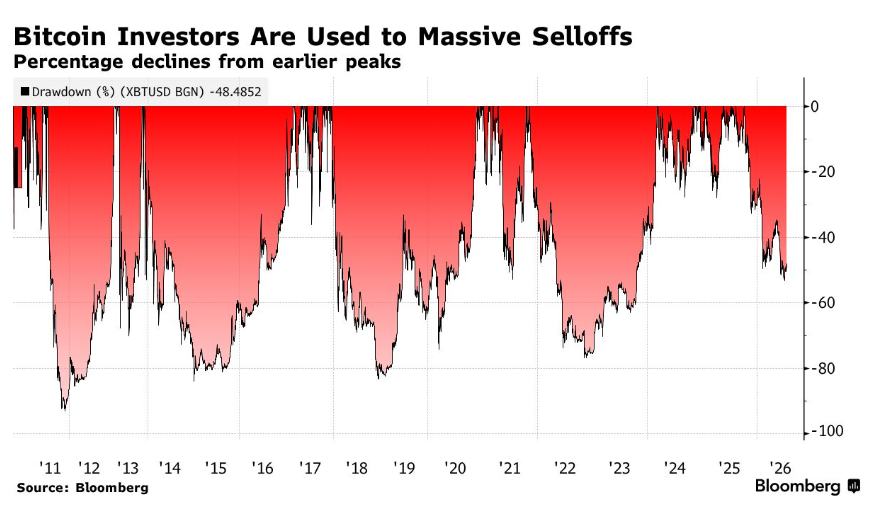
As shown in the chart above, Bitcoin investors have long been accustomed to large-scale sell-offs — a percentage drop from previous peaks
Many investors have accepted the view that Bitcoin can maintain its value during economic and political crises, because unlike traditional currencies, it is not strictly controlled by the global central banking system, so monetary authorities cannot depreciate it through increased issuance. Some proponents refer to it as “digital gold,” comparing it to gold which is generally considered a safe investment during times of geopolitical turmoil or sharp sell-offs in financial markets.
However, for a new group of institutional holders focusing on Bitcoin investment strategies, the cryptocurrency did not live up to its advertising position as an effective safe-haven asset as prices soared due to the war in Iran. As the expected trajectory of market interest rates followed the rise in oil prices and inflation in a broad sense, the appeal of Bitcoin, which does not pay any interest to holders, declined.
In contrast, Bitcoin has always been publicly traded like other high-risk assets, so it has to compete for capital with increasingly popular low-volatility financial products for high-net-worth groups, such as perpetual futures, and one-way bets on popular events in prediction markets such as Polymarket and Kalshi. Furthermore, venture capital from Silicon Valley is also going to big tech companies benefiting from the AI boom.
“Never sell coins” myth bursts: Strategy lets go, corporate coin hoarding flywheel runs in reverse
Strategy has long relied on a positive feedback cycle of “issuing stocks or high-yield securities — buying Bitcoin — asset appreciation — maintaining valuation premium — continuing financing”, but when the company's valuation falls close to or even lower than the net value of Bitcoin holdings, the financing capacity and dividend burden will reverse squeeze the balance sheet.
The company sold Bitcoin for the first time since 2022, and then further authorized the expansion of the scale of coin sales, which meant that the enterprise's crypto asset reserve model had shifted from unidirectional accumulation to liquidity management; this not only weakened the market's most important belief anchor, but also revealed a mismatch between the period and cash flow of zero return on underlying assets and higher level financing instruments requiring payment of high dividends.
Bitcoin investors often keep a close eye on position adjustments by other institutional investors who also focus on Bitcoin assets. At the beginning of June, Strategy (formerly Microstrategy), the largest business-type Bitcoin buyer, announced that it had sold 32 bitcoins worth $2.5 million. This is the first time the company has sold Bitcoin since December 2022, during the last crypto winter. The market reacted quickly. By the end of the week, the price of Bitcoin had fallen by more than $10,000 and had fallen below $60,000 for the first time in two years.
Strategy entered the cryptocurrency market in 2020, when the company's helmsman and founder Michael Saylor completely transformed his software company into a Bitcoin proxy investment tool. The company has accumulated more than 4% of the total amount of nearly 20 million bitcoins in circulation in the market. Over the years since then, Saylor has promoted the idea that Strategy will never sell its bitcoins, but will continue to expand its holdings.
Last year, the company introduced preferred shares that pay high dividends. Some investors question whether the business model of a technology-type company that needs to pay high dividends when the underlying assets themselves have zero returns is sustainable. Strategy's market capitalization once had a significant premium over the value of its Bitcoin holdings. Today, as its business model comes under pressure, this valuation is closer to parity.
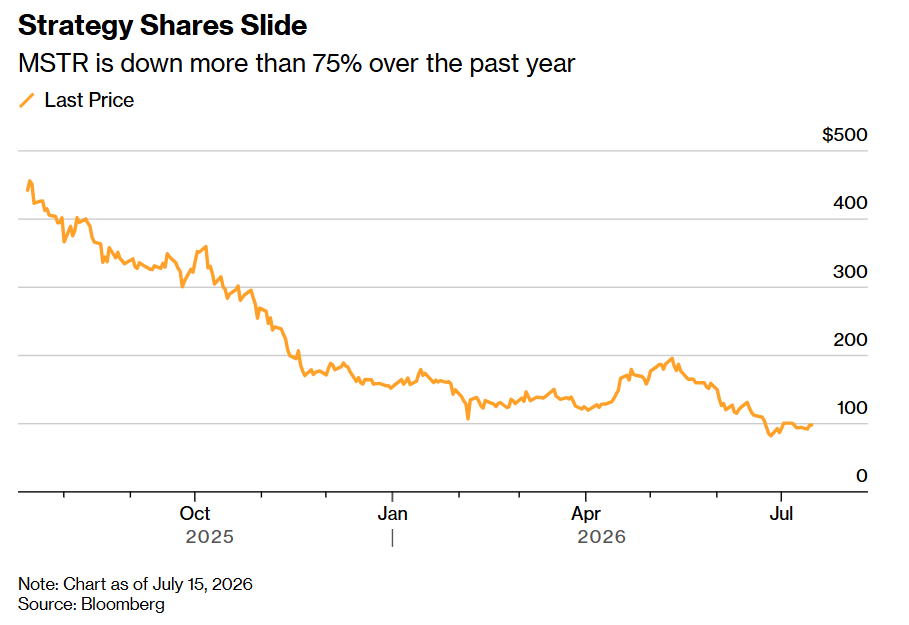
As shown in the chart above, Strategy's stock price has dropped sharply — Strategy's stock price, which has the stock code MSTR, has fallen violently by more than 75% over the past year. Note: Chart data is as of July 15, 2026.
The dawn of regulation turns into political fog: the Clarity Act has been slow to deliver on institutional dividends
After Donald Trump returned to the White House last year, the market once highly anticipated that the new legislation would establish more clear rules for the cryptocurrency industry under the impetus of the president, who is very pro-cryptocurrency. However, discussions surrounding the Digital Asset Market Clarity Act (the Clarity Act) have dragged on for so long that it has become increasingly difficult to determine whether the bill will finally be passed.
The market originally expected the “Digital Asset Market Clarity Act” to clarify the jurisdictional boundaries between the US Commodity Futures Trading Commission and the Securities and Exchange Commission, and further establish a crypto asset market structure within the stablecoin framework of the “GENIUS Act”; however, issues such as stablecoin interest payments, decentralized finance, anti-money laundering responsibilities, and government officers' conflicts of interest in crypto assets have stalled Senate negotiations for a long time.
Although the bill has entered the Senate legislative agenda, it still needs to cross the 60-vote threshold, coordinate the Agriculture Committee version, and merge it with the House text. As a result, the regulatory dividend has changed from a definitive catalyst to an option that is constantly being postponed.
The bill was originally planned to build on last year's GENIUS Act. The latter first established regulatory rules for the issuance and use of stablecoins — a type of cryptocurrency that maintains the stable value of fiat money. The Clarity Act (Clarity Act) targets other cryptocurrencies in a broad sense, and will eventually clarify the regulatory jurisdiction for tokens such as Bitcoin.
The Clarity Act will divide formal supervision of cryptocurrency assets between the US Commodity Futures Trading Commission and the US Securities and Exchange Commission based on whether a token is recognized as a commodity or a specific securities asset.
The banking industry strongly opposes any move that allows stablecoins to pay interest. Democratic lawmakers, on the other hand, are generally reluctant to approve legislation that could stimulate demand for cryptocurrencies and could further benefit Trump and other officials with large crypto assets. Trump recently revealed that he obtained $1.4 billion in revenue data from crypto-related businesses last year, which will inevitably make negotiations on the Clarity Act between the two parties in the US more divided.
Some lawmakers are also wary of providing legal protection for cryptocurrencies, as cryptocurrencies are often used for criminal activities and money laundering. One of the most contentious parts of the bill is section 604, which will protect blockchain developers and veteran traders from being classified as fund transfer service providers in legal disputes. Law enforcement organizations, including the National Association of District Attorneys, warned in an open letter to Patrick J. Witt, executive director of the US President's Digital Asset Advisory Committee on June 23 that this provision could create a safe haven for potential large-scale criminal transactions.