


- Lyft, Inc. and Curb recently expanded their partnership to New York City, allowing eligible Lyft riders to be matched with licensed taxis through Curb Flow directly in the Lyft app, extending an integration already active in Los Angeles and San Francisco.
- This move gives Lyft access to New York’s extensive taxi fleet without new hardware for drivers, reinforcing its model of adding supply through licensed operators rather than owning vehicles itself.
- Next, we’ll examine how tapping New York’s licensed taxi network via Curb Flow could influence Lyft’s long-term growth and partnership-focused investment narrative.
Find 47 companies with promising cash flow potential yet trading below their fair value.
Lyft Investment Narrative Recap
To own Lyft, you need to believe it can deepen rider demand and monetization while keeping costs in check in a fiercely competitive market. The key short term catalyst remains execution on partnerships that add reliable supply without heavy capital spend, while the biggest risk is Lyft’s dependence on external partners whose priorities and economics it does not control. The New York Curb expansion supports the partnership story but does not fundamentally change that risk balance.
The recent appointment of Senthil Padmanabhan as Chief Technology Officer sits in the background of the Curb news but is still relevant. If Lyft wants to make the most of API based integrations like Curb Flow, its ability to build scalable, reliable infrastructure and apply AI across pricing, matching, and safety will matter, and the new CTO will be central to how effectively Lyft can execute on that technology heavy catalyst.
But while more taxis on the platform sound positive, investors should also be aware of how much Lyft now relies on third party networks and what happens if those partners...
Read the full narrative on Lyft (it's free!)
Lyft's narrative projects $8.9 billion revenue and $456.5 million earnings by 2029.
Uncover how Lyft's forecasts yield a $18.64 fair value, a 20% upside to its current price.
Exploring Other Perspectives
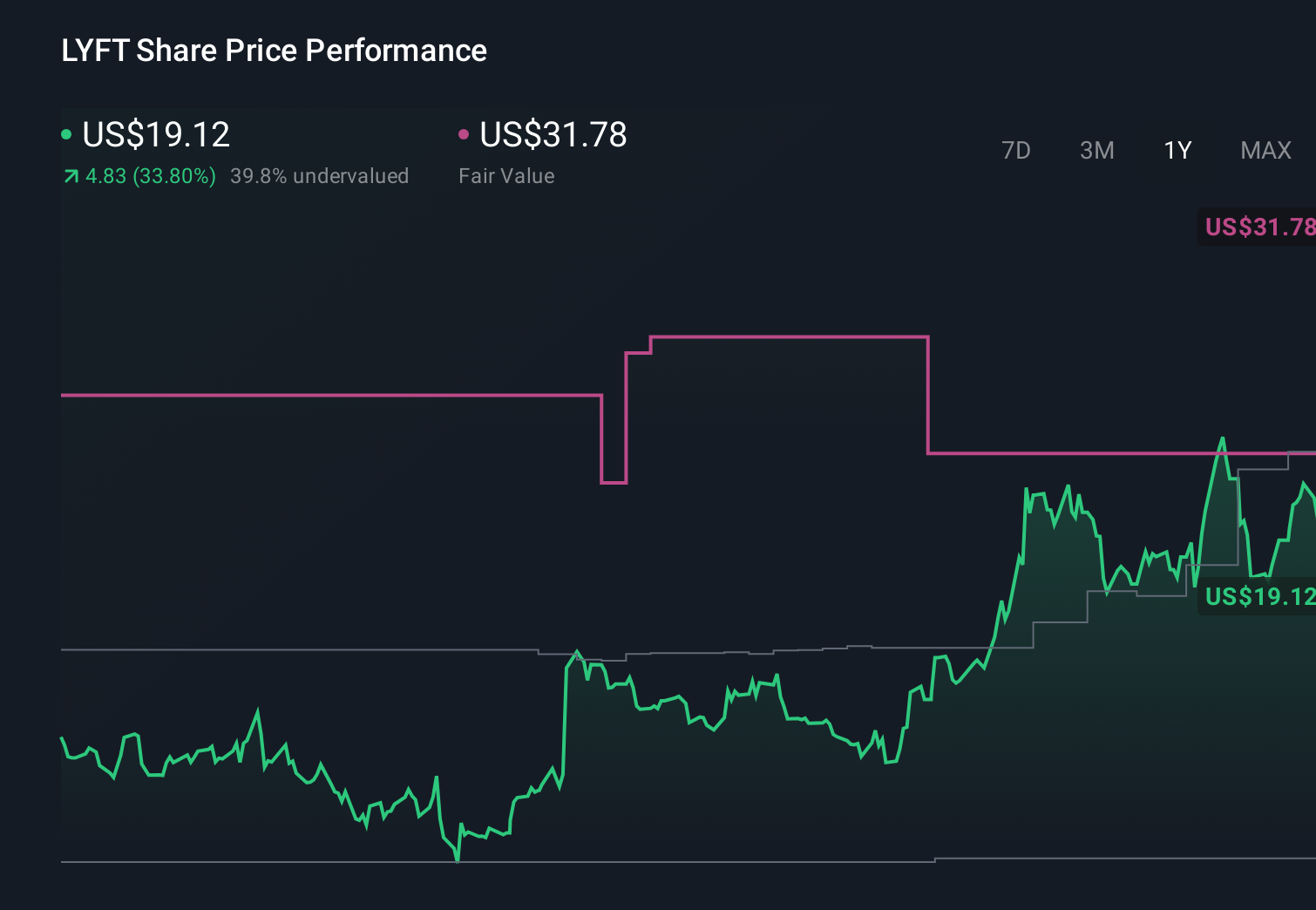
Some of the lowest estimate analysts saw a tougher road ahead, with earnings falling toward about US$181.5 million by 2029, even as partnerships like Curb expand, so you should weigh how that more cautious view on Lyft’s reliance on outside networks might shift if this New York taxi integration meaningfully changes the revenue or margin picture.
Explore 9 other fair value estimates on Lyft - why the stock might be worth over 3x more than the current price!
The Verdict Is Yours
Don't just follow the ticker - dig into the data and build a conviction that's truly your own.
- A great starting point for your Lyft research is our analysis highlighting 3 key rewards and 2 important warning signs that could impact your investment decision.
- Our free Lyft research report provides a comprehensive fundamental analysis summarized in a single visual - the Snowflake - making it easy to evaluate Lyft's overall financial health at a glance.
Ready To Venture Into Other Investment Styles?
Our top stock finds are flying under the radar-for now. Get in early:
- Explore 26 top quantum computing companies leading the revolution in next-gen technology and shaping the future with breakthroughs in quantum algorithms, superconducting qubits, and cutting-edge research.
- We've uncovered the 8 dividend fortresses yielding 5%+ that don't just survive market storms, but thrive in them.
- Rare earth metals are an input to most high-tech devices, military and defence systems and electric vehicles. The global race is on to secure supply of these critical minerals. Beat the pack to uncover the 29 best rare earth metal stocks of the very few that mine this essential strategic resource.
This article by Simply Wall St is general in nature. We provide commentary based on historical data and analyst forecasts only using an unbiased methodology and our articles are not intended to be financial advice. It does not constitute a recommendation to buy or sell any stock, and does not take account of your objectives, or your financial situation. We aim to bring you long-term focused analysis driven by fundamental data. Note that our analysis may not factor in the latest price-sensitive company announcements or qualitative material. Simply Wall St has no position in any stocks mentioned.
Have feedback on this article? Concerned about the content? Get in touch with us directly. Alternatively, email editorial-team@simplywallst.com