


Key Points
Advanced Micro Devices currently shows much stronger and significantly more stable revenue generation than Navitas over the observed timeframe.
Over the last eight quarters, AMD displayed steady quarter-over-quarter growth before a recent plateau, while Navitas experienced a highly volatile and consistently downward trajectory.
Investors should carefully watch whether the massive revenue gap between the two companies continues to widen or if it stabilizes in upcoming quarters.
Advanced Micro Devices: Steady Scaling in Revenue
Advanced Micro Devices (NASDAQ:AMD) primarily develops and sells microprocessors, graphics processing units, and custom system-on-chip solutions to hardware manufacturers and public cloud providers.
It committed over $10 billion to scale advanced packaging capabilities in Taiwan, and it generated 14% net income margin for the quarter ended March 28, 2026.
Navitas Semiconductor: Navigating Revenue Volatility
Navitas Semiconductor (NASDAQ:NVTS) primarily designs and markets gallium nitride and silicon carbide power integrated circuits for automotive, mobile, and consumer electronics applications.
It recently responded to a patent infringement complaint filed by Wolfspeed, and it recorded -393% net income margin for the quarter ended March 31, 2026.
Why Revenue Matters for Retail Investors
Revenue serves as a foundational indicator of total customer demand before operating expenses are subtracted. Tracking this figure helps investors understand the total scale and top-line growth trajectory of a business.
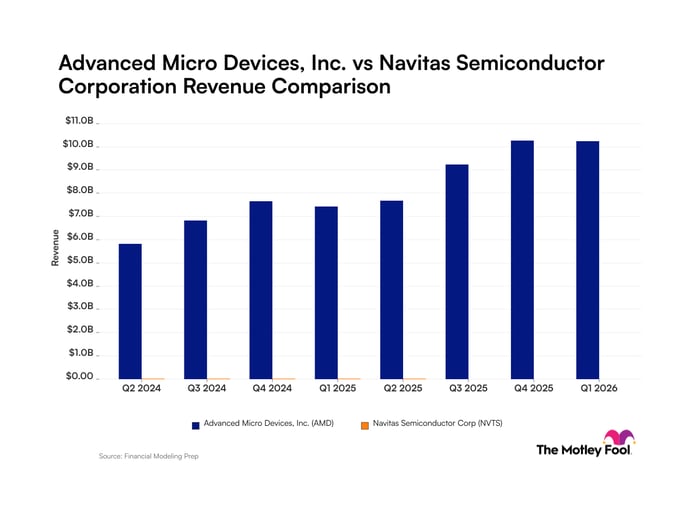
Quarterly Revenue for Advanced Micro Devices and Navitas Semiconductor
| Quarter (Period End) | Advanced Micro Devices Revenue | Navitas Semiconductor Revenue |
|---|---|---|
| Q2 2024 | $5.8 billion (period ended June 2024) | $20.5 million (period ended June 2024) |
| Q3 2024 | $6.8 billion (period ended Sept. 2024) | $21.7 million (period ended Sept. 2024) |
| Q4 2024 | $7.7 billion (period ended Dec. 2024) | $18.0 million (period ended Dec. 2024) |
| Q1 2025 | $7.4 billion (period ended March 2025) | $14.0 million (period ended March 2025) |
| Q2 2025 | $7.7 billion (period ended June 2025) | $14.5 million (period ended June 2025) |
| Q3 2025 | $9.2 billion (period ended Sept. 2025) | $10.1 million (period ended Sept. 2025) |
| Q4 2025 | $10.3 billion (period ended Dec. 2025) | $7.3 million (period ended Dec. 2025) |
| Q1 2026 | $10.3 billion (period ended March 2026) | $8.6 million (period ended March 2026) |
Data source: Company filings. Data as of July 17, 2026.
Foolish Take
While Advanced Micro Devices (AMD) and Navitas both benefit from growth in the artificial intelligence sector, a comparison of their revenue trends reveals that AMD is enjoying far greater success. It has experienced steadily rising sales growth while Navitas has seen a downward trajectory.
However, Navitas’ revenue decline is intentional. The company decided to exit its mobile and consumer businesses in China last year to focus on AI. The China market produced 60% of revenue in 2024.
Navitas management indicated sales would begin to recover this year. The company’s first-quarter revenue increased over Q4, suggesting that the predicted recovery may be happening. Even so, the share price has fallen in recent days, partly due to the Wolfspeed lawsuit, as well as Navitas’ decision to pursue a $500 million at‑the‑market equity program, which threatens shareholder dilution.
As AMD’s revenue trend shows, its business is going strong. The company’s semiconductor chips are in demand to power AI systems. Its forte in CPU chips looks to boost revenue further over time as customers focus increasingly on AI inference capabilities, driving up demand for CPUs.
Robert Izquierdo has positions in Advanced Micro Devices. The Motley Fool has positions in and recommends Advanced Micro Devices. The Motley Fool recommends Wolfspeed. The Motley Fool has a disclosure policy.