


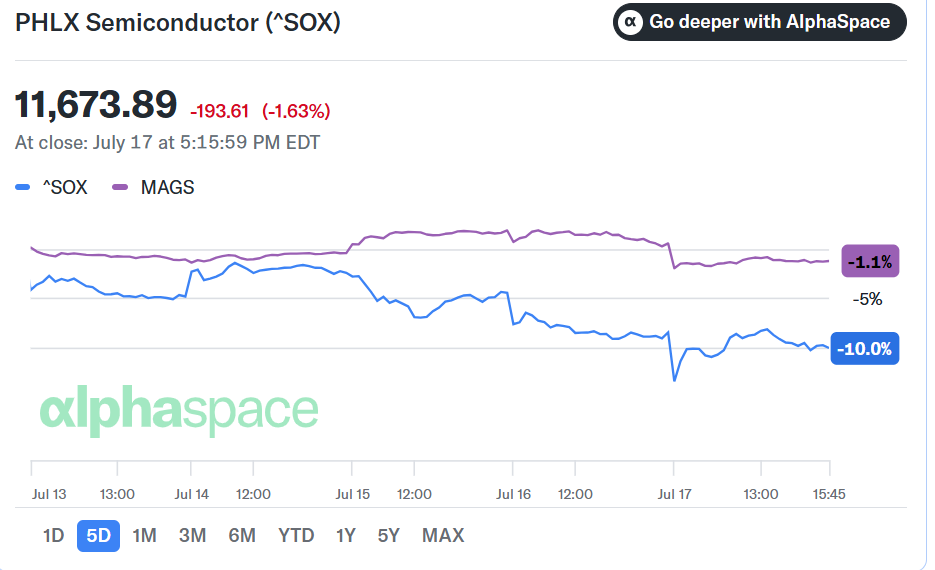
This past week, the market fluctuated sharply, and traders kept an eye on the headlines for almost 24 hours. The global financial market can be described as extremely busy. The war situation in the Middle East has once again escalated and intensified, leading to another sharp rise in oil prices, and the apparently invincible AI computing power infrastructure trading theme has experienced an unusually violent sell-off, dominating the global stock market trend.
The Zhitong Finance App notes that the global stock market and even the global financial market in the broad sense of the world are facing a complex superstress test of “large-scale warming of the Middle East geopolitical conflict+return of energy inflation+AI computing power theme momentum deleveraging”: the Philadelphia Semiconductor Index has fallen more than 20% from the June high level and has officially entered a technical bear market; the Korean stock market has become the epicenter of a major reversal in AI global computing power trading due to excessive weight of memory chips, daily rebalancing of single-share leveraged ETFs, and concentration of retail financing positions.
From the chip deleveraging craze in Seoul to Wall Street's search for “safe havens” through quantitative models, stocks that continue to have strong cash flow, strong balance sheets, and have failed the AI theme for a long time can now be described as a well-deserved “C position” in the stock market — for example, consumer electronics giant Apple (AAPL.US), which is regarded as an “AI laggard” and continues to have huge cash flow, has recently skyrocketed and taken back the position of “the company with the highest market capitalization in the world.”
Recently, the South Korean stock market, which has the title of an “AI computing power weather vane,” has frequently fallen into upside failure and collapse. The Philadelphia Semiconductor Index of the US stock market plummeted more than 20% from its June high and fell into a technical bear market. In addition, global AI hash-themed stocks and the semiconductor sector have fallen into extreme sharp sell-off due to overcrowded and highly leveraged long positions. The global stock market investment trend seems to be shifting to high-quality fundamentals, low momentum, abundant cash flow, and the strong fundamentals and defense cycle of this year's gains far less than popular technology stocks Shares.
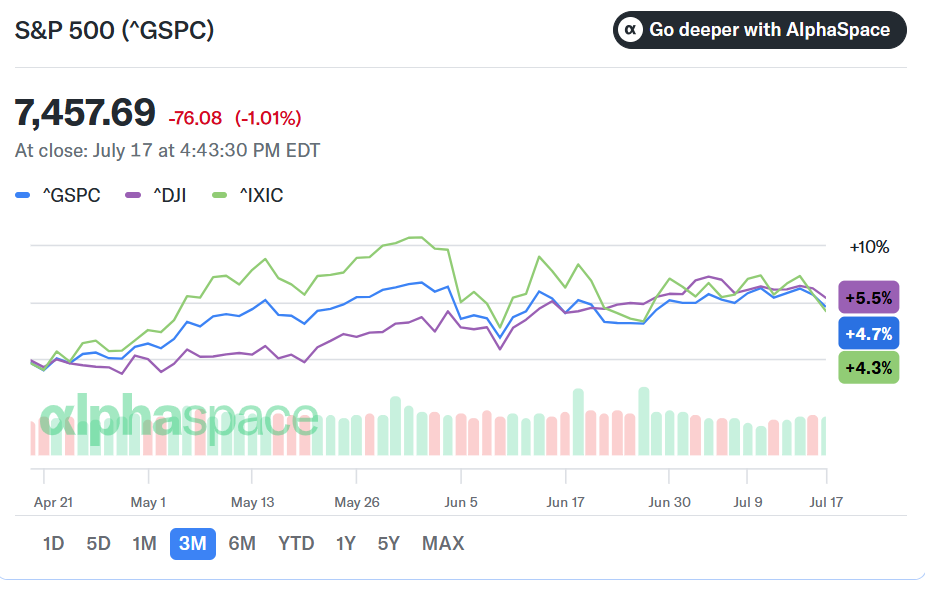
Last week, the most important benchmark index in the US stock market, the S&P 500 index, closed down 1% on Friday, with a cumulative decline of about 1.5% throughout the week. The Dow Jones Industrial Average fell 0.8% on Friday, with a cumulative decline of 0.9% throughout the week. The Nasdaq Composite Index, which can be called the “global technology stock weather vane,” saw the biggest decline. It fell 1.4% on Friday, with a cumulative decline of 2.9% throughout the week.
This week, investors will enter another five trading days with an extremely intensive financial schedule as the geopolitical situation in the Middle East escalates, the Philadelphia Semiconductor Index falls into a bear market, and the South Korean stock market continues to face severe deleveraging.
Among these major global financial events, there is no doubt that the geopolitical situation in the Middle East continues. Among them, the two major tech giants in the “Seven Big Tech Giants” (the Magnificent Seven), which have huge weight in the S&P 500 index — Google's parent company Alphabet (GOOGL.US) and Tesla (TSLA.US), a leader in AI, electric vehicles, and robotics, with the world's richest Musk at the helm, will announce results after the US stock market on Wednesday EST. In terms of the monetary policy of central banks around the world, the ECB's interest rate decision has hit, and market expectations have remained on hold.
In addition, IBM (IBM.US), Intel (INTC.US), and Texas Instruments (TXN.US), which are also global chip giants, will also release financial reports this week. GE Vernova (GEV.US) and Honeywell (HON.US), which focus on AI data center power supply systems, will also release financial reports this week — in particular, gas turbines, which are currently in extreme shortage of AI data center construction around the world, are GE Vernova's important business, second only to Nvidia's AI chip leader AMD ( (AMD.US) “Innovative AI” conference will also be held this week. CEO Su Zifeng may give a speech or bring new AMD AI GPU product plans and roadmap updates.
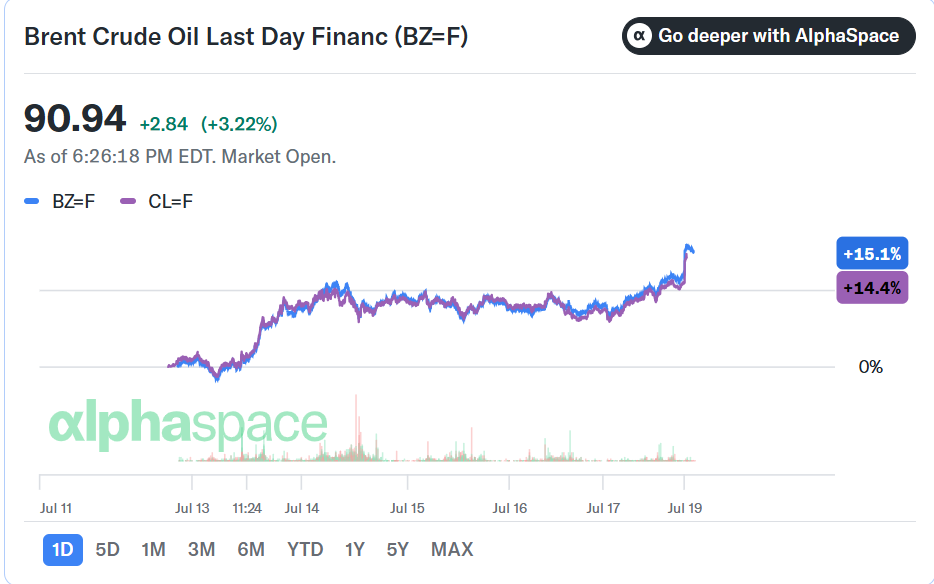
As energy transportation in the Strait of Hormuz was once again blocked across the board, and the international oil price benchmark, Brent crude oil returned above $90 per barrel on Monday, which can be described as a sharp increase in inflation and interest rate risks. These cover AI chips, data center CPUs, industrial/analog chips, AI applications/AI large models, electric vehicles, robots, AI data center power supply, and even cloud computing, and the product line of the AMD Promises AI Conference product line Planning and Su Zifeng's speech are becoming more and more important.
Against the backdrop of the escalation of geopolitical turmoil and the drastic correction of the AI computing power theme, the performance and future prospects of tech giants such as Alphabet, Tesla, Intel, IBM, GE Vernova, and Honeywell this week are no longer just regular financial reports and outlook expectations, but will test the key pricing threshold of “whether unprecedented AI computing power capital expenditure can be converted into actual revenue, cash flow, and return on investment”, and will determine whether or not the current AI computing power trading theme is nearing its end, or whether it continues to rotate from AI on a large scale to non-AI technology with strong cash flow The decline spread from AI computing power leaders to tech giants in a broad sense and the broader sector of the global stock market, causing the global stock market to fall into a pessimistic bear market.
The market value of chip stocks evaporated by 3 trillion US dollars, and oil prices returned to the 90 US dollar mark! At a time when geopolitics are heating up, “AI real revenue generation” has become a new pricing anchor for technology stocks
In addition to Alphabet and Tesla, the heavyweight companies in the “Big Seven,” we will also be watching the performance report to be released by Intel on Thursday EST to test the outlook for chip demand linked to AI computing power; the performance of established US tech giants GE Vernova and Honeywell is expected to help investors understand the business conditions at the level of industrial activities and the underlying power demand level of AI data centers.
Also of paramount importance is the performance report released by established tech giant IBM (IBM) on Wednesday. Earlier, a pessimistic letter from CEO Arwind Krishna triggered a sharp sell-off of the stock.
In addition, the performance reports of the three major US telecom operators — AT&T (T.US), T-Mobile (TMUS.US), and Verizon (VZ.US) — will help investors assess the current state of demand in the traditional telecom industry — in particular, whether the satellite internet technology wave led by SpaceX (SPCX.US) will continue and significantly erode the market share of these traditional telecom operators. These performance reports may be particularly noteworthy. Investors may use their performance to see whether SpaceX Starlink's revenue prospects are becoming more optimistic.
An intensive financial schedule balances a relatively calm calendar of global economic data. S&P Global will release a series of preliminary PMI data for July this week, which will help investors assess the state of the global economy at a broad macro level.
For stock market investors, these big tech companies need to hand over a “quantifiable positive return on investment.” Since June 22, under the global chip stock sell-off, the global chip sector has evaporated more than 3 trillion US dollars in market value. A significant portion of the capital has flowed into the “Big Seven” of US stocks and blue-chip companies with long-term high quality fundamentals and financial conditions, abundant cash flow, and underperformed the AI theme for a long time. This week, this rotation will be put to a major test on both sides of the trade: Buyers' “Big Seven” companies Alphabet and Tesla will announce their results, and the leader on the seller side, Intel, an established US chipmaker, will also release financial reports.
Daniela Hathorn, a senior analyst from Capital.com, said, “Investors will pay close attention to whether the profits of these tech giants can justify the high valuations, and whether the recent pullback will evolve into a broader adjustment, or whether it only constitutes a pause in the upward trend in global technology stocks driven by the AI computing power theme.”
In the first quarter of 2026, global semiconductor sales significantly exceeded expectations by 79% year-on-year, far higher than 38% in the fourth quarter of 2025. BNP Paribas expects sales growth of an impressive 132% in the second quarter.
A team of analysts at BNP Paribas said that for large technology companies, AI data center capital expenses of the five largest technology giants, Microsoft (MSFT.US), Alphabet (GOOGL.US), Amazon (AMZN.US), Meta (META.US), and Oracle (ORCL.US), are expected to increase 79% year over year in 2026 to reach 644 billion US dollars; in 2027, the AI data center capital expenditure will increase by 18% year on year $759 billion.
However, Jeff Buchbinder, chief stock strategist at LPL Financial, said that currently the most important market question these tech giants need to answer is: can such huge AI spending generate a real and reasonable return on investment. Simply spending money is no longer enough — investors are eager to see real AI revenue results.
Buchbinder wrote in a report: “Frontier AI technology is entering a new phase. The market is shifting from pricing promises to pricing revenue-generating execution.” Buchbinder said that the recent sharp correction in the semiconductor sector means they should show investors that this transformation has begun to accelerate. Buchbinder said, “Investors should pay less attention to who is spending the most money in this AI superwave and should pay more attention to who can generate quantifiable and optimistic investment returns from these huge investments.”
Overall, the current stock market has moved from rewarding “investment scale” to examining incremental revenue, inference usage, depreciation pressure, free cash flow, and return on computing power per unit of cloud business. If Alphabet's performance report and outlook prove that the revenue from AI search and AI cloud computing service types closely linked to AI applications is sufficient to cover the increase in AI computing power capital density, the rotation of capital from chips to Mag7, and even technology-themed stocks closely linked to AI computing power infrastructure, such as global chip stocks, will be supported; conversely, any degree of AI capital expenditure reduction, AI-related return on investment, or deterioration in free cash flow may be interpreted as a major negative turn in the AI computing infrastructure investment cycle.
At the same time that the impact on oil prices is being tested in science and technology, energy transportation in the Strait of Hormuz is once again in a hurry! Is grasping “cash flow” the main line of investment now?
Currently, the geopolitical aspect seems to be intensifying. The flow of oil transported through the Strait of Hormuz began to resume rapidly within about a month of reaching a preliminary agreement between the US and Iran to end the war.
However, Goldman Sachs said that this progress was drastically reversed in the past week, as the memorandum of understanding broke down, and the cease-fire was replaced by an increasingly intense exchange of fire between the US and Iran for several days. Currently, energy transportation in the Strait of Hormuz has been drastically reduced under a new round of bombings between the US and Iran.
Lu Ming Pang, vice president of energy gas and liquefied natural gas research at Rystad Energy, said: “The market initially anticipated that oil and gas transportation flows would return to normal after the signing of the US-Iran Memorandum of Understanding on June 17. However, these expectations have not been realized, and the latest round of escalation has further reduced the possibility of recovery in the short term.”
At the beginning of the war, oil flow through the strait dropped to close to zero, then recovered to around 10 million barrels per day in early July. Goldman Sachs commodity strategists, led by Dan Struyven, said that as of July 15, traffic had dropped back to only about 3 million to 5 million barrels per day, and it is likely to decrease further in the future. Strategists say this setback is currently causing the oil market to face a supply gap of up to 13.4 million barrels per day from the Gulf region.
Geopolitics in the Middle East are heating up, driving international oil prices to rise sharply again. As of Friday afternoon, Brent crude oil futures had accumulated gains of about 15% throughout the week, driving this international benchmark contract back above $87.50 per barrel. The US benchmark WTI crude oil futures rose by about 14%, and the trading price rose above $81 per barrel. At the beginning of the Asian session on Monday, Brent crude oil futures continued to rise, breaking the $90 per barrel mark at one point.
Lu Ming Pang from Rystad Energy added: “As market confidence in the safety situation in the Strait of Hormuz continues to weaken, the market will increasingly need to take into account the possibility of supply disruptions lasting longer.”
Due to the increasingly volatile global geopolitical situation, the continued strong demand from overseas investors for the US stock market, and the Federal Reserve's seemingly more hawkish stance, the US dollar index started the year strongly.
However, even though the dollar has risen by about 2.5% against a basket of other major currencies, Wall Street financial giant Bank of America still believes that there is room for the dollar to rise further in the second half of 2026. The bank's foreign exchange trading department believes that the three main drivers for the US dollar's performance are the geopolitical conflict in the Middle East, the AI investment boom, and the prospect that interest rates will remain high for a longer period of time.
First, the Iran war and the closure of the Strait of Hormuz will keep geopolitical tension high and push up oil prices in US dollars. Second, Bank of America analysts wrote that the US dollar will benefit from a continued surge in demand for US stocks from overseas investors, as investors from outside the US seek to participate and gain exposure to the US AI computing power topic and the tech sector in a broader sense.
The team said the final piece of the puzzle was Bank of America's “judgment that clearly deviates from market consensus” on interest rates. The Bank of America anticipates that the Federal Reserve will raise interest rates three times in 2026, 25 basis points each, while the market currently only accounts for one rate hike. The bank believes that if interest rates eventually increase by 75 basis points, this is likely to be a major benefit to the US dollar.
According to the agency's latest quantitative statistics, the tech media telecom momentum factor retracted by about 40% from its peak, and the high-beta momentum basket retracted by about 33%; the Philadelphia Semiconductor Index fell nearly 10% in a week, while TSMC and ASML (ASML), the core leaders in the chip industry chain, were sold off even after announcing strong results, indicating that price adjustments were mainly due to excessive positions, leverage, and expectations, rather than the collapse of current profits. The Goldman Sachs trading team believes that momentum trading has entered “late innings” (late innings). The core reason is that the impact after adjustments for decline, speed, and fluctuation are all close to historical extremes; however, if financial reports fail to prove that AI capital expenditure has quantifiable returns, or if large technology companies begin to emphasize cutting expenses and protecting cash flow, the remaining crowded positions may still trigger the final round of surrender sell-off.
Therefore, the core of this round of global technology stock earnings season is undoubtedly the simultaneous trial of both ends of the AI value chain: Alphabet and Tesla represent the computing power buyers and AI application cashing side, while Intel represents the chip supply and manufacturing side; GE Vernova and Honeywell further provide cross-verification of data center electricity, industrial equipment, and real economy requirements.
This is the underlying logic of the “summer retreat window” emphasized by senior Bank of America strategist Michael Hartnett (Michael Hartnett), who has the title of “Wall Street's Most Promising Strategist.” The Bull and Bear Index compiled by Bank of America rose to the extreme range of 9.6, reflecting the high concentration of capital flows between technology stocks and emerging markets. Market optimism was based on the simultaneous establishment of the four assumptions of “no hard landing, no interest rate hike by the Federal Reserve, no reduction in AI capital expenditure, and no political shock.” Hartnett sees the Mag7 ETF's 200-day EMA of about $65 as a key support for risk appetite: as long as this position is maintained, investors may still make up for the low; once capital expenditure is cut to any extent and this reduction fails to drive Mag7 to a new high, the market will simultaneously lower AI growth expectations and macroeconomic growth expectations. At that time, cyclical sectors such as banks, industry, and brokers that previously undertook rotating capital may not be safe. Therefore, “moving from chip to Mag7” is not a natural hedge, but rather a shift of risk from equipment orders to return on capital expenditure.
The heightened geopolitical risks in the Middle East have undoubtedly made this financial stress test for tech giants even more complicated. The renewed escalation of the US-Iran conflict has slowed the passage of oil tankers in the Strait of Hormuz, and Brent crude oil once exceeded 90 US dollars; the strait carries about 20% of global energy transportation, and continued shutdown will reopen the path of energy inflation, pressure on corporate profit margins, and the Federal Reserve's higher and longer pricing path. Therefore, the most reasonable market framework for this week is probably not to simply judge “the end of the AI super bull market” or “no idea after the collapse”, but rather enter a stage where the surface of the index fluctuates, internal dispersion is extremely high, and cash flow regains pricing power. In the short term, single-share leveraged ETFs, short-term bullish options, and high-momentum exposures that rely solely on valuation expansion should be reduced to hedge oil price and interest rate risks with high-quality balance sheets, defensive cash flow, energy, and some undervaluation cycle assets.
Next, the five signals that actually determine the direction of the market are the growth rate of revenue generation associated with AI applications such as Mag7 capital expenditure guidelines, inference cloud computing resources, and the actual traffic volume of chips in the Strait of Hormuz, and whether South Korea and the US can complete leveraged positions — exceeding expectations can only provide a temporary rebound catalyst; only when the return on investment in AI-related capital exceeds expectations is enough to restart the continued strong bull market around the AI theme.