


[Editor-in-chief Guan Shi]
In the face of a sharp decline in global stock markets, Hong Kong stocks showed strong performance last week, with the Hang Seng Index breaking through 25,000 points.
Changxin Technology was upgraded on July 16, and the surrounding environment is getting better. On July 20, Beijing time, Spain defeated Argentina 1:0 to win the championship in the 2026 US-Canada-Mexico World Cup final at the New Jersey Stadium in New York, USA. The World Cup spell that has plagued us for more than a month is over. Furthermore, the US side has confirmed to the Chinese side that the state of emergency relating to Hong Kong in Executive Order No. 13936 will not continue after it expires this year, and the executive order will be terminated. This means that investment in Hong Kong stocks by US institutions has been loosened, and incremental foreign capital is on the way.
This week's disturbance continues to focus on the US-Iran conflict. The focus is on whether the US side is manipulating Iranian civilian targets and whether the Mander Strait in the direction of the Red Sea will be blocked.
In terms of technology, Changxin Technology launched a new project on July 16, and selling pressure has been concentrated and released, but after a sharp decline and a rebound, new catalysts are needed. This week, Google's parent company Alphabet, Intel, Tesla, IBM, and Texas Instruments will announce the latest quarterly results after the US stock market on Wednesday. The market's focus is on the latest guidance on the giants' future AI capital spending; Meta is in talks to lease computing power to Anthropic, with a potential transaction amount of $10 billion.
The large domestic model on the application side has been rapidly iterated. The Kimi K3 was launched last week, taking first place in the global code list. The gap between the big models between China and the US continues to narrow, and the official version of DeepSeek V4 will probably be released as early as Monday. It is expected to bring new stimuli in areas such as computing power.
It is currently in a new high temperature peak phase from July 18 to 23. The Central Meteorological Observatory continues to issue high temperature warnings. At the 2026 World Artificial Intelligence Conference, the head of the National Energy Administration revealed that China will speed up the construction of a new energy system to enable AI development.
Note that the weekend had crazy results. It is very rare for nine companies. The results are all promising, and all GEM are all released over the weekend. They are all varieties that have plummeted in the early stages. Let's see if they can be stimulated.
[This week's gold stocks]
Anta (02020)
Anta Sporting Goods Co., Ltd. released operating data for the second quarter and first half of 2026. The Anta brand achieved positive year-on-year growth in the number of low and medium units in both the second quarter and the first half of this year, healthy inventory and stable retail discounts, and continued to outperform the overall level of the industry. Despite uncertainty in the macro-consumption environment, the brand has maintained a good growth trend in professional sports categories such as running and outdoor activities.
The FILA brand showed strong resilience, and achieved positive year-on-year growth in the number of low and medium units in the second quarter and the first half of the year, respectively. During the reporting period, the two major sports mentality of tennis and golf continued to be strengthened, and product system and retail store upgrades progressed steadily. During the “618” period this year, FILA's performance was still outstanding, continuing to rank first in all categories of mainstream e-commerce platforms.
Other brands, represented by DESCENTE (Descente) and KOLON SPORT (Colon), performed particularly well. Retail sales in the second quarter and the first half of the year achieved year-on-year growth of 25% to 30% and 35% to 40%, respectively, and also performed well among leading brands.
On June 29, the State Council approved the “Fifteenth Five-Year Plan” to build a strong sports nation, clearly proposing improving the national fitness public service system and speeding up the upgrading of the sports industry, opening up a policy window for long-term growth for the sports footwear industry. According to the analysis of brokerage research reports, other brands are gradually growing from small and high-growth sectors to important engines driving both the Group's revenue and profit growth.
Citi expects that after completing the acquisition of Puma, Anta Sports will technically merge Puma's business in China and make a positive profit contribution to Anta throughout 2027. The bank anticipates that the potential positive contribution of Puma's business in China will largely offset the negative impact of Anta Associates' business line in 2027 (associated with its 29% stake in Puma). As a result, Citi raised Anta's 2026 and 2027 net profit forecasts by 2% and 3%, respectively.
[Industry Watch]
Regarding KIMI3, the following three points are a summary of Zheshang Securities:
(1) Analysis of Kimi K3 model product characteristics: K3 performance positioning and measured performance: KiMiK3 product positioning shift, moving away from the previous route of focusing on cost performance and deep cultivation in the middle and low end markets. For the first time, it aimed to impact the global SOTA level and directly benchmarked top overseas models such as GPT-5.6. Actual measurements show that there is still an identifiable gap with the world's top models, but there is no identifiable gap with Claude3Opus 4.8, and the processing and mindset are very close. Among them, the front-end performance is outstanding. Relying on Kimi's strong multi-modal visual ability, its front-end programming performance and aesthetics crush all overseas models, and is the only link that is superior to Claude3Opus; the architecture design and back-end execution performance is basically the same as Claude 3Opus 4.8. In terms of pricing, its single-task price is 30%-80% of Claude 3Opus 4.8, an average of about 50% of the latter.
(2) K3 architecture features and technological innovation: KiMiK3 is a bucket model with balanced development. The core parameters reach the top level in the industry: the number of parameters reaches 2.8 trillion, natively supports strong visual multi-modal capabilities, and the context window reaches 1M. Its two major self-developed technological innovations solve pain points related to the number of large ginseng: a. The attention residual mechanism solves the problem of increased training difficulty caused by large numbers of ginseng; b. The hybrid linear attention mechanism can greatly reduce the use of KV Cache and promote application in the DDR5 direction. In response to the large parameter quantitative inference efficiency problem, it introduced multiple optimization solutions: using MoE sparsity optimization, 896 experts only activate 16 at a time; the Latent MoE architecture uses a mode of reducing dimensions first and then upgrading to complete inference calculations in a low-dimensional space to improve efficiency. Actual measurements showed that its single task run time was 3-5 times that of Claude.
(3) K3 deployment requirements and open source arrangements: Due to the large number of KMiK3 parameters, the official recommendation is to use a deployment plan with 64 or more supernodes. The related hardware requirements are worth focusing on. All K3 related information disclosed so far is a preview. Officials clearly state that it will be fully open source before July 27, 2026, and the full technical report will be released simultaneously. All current experimental findings can be further verified after the technical report is released.
Another research institute said that the latest concern in the market is the low-cost AI model introduced by China, which may become a cheap alternative to mainstream American models such as Anthropic and OpenAI. If cheaper models can already meet demand, the demand for investment in AI-related infrastructure may decline in the future, thereby weakening the overall AI capital expenditure logic.
So how does the low cost model affect the AI industry chain? First, the low-cost model may reduce the computing power requirements for unit training, but it also lowers the AI usage threshold and amplifies long-term inference requirements — this is the so-called Jevons Paradox (Jevons Paradox), and improving efficiency instead stimulates total usage. Therefore, for upstream hardware, the impact depends on whether you look at the short term or long term (short-term pressure, long-term benefit).
Second, for cloud computing vendors, they probably won't need to rush to expand computing power in the short term, but will focus on how to reduce the cost per token or increase the usage value of existing computing power (for example, Meta will rent out its own computing power to optimize resource allocation). Therefore, if these cloud vendors give more moderate capital expenditure guidelines in the next financial report, the market may not necessarily punish them.
Third, for expensive models such as Anthropic and OpenAI, they face the greatest challenges, because the winners on the model side of the future will be companies that can use tokens most efficiently. There are more and more signs that the AI competition has now moved from larger models to cheaper and smarter systems, and the advent of Kimi3 has only accelerated this trend.
If the above logic holds true, then the AI theme is not over, but is maturing; the overall market is only adjusting, not entering a phase of systemic decline. Of course, due to the emergence of new variables, the pricing logic of some segmented tracks will change, such as GPUs, storage, etc., and may face varying degrees of expected correction. Overall, however, AI will shift from a stage of rapid investment to a stage of efficiency improvement, and this is the only way for AI to shift from “economies of scale” to “economies of scale.”
The Hong Kong stock market focuses on Minimax (00100), Smart Spectrum (02513), Ali (09988), Xunze (03317), and Meitu (01357).
[Data View]
According to data released by the Hong Kong Stock Exchange, the total number of outstanding contracts in the Hang Seng Futures Index (July) was 13,157, and the net number of outstanding positions was 5,3006. Hang Seng Futures refers to the settlement date of July 30, 2026.
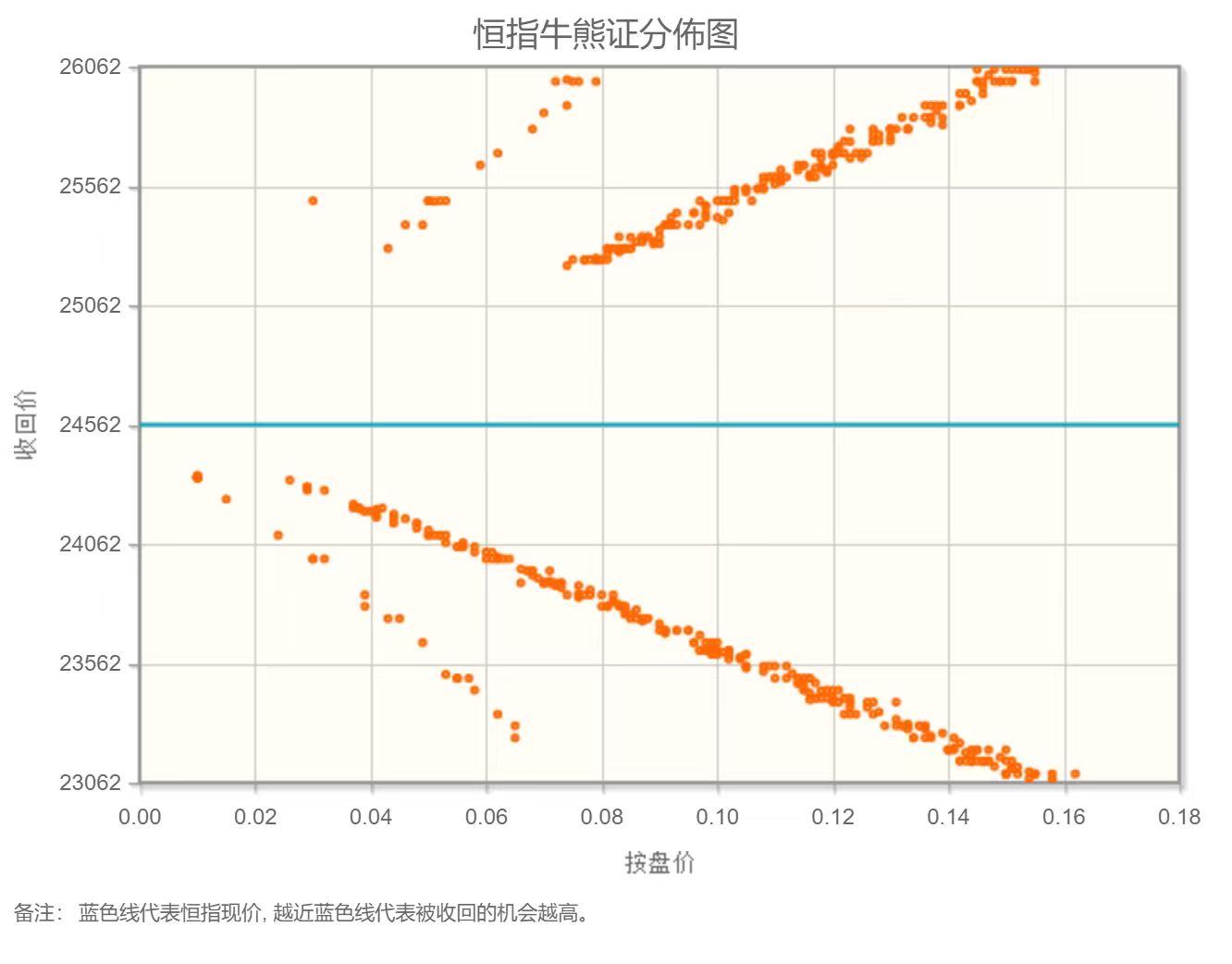
The Hang Seng Index is at 24,562 points. The area where bullish stocks are concentrated below is close to the central axis, the upper bears deviate, and Hong Kong stocks are motivated to go short. The yield on 30-year US Treasury bonds was 5.06%, all breaking through the warning line. Large fluctuations in global stock prices of storage semiconductors led to adjustments in technology stocks. The data showed that the Hong Kong stock Hang Seng Index was bearish this week.
[Editor's Testimonial]
This week, Hong Kong stocks ushered in a key policy inflection point: when the state of emergency corresponding to US Executive Order No. 13936 expires, it no longer continues, suppressing a layer of core risk discounts for Hong Kong stocks for six years, and finally ushered in relaxation.
This is by no means a short-term sentiment pulse, but rather a marginal correction in the foreign pricing logic. Over the past six years, long-term dollar capital has passively reduced its holdings due to compliance restrictions, and risk premiums have been high for a long time, which is the core external cause of Hong Kong stock valuations continuing to deviate from fundamentals. Now that shackles have been lifted, the long-term misalignment between the valuation and profit of Hong Kong stocks has a foundation for systematic repair.
However, we need to stay alert: not all restrictions have been eliminated; the relevant laws are still in effect; the general environment of the game between China and the US has not been reversed; the restoration is bound to be a slow variable and will not be achieved overnight. Internet leaders, the Hong Kong Stock Exchange, and high-dividend blue chips have more room to converge, and A-share cross-border brokerage firms and A/H large-cap blue chips will also benefit indirectly. In the future, it is necessary to keep an eye on signals such as turnover and foreign capital flow to verify the sustainability of capital return.
This is the first step in repairing the valuation of Hong Kong stocks, and it is an important catalyst for the bottom.