


After the stock price of the established US chip manufacturing giant Intel Corporation (INTC.US) retreated sharply from near its all-time high in June, the risk-return ratio has improved compared to a few months ago. Coupled with strong demand for CPUs in superimposed data centers, expanded OEM customer relationships, and the AI industry's capital expenditure remains high, Wall Street analysts can be described as increasingly optimistic about Intel's stock price and basic outlook. Most analysts are betting that Intel's second-quarter results, which will be announced after the US stock market on July 23, EST, will surpass the company's original guidelines, and that the future growth prospects announced by management will also be better than the market's agreed expectations.
Notably, Intel's investment logic is fundamentally changing: the market no longer sees it as just a traditional consumer electronics central processor manufacturer waiting for the PC cycle to recover, but is beginning to reprice the full-stack AI computing power infrastructure platform based on “data center server CPU+ advanced process chip manufacturing/foundry/advanced packaging”. This is why international financial giant HSBC (HSBC) raised the agency's price target for Intel by 100% to $200 — this is also the highest target point for Intel among Wall Street analysts. Intel can once again be described as one of the most popular semiconductor stocks among retail and institutional investors around the world.
At a time when AI agents (Agentic AI) are rapidly gaining popularity around the world, cloud computing giants and AI application leaders such as Anthropic are rapidly expanding artificial intelligence (AI) infrastructure spending, and global AI data center computing power infrastructure is in full swing, HSBC gave this aggressive bullish judgment. This is also the core logical line for Wall Street peers such as Citibank and Bank of America to raise Intel's stock price.
Although AI chip superpower Nvidia (NVDA.US) has always dominated the AI GPU computing infrastructure market, data center CPU, advanced packaging, and wafer/semiconductor manufacturing capacity expenses are becoming an increasingly critical part of the AI computing power supply chain system. HSBC believes Intel can benefit from the continued surge in data center CPUs brought about by AI agents and the global AI semiconductor production capacity expansion frenzy led by Musk TeraFab's “superchip factory.”
Performance threshold: This is not an ordinary financial report, but a stress test of the credibility of the valuation
Intel's official second-quarter revenue range was 13.8 billion US dollars to 14.8 billion US dollars, and the median range was exactly 14.3 billion US dollars; non-GAAP gross margin was about 39%, and non-GAAP earnings per share were 0.20 US dollars. The company's revenue for the first quarter was US$13.6 billion, up 7% year on year, non-GAAP earnings of $0.29 per share, and achieved revenue data higher than its own expectations for the sixth consecutive quarter, providing a fundamental starting point for Wall Street analysts to make a unanimous bullish judgment.
However, the actual threshold faced by this financial report is significantly higher than the company's guidelines. After Intel announced an outlook that exceeded expectations in the first quarter, it rose 19% after the market; then, it rose sharply, driven by AI chip fanaticism, local US manufacturing policies, and potential OEM order expectations. Even though the stock price had fallen back to about $95 as of July 17, it still rose more than 160% during the year, while the Philadelphia Semiconductor Index fell more than 20% from its June high and entered a technical bear market.
In other words, the current market is not satisfied with Intel's “reaching” 14.3 billion US dollars and 0.20 US dollars. Instead, management is required to simultaneously prove that revenue is rising, gross margin improvement, and future performance guidance is sustainable growth. In particular, actual orders are needed to prove that demand prospects for data center CPUs, advanced manufacturing logic chips, and advanced packaging far exceed the agreed market expectations. Otherwise, the earnings report may turn “out of favor” like the performance of Samsung and TSMC.
Intel's expected price-earnings ratio of about 87 times (expected P/E) has declined from the previous extreme valuation range of about 120 times, but it is still not the value sector where the stock has been valued for a long time in the traditional sense.
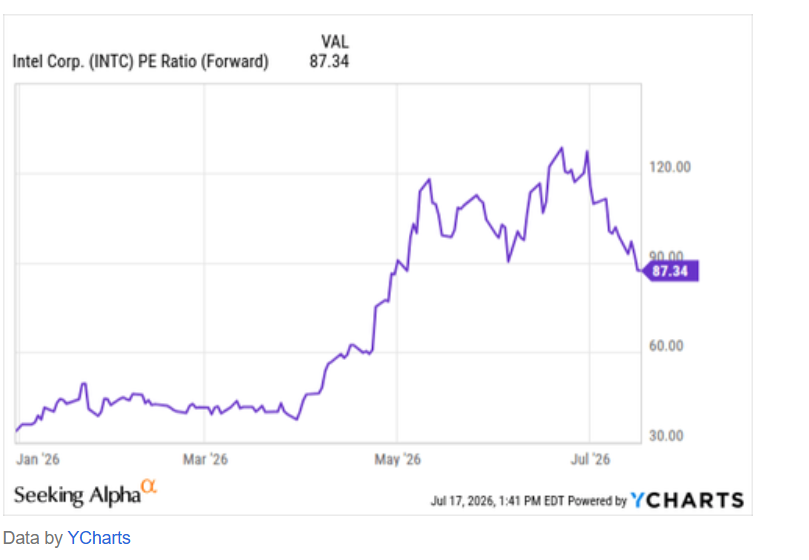
According to Wall Street analysts, Intel's investment logic is essentially an “expected P/E denominator repair transaction”: as long as future profit growth is significantly faster than the rate of stock price growth, the price-earnings ratio can decline rapidly while maintaining strong stock prices; conversely, if profit cashing is delayed, high valuations will amplify any operating mistakes. According to data compiled by the agency, Intel's expected price-earnings ratio is still far higher than its long-term average, so this Wall Street target price upgrade is closer to speculative betting on changes in profit slope, rather than a safe margin investment based on current free cash flow or static valuations.
CPU Renaissance Big Wave: Agentic AI (AI Agent) is pulling Intel back to the main AI computing power chain
In the past two years, AI narratives were almost monopolized by GPUs, and CPUs once seemed like “supporting actors” in the AI arms race; however, with the open source OpenClaw type of proxy AI workflow (AI agent) dominated by inference workloads, data orchestration, task scheduling, memory access, network communication, and multi-tool calls, the market can be described as fully aware that without a powerful CPU as the backbone of the system, GPU clusters cannot operate efficiently. This essentially means that the CPU has returned from “underrated infrastructure” to the center of the chip stage, with a very clear “renaissance” retro wave meaning.
This round of “CPU renaissance” is not a rebound in the traditional PC cycle, but rather a systemic change in the AI workload structure after shifting from training to reasoning and then to intelligence. GPUs are still responsible for matrix computation and model generation, but agents require continuous execution of tool calls, code execution, retrieval, database access, task scheduling, memory management, and multi-process orchestration, and the CPU's bottleneck position in end-to-end throughput has risen again. Tom's Hardware quoted Intel management's internal opinion as saying that the CPU:GPU ratio in AI servers has moved from 1:8 to 1:4 and may converge to 1:1 in the smart device scenario; this means that the same GPU cluster requires more server CPU packages, directly boosting Xeon's demand, delivery cycle, and pricing capabilities.
The market meaning of Intel's recent increase in server CPU prices is that it has verified “demand is stronger than supply” rather than just “cost transfer.” The price of some consumer-grade Core Ultra 200S Plus SKUs increased by $30 to $50, but more importantly, data center grade Xeon CPUs increased even more. The new recommended customer price for the data center Xeon 6980P listed by Tom's Hardware was $13,955, up from $12,460 in 2025, an increase of $1,495. Furthermore, instead of generally increasing the entire Arrow Lake family, Intel is selectively increasing specific SKUs that customers are willing to buy at a higher price, so it is essentially an upward shift in product structure and price weight in the context of limited supply.
Intel's most definite advantage right now is not external outsourcing, but the structural revival of data center CPU demand. In the first quarter, revenue related to the data center and AI business reached 5.1 billion US dollars, up 22% year on year, significantly faster than the 1% growth rate of traditional client computing business. Intel management said at the first quarter results conference that the migration from basic models to inference and intelligent AI is significantly increasing demand for CPUs, wafer manufacturing, and advanced packaging.
At the 54th Global Technology, Media, and Communications Annual Conference hosted by Wall Street financial giant J.P. Morgan Chase, Intel CEO Chen Liwu said that Intel 18A (that is, 1.8nm advanced chip manufacturing process below 2nm) already supports mass production of Panther Lake, increasing yield by about 7% every month, exceeding Intel's internal expectations. Chen Liwu also said that as the focus of AI computing power infrastructure gradually shifts from training to reasoning, CPUs are becoming more and more important and indispensable in the AI era, and the CPU to GPU configuration ratio accelerates from 1:8 to 1:1, and can even reach 4:1.
TSMC's latest performance provides cross-validation of this judgment at the industry level. TSMC's second-quarter dollar-denominated revenue reached US$40.2 billion, at the top of the performance guide, with gross margin of 67.7%, and the total revenue for the third quarter is expected to rise further to 44.6 billion US dollars to 45.8 billion US dollars, exceeding the agreed market expectations; TSMC management continues to emphasize that AI demand has continued for many years, and pointed out that AI agents are driving up demand for AI computing power such as data center CPUs. This shows that AI infrastructure is being upgraded from simply stacking Nvidia's AI GPUs to a system engineering where GPUs, CPUs, Ethernet network infrastructure, storage chips, data center optical interconnect communication, and 2.5D/3D advanced packaging are being expanded together, supporting the real demand for Intel's data center Xeon product line.
Furthermore, if Intel's data center business revenue is strong but the gross margin remains around 39%, the market may judge that incremental revenue is offset by manufacturing costs, product structure, or supply bottlenecks; only if the Xeon product portfolio and average sales price are stronger than expected, and total revenue growth and profit margins rise simultaneously, will the recovery in CPU demand actually enter Intel's profit report.
18A and OEM: The order story must ultimately be tested for yield and cash flow
The chip foundry business is still the determining factor in Intel's valuation cap and the biggest source of risk. The revenue of the Intel Foundry (Intel chip foundry business) segment in the first quarter was approximately US$5.421 billion, up 16% year over year, but approximately US$5.251 billion of this was later offset within Intel, indicating that the vast majority still came from providing manufacturing services for Intel's own products rather than external customer revenue; the division recorded an operating loss of US$2,437 billion during the same period. It can be seen from this that the transition to the “TSMC model” is a strategic direction, not a completed business model transformation: the real verification criteria are not segment revenue growth, but whether external wafer revenue share, wafer utilization rate, unit manufacturing costs, and operating losses have improved continuously.
18A is the technical fulcrum of this transformation. Intel announced in June that the 18A-P had entered risky trial production, and said that compared to the 18A, its performance was increased by 9% under the same power consumption, or the power consumption was reduced by 18% under the same performance; this helped to enhance the design wishes of external customers, but risk trial production was not equivalent to large-scale mass production, let alone that the economic yield had reached the standard.
The “yield fluctuation between wafers has been resolved” that has recently been circulating in the market still mainly comes from supply chain research, rather than official disclosure by Intel. Therefore, statements in the financial Q&A session on yield, production capacity climbing, customer flow, and mass production schedules may determine the direction of stock prices more than current earnings per share. If management confirms an improvement in progress, the recent sell-off may be redefined as a reset of expectations; if the schedule is moved backwards again, the OEM valuation premium may continue to be compressed.
Relationships such as Apple, Tesla, SpaceX, xAI, and Nvidia should be treated as long-term option values and cannot be fully capitalized ahead of time. Although manufacturing cooperation between Apple and Intel currently has exploratory arrangements, specific chips, process nodes, output, and specific revenue contributions are still unclear, and large-scale production may take several years; Intel's participation in the TeraFAB project involving SpaceX, XAI, and Tesla also proves that its wafers and advanced packaging capabilities have received strategic attention, but this is not equivalent to having locked in large-scale commercial orders. Similarly, customer testing 18A or evaluating packaging services is fundamentally different from officially entering mass production. The most reasonable investment framework is to view these relationships as upward options for the OEM business, and base recent valuations on verifiable data center CPU revenue, external OEM orders, and chip production capacity and yield data.
What Intel's current financial report really needs to prove is not that “demand for AI computing power is still expanding,” but that the chip giant finally has the ability to execute the transformation of AI computing power requirements into deliverable production capacity, sustainable profits, and external OEM cash flow.
As far as Intel's stock price outlook is concerned, the partial scenario requires second-quarter revenue and earnings per share to surpass the guidelines, DCAI (data center and AI business) continue to accelerate, gross margin improvement, and management to confirm 18A yield and external customer progress; the neutral scenario is that the CPU business is strong but OEM losses and mass production schedules have not improved significantly, and the stock price remains highly volatile; in the current environment of deleveraging and high compression in the semiconductor sector, the stock price may still fall by about 30%.