


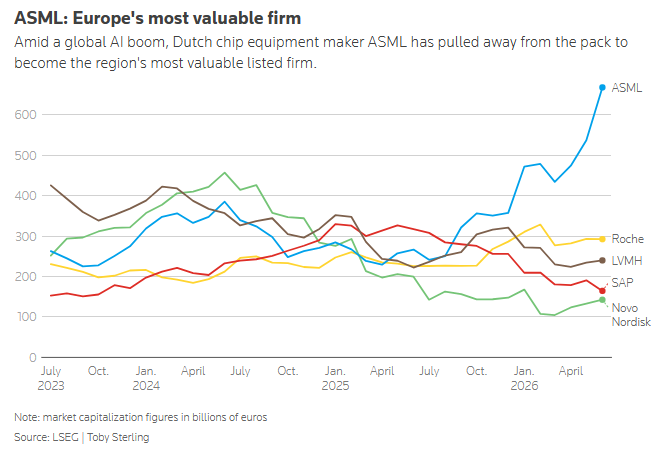
The Zhitong Finance App learned that under the crazy impetus of the global wave of artificial intelligence (AI), Dutch lithography giant ASML.US (ASML.US) not only holds the position of the listed company with the highest market capitalization in Europe, but has also recently sparked an unprecedented bold conjecture in the market: can this jewel in the crown of European technology become the first company in European history to surpass 1 trillion US dollars in market capitalization?
On June 3, 2026, Asmack's stock price once rose more than 2%, and the market value was pushed to about US$674 billion, making it the company with the highest market capitalization in European history. Up to that point, Asmack had increased 60% during the year, leading the European Stoxx 50 Index, and its market capitalization even surpassed the combined market capitalization of the two European giants HSBC Holdings (HSBC.US) and Roche Pharmaceuticals (RHHBY.US).
Although the stock price fluctuated at a high level since then, Asmack's position as the absolute hegemon of the world's semiconductor lithography equipment is still unshakable, and what ignited this round of valuation carnival is an unprecedented boom in AI data center construction.
Financial reports far exceeded expectations, and production capacity expansion accelerated across the board
Entering July, Asmack responded to the market's high expectations with a quarterly report card called “the strongest in recent years” by analysts. In the second quarter of this year, Asmack achieved net revenue of 9.33 billion euros, gross margin of 54%, and diluted earnings per share of 7.59 euros. All indicators far exceeded the company's internal guidelines. Management followed the trend and sharply raised its full-year performance forecast for 2026. The revenue guidance was raised from the previous 36 billion to 40 billion euros to 43 billion to 45 billion euros, and the gross margin target was also raised from 51%-53% to 54%-56%.
What supports this confidence is Asmack's aggressive blueprint for capacity expansion. According to the latest plan, the company expects to deliver about 65 low aperture extreme ultraviolet lithography machines (EUV) in 2026, and this number will jump to 85 units in 2027, a significant increase from previous expectations. The company is also currently evaluating the possibility of expanding production by another 30% by 2028. Meanwhile, the production capacity of deep ultraviolet lithography immersion systems (DUV) is expected to reach about 130 units this year, and is expected to continue to expand 30% in 2027.
In the next generation of high numerical aperture extreme ultraviolet lithography technology, Intel (INTC.US) has taken the lead in migrating some key steps of the 18A process to Asmack's high-NA EUV system, marking the first time that the next generation of lithographs has entered the certification stage for high-volume production logic chips.
Trillion-dollar market capitalization: the only key to the computing power arms race
The reason why the market dared to expect Asmack to reach a trillion-dollar market capitalization is rooted in the insane demand for computing power in the AI era. Nvidia (NVDA.US) CEO Hwang In-hoon predicted at the GTC 2026 conference in March that AI chip orders would reach at least 1 trillion US dollars by 2027. Broadcom (AVGO.US) CEO Chen Fuyang also gave an aggressive forecast of AI chip revenue reaching 100 billion US dollars for the 2027 fiscal year. Meanwhile, the total capital expenditure of the four major cloud giants Amazon (AMZN.US), Microsoft (MSFT.US), Google (GOOGL.US), and Meta (META.US) is expected to exceed 700 billion US dollars in 2026, and the vast majority will go to AI infrastructure.
The throat of this arms race for computing power is firmly in Asmer's hands. It is almost impossible to bypass Asmack's extreme ultraviolet lithography technology in the production of advanced AI chips, and Asmack has almost a monopoly position in this field. As the share of high-margin EUV systems in orders continues to expand, and service revenue from sold equipment stocks (accounting for a quarter of total sales in 2025), Asmack has a very clear long-term growth track.
“I think Asmack is likely to be the first company in Europe to cross the trillion threshold,” said Caroline Bell, chief fund manager of Stonehage Fleming's World's Best Creative Portfolio. She revealed that Asmack accounts for about 8% of its investment portfolio.
“It's just that it's hard to predict when this moment will come.”
Wall Street investment banks take turns singing well
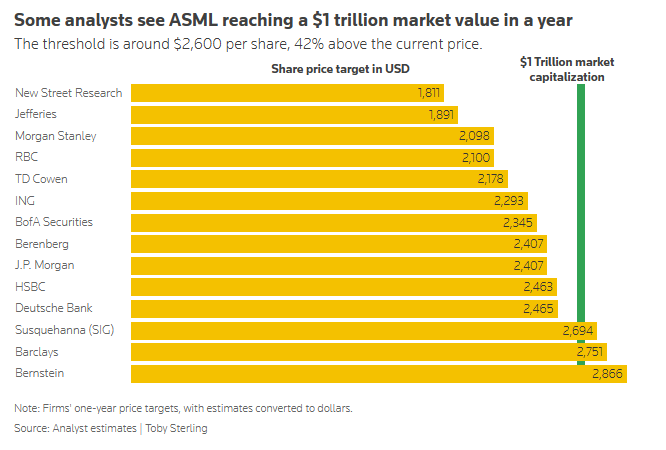
Strong fundamentals enabled investment banks to act quickly after earnings reports were released. RBC raised the target price of Asmack's US stock from $2,000 to $2,100, maintaining a “outperforming the market” rating. The bank pointed out that the expected shipment of low-na EUV equipment is significantly stronger than previous guidance. Coupled with the continuous improvement of the product portfolio, steady service revenue performance, and demand for immersive deep ultraviolet lithography (ArFi) exceeding expectations, all constitute a catalyst for further expansion in gross margin. It is expected that the upward trend in the company's revenue and profit margin will continue until at least 2028.
Deutsche Bank sharply raised the target price of Asmeros shares from 1,800 euros to 2,150 euros and reaffirmed the “buy” rating. The bank emphasized that Asmack expects gross margin to reach 56% in the second half of 2026, far higher than the general market forecast of 52.6%, which is a key factor in raising its valuation.
Bernstein raised Asmack's target price from 2,300 euros to 2,500 euros, maintaining the “outperforming the market” rating. Analyst David Dai listed three major upward drivers: First, Asmack plans to increase the production capacity of low-na EUV and ARFI by 30% each year in 2027 and 2028; second, there is significant room for upward pricing. The average price of EUV is expected to rise 10% in 2027, and it is expected to achieve another high single-digit percentage increase in 2028; third, the prospects for improving profit margins are clear. Based on this, Bernstein raised Asmack's 2027 and 2028 revenue forecasts to 56 billion and 72 billion euros, respectively, and the earnings forecast per share was also raised sharply to 53.6 and 75.3 euros.
Beautiful visions versus resistance to reality
However, behind this optimistic picture, the short-term trend of the market revealed severe chill, and Asma's path to a trillion dollar market capitalization is far from easy. Just after the company released its strong quarterly report, the stock price did not rise but fell 2.51% to 1,528 euros on July 17, a weekly decline of nearly 3%.
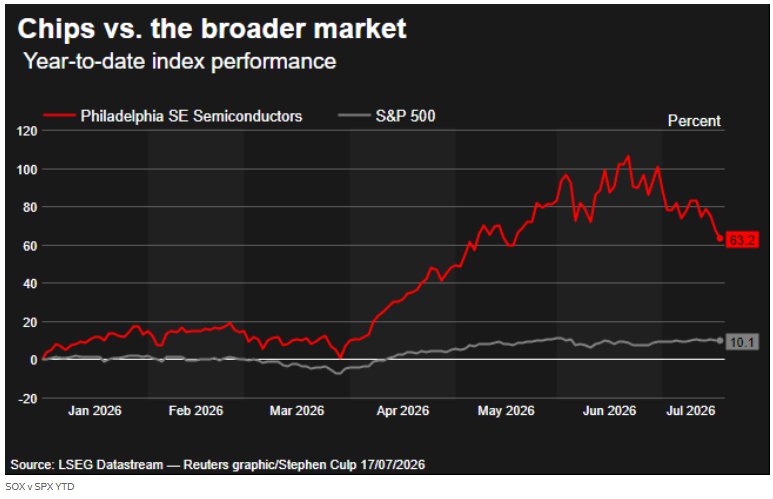
This trend echoes the sell-off in the chip sector as a whole — Wall Street's fervor about the AI boom is cooling down. The Philadelphia Semiconductor Index recorded its biggest weekly decline in more than a year. Since July, it has accumulated a cumulative decline of more than 18%, down more than 20% from its historical closing high on June 22, confirming a technical bear market. The analysis points out that some investors have begun to prepare ahead of time for a possible slowdown in AI spending feast of nearly trillion US dollars, and some actively managed funds have begun to reduce related exposure.
“The market seems to be suffering from 'chip fatigue',” said Ryan Detrick, chief market strategist at Carson Group. “Chip stocks have been falling for three weeks in the past four weeks, and the market has always been concerned about the same issues — these stocks have risen too high and fast before, but are now returning to a reasonable price.”
On the other hand, Asma itself faces real resistance that cannot be ignored.
First, there is a lingering geopolitical shadow. The proposed “MATCH Act” of the US Congress may further tighten restrictions on the export of deep UV engraving machines and related services to China. According to the data, the share of system sales in the Chinese market has further declined from 19% in the first quarter of 2026 to 14% in the second quarter of 2026. If the new ban is implemented, it will directly impact Asmack's business in China, which accounts for about 20% of this year's revenue. The Dutch government has expressed diplomatic opposition to this.
Second, the process route choices of major customers have brought uncertainty. TSM.US (TSM.US), the world's largest advanced chip foundry, has publicly stated that its A14 node will skip Asmack's latest high-NA EUV technology, and analysts generally expect TSMC not to adopt the device until 2029 at the earliest. In the time gap between Intel's early adoption and TSMC's large-scale commercial use, it is still questionable when the huge amount of capital invested by Asma will fully pay off.