


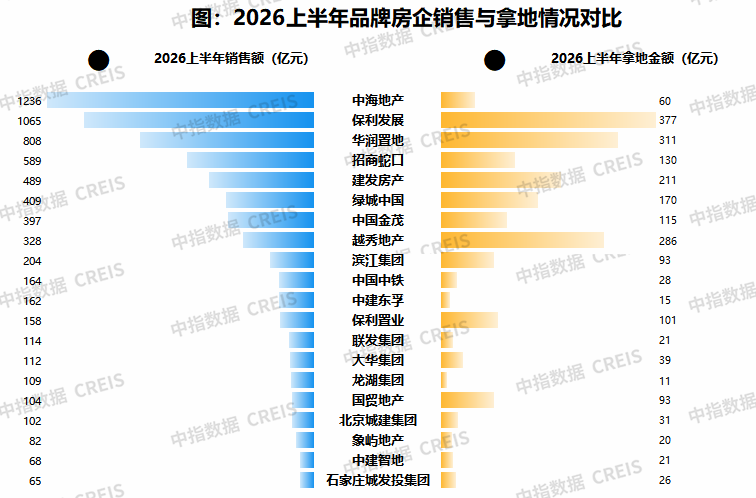
The Zhitong Finance App learned that the China Index Research Institute published an article stating that in the first half of 2026, the total sales of 100 real estate companies was 1,586.36 billion yuan. The year-on-year decline was 1.3 percentage points lower than in January-May, and narrowed for four consecutive months. Mainly due to increased activity in the real estate market in core cities, the decline in sales performance of key housing enterprises has declined. In terms of land acquisition enterprises, central state-owned enterprises are still the main force in land acquisition in the land market. In the first half of 2026, out of the top 100 companies with land acquisition amounts, 74 were central state-owned enterprises and local state-owned enterprises, accounting for 85.1% of the land acquisition amount, of which the central state-owned enterprises acquired more than 55%.
Data source: Middle Index Data CREIS
Sales performance: The cumulative year-on-year decline narrowed for four consecutive months
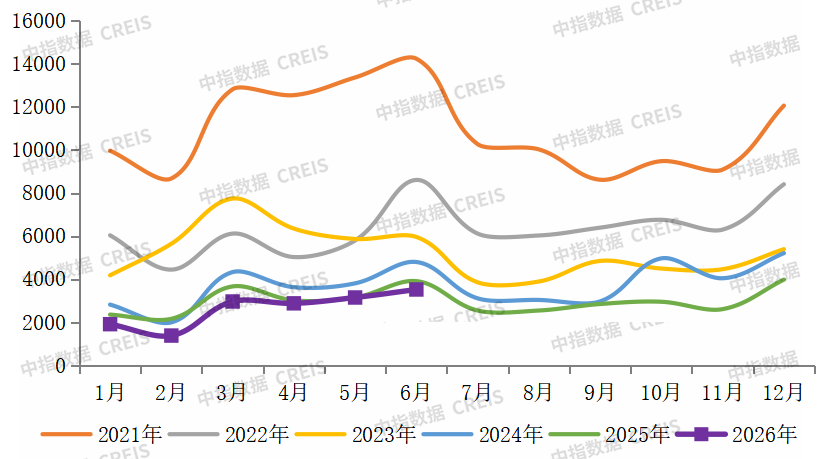
In the first half of 2026, the total sales of 100 housing enterprises was 1,586.36 billion yuan. The year-on-year decline was 1.3 percentage points lower than in January-May, and narrowed for four consecutive months. Mainly due to increased activity in the real estate market in core cities, the decline in sales performance of key housing enterprises has declined. The trading sales of 100 housing enterprises were 1259.63 billion yuan, and equity sales were 1119.34 billion yuan. In June alone, the full-caliber sales of 100 real estate companies increased 11.8% month-on-month.
Figure: Average cumulative full-caliber sales volume and growth rate of 100 real estate companies from January 2022 to June 2026
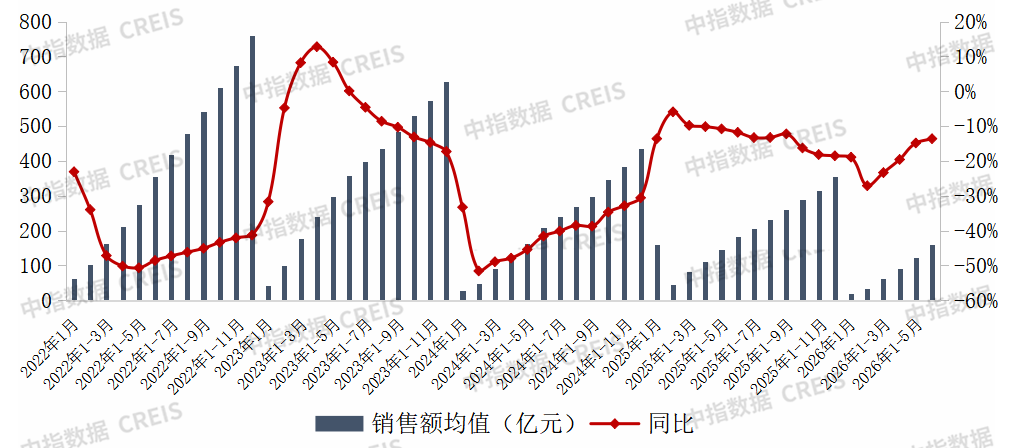
Figure: Monthly sales of 100 housing enterprises in a single month from January 2021 to June 2026 (unit: 100 million yuan)
Data source: Middle Index Data CREIS
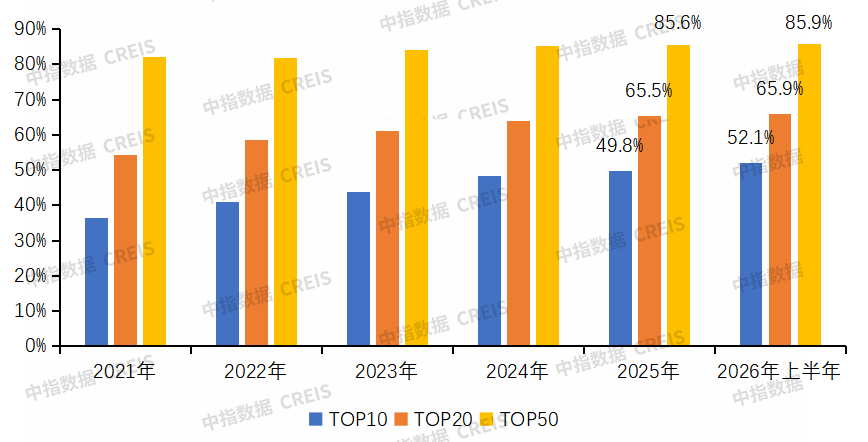
Leading companies have more obvious advantages, and industry concentration is still increasing. In the first half of 2026, of the TOP10 companies with full-caliber sales volume, the share of sales of TOP10 companies broke through the 50% mark and reached 52.1%, up 2.3 percentage points from the end of last year; TOP20 and TOP50 companies accounted for 65.9% and 85.9% of sales, respectively, up 0.4 and 0.3 percentage points from the end of last year. The sales share of the three factions increased at the same time, indicating a structural trend where market resources are being gathered at an accelerated pace. Among them, TOP10 concentration increased significantly, and the share is already over half, indicating that the industry share is rapidly tilting towards the most comprehensive competitive first tier. This change means that the industry has entered a period of deep division of the “strong and strong”, and leading housing enterprises have built extremely high moats with advantages in financing costs, land storage in core cities, and steady delivery capacity.
Figure: Share of TOP10, TOP20, and TOP30 among the TOP100 full-caliber sales volume from 2021 to the first half of 2026
Data source: Middle Index Data CREIS
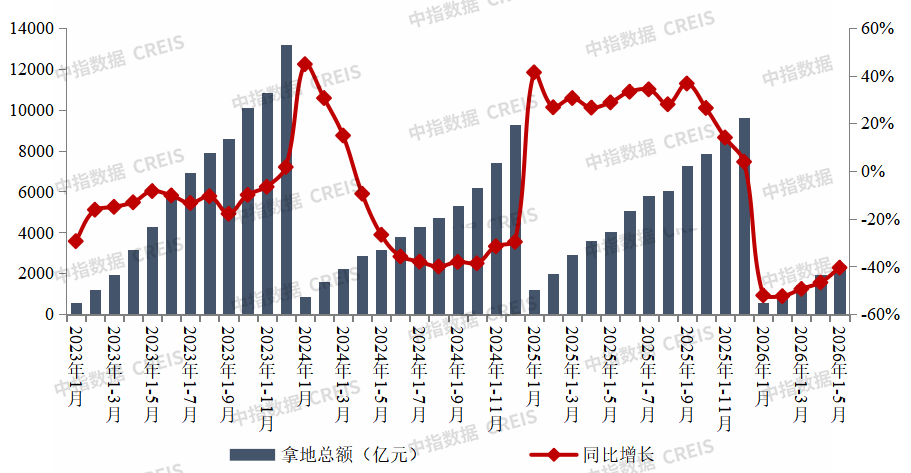
Land acquisition performance: The total amount of land acquired by key housing enterprises fell 33.7% year on year, and the decline narrowed continuously for April
In the first half of 2026, 100 housing enterprises acquired a total of 336.0 billion yuan of land, a year-on-year decrease of 33.7%. The decline was 6.8 percentage points narrower than the previous month. Markets in core cities such as Beijing and Shanghai have continued to be popular. Since May, the effects of the Shenzhen New Deal have clearly been driving, while there has also been marginal improvement on the sales side of housing enterprises. Driven by sales performance and market popularity, the year-on-year decline in land acquisition amounts has narrowed continuously for April. In the first half of 2026, the value of new goods added by 100 housing enterprises fell by 33.4% year on year. The decline was narrower than in January-May. Mainly in June, land auctions in core cities were more popular.
Figure: Total cumulative land acquisition volume of 100 housing enterprises from 2023 to 2026 and the year-on-year ratio
Data source: Middle Index Data CREIS
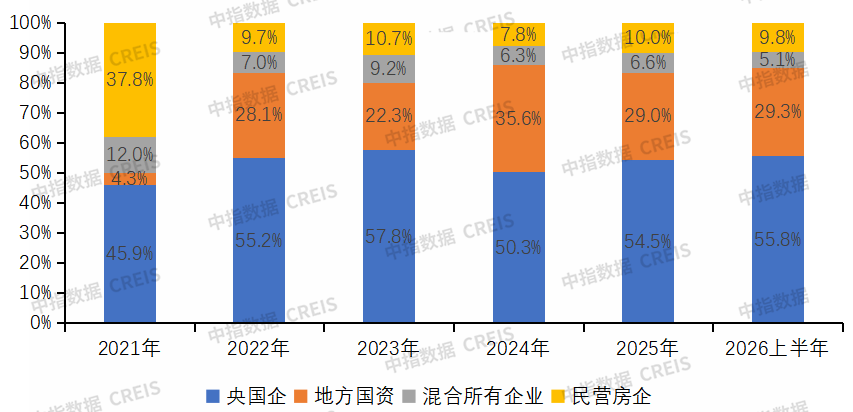
In terms of land acquisition enterprises, central state-owned enterprises are still the main force in land acquisition in the land market. In the first half of 2026, out of the top 100 companies with land acquisition amounts, 74 were central state-owned enterprises and local state-owned enterprises, accounting for 85.1% of the land acquisition amount, of which the central state-owned enterprises acquired more than 55%. Large central state-owned enterprises such as Poly Development, China Resources Land, Yuexiu Real Estate, C&D Real Estate, China Merchants Shekou, and China's Jinmao rank among the top in land acquisition amounts. The number of local state-owned enterprises increased by 3 compared to the end of 2025, but the share of land acquisition amounts remained basically unchanged.
Overall land acquisition by private enterprises is still at a low level, and some local private enterprises in cities such as Hangzhou and Shanghai maintain a certain layout rhythm in specific regions. In the first half of 2026, there were 15 private enterprises in the TOP100, an increase of 3 over the end of 2025, but the share of land acquisition remained around 10%. There is 1 private enterprise in the TOP10, Binjiang Group; there are 2 private enterprises in TOP11-20, Dahua Group and Bangtai Group, 2 in the same period last year; 1 private enterprise in TOP21-30, compared to 3 in the same period last year. Judging from the scale of land acquisition, the total amount of land acquired by the TOP30 private enterprises in the first half of 2025 was about 55.3 billion yuan. The first half of 2026 was only 18.91 billion yuan, and the scale of land acquisition declined sharply. Looking at cities where private enterprises acquire land, they are mainly cities such as Hangzhou, Shanghai, and Chongqing. Private enterprises generally focus on deep-cultivating advantageous cities.
Figure: Proportion of the number of enterprises of different nature in the TOP100 land acquisition amount from 2021 to the first half of 2026
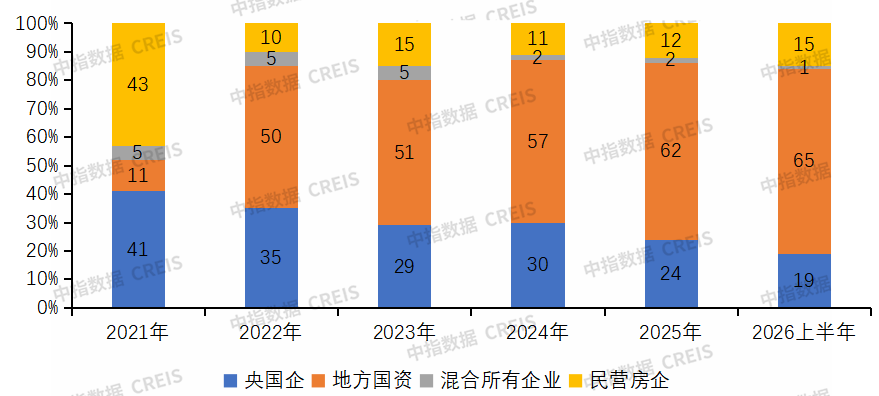
Figure: Percentage of land acquisition amount of enterprises of different nature in the TOP100 land acquisition amount from 2021 to the first half of 2026
Data source: Middle Index Data CREIS
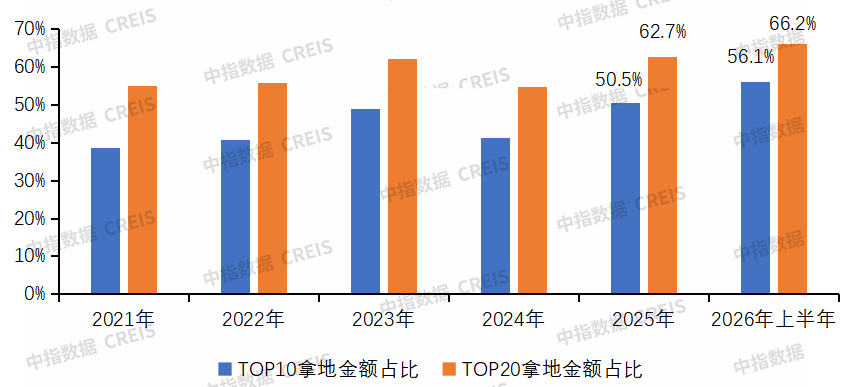
Judging from the camp, leading companies are continuously strengthening their land acquisition efforts, and their share is further increasing. In the first half of 2026, the TOP10 companies accounted for 56.1% of the top 100 land acquisition amounts, and the TOP20 companies accounted for 66.2%. Compared with the end of last year, this is an increase of 5.6 percentage points and 3.5 percentage points respectively. The share of leading housing enterprises in land acquisition amounts has further increased, indicating that the land acquisition capacity of leading housing enterprises continues to increase. In the short term, the core areas of future first-tier and second-tier cities are expected to continue to welcome more high-quality residential land into the market. With high-quality locations and perfect facilities, they can maintain the popularity of the land market and stabilize expectations. Leading real estate companies are active in acquiring land, focusing on high-quality land plots in core cities. For example, China Resources Land acquired 8.7 billion yuan of land in Beijing, Poly Development obtained 8.6 billion yuan of land in Shanghai, and Yuexiu Real Estate acquired 25 billion yuan of land in Guangzhou, all ranking at the top of each city's land acquisition amount list.
Figure: Percentage of TOP10 and TOP20 companies in the top 100 land acquisition amounts from 2021 to the first half of 2026
Data source: Middle Index Data CREIS
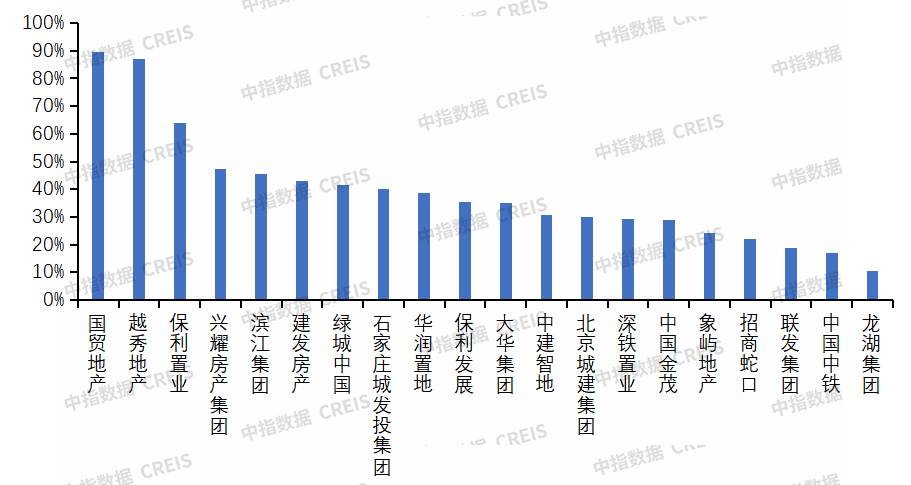
In the first half of 2026, judging from the land acquisition sales ratio of the 20 representative companies, the land acquisition sales ratio was clearly differentiated. Some companies actively replenished their positions, while some companies were still less willing to acquire land and were more cautious. In the first half of 2026, the average land acquisition sales ratio of the 20 representative companies was 25.0%, down 11.9 percentage points from the same period in 2025. Overall, it represents a decline in the willingness of housing enterprises to acquire land. By enterprise, some representative enterprises are more willing to acquire land. For example, Guomao Real Estate and Yuexiu Real Estate have a land acquisition sales ratio of over 85%, Poly Real Estate's land acquisition sales ratio is over 60%, and the rest of representative enterprises have a land acquisition sales ratio of less than 50%. Currently, overall demand in the real estate market is weak, the pace of new housing removal is slowing down, and the industry has completely bid farewell to the trend of scale expansion. Private housing enterprises are under pressure to finance, and most have withdrawn from local auctions. Only leading central state-owned enterprises have laid out a small amount of high-quality land. Housing enterprises are cautious about future profit expectations, avoiding inefficient plots in low-energy cities. The local auction market showed structural differentiation where core cities were hot and the country's total was deserted, which ultimately caused the land acquisition sales ratio to decline simultaneously.
Figure: Land acquisition sales ratio of 20 representative companies in the first half of 2025
Data source: Middle Index Data CREIS