


Key Points
In addition to the evolution of artificial intelligence, inflation has become a hot-button topic in 2026.
Falling crude oil prices, spurred by the hope of peace between the U.S. and Iran, should ease fuel prices in July and lower headline U.S. inflation.
However, the Federal Open Market Committee's (FOMC) favorite inflationary measure is forecast to be as sticky as ever, implying that rate hikes are still firmly on the table.
Thanks to investor excitement for the artificial intelligence (AI) revolution, the Dow Jones Industrial Average (DJINDICES: ^DJI), S&P 500 (SNPINDEX: ^GSPC), and Nasdaq Composite (NASDAQINDEX: ^IXIC) have all catapulted to several record highs in 2026. But AI isn't the only catalyst moving markets.
Inflation has become a hot-button issue that's dividing the Federal Reserve's policymakers. The latest inflation forecast for July from the central bank, released on July 16, offers a partial reprieve for consumers. But at the same time, this estimate contains a surprising red flag that can upend Wall Street's historic AI-driven rally.
Where to invest $1,000 right now? Our analyst team just revealed what they believe are the 10 best stocks to buy right now, when you join Stock Advisor. See the stocks »
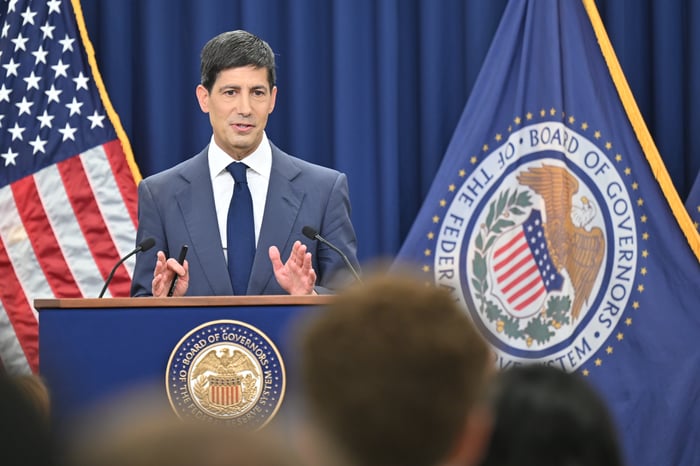
Fed Chair Kevin Warsh delivering remarks. Image source: Official Federal Reserve Photo.
The Fed's July inflation forecast offers a partial silver lining for consumers
Although President Donald Trump's tariffs have been pushing up prices in the goods sector since the midpoint of 2025, trailing 12-month U.S. inflation was a relatively modest 2.4% in February and headed toward the Federal Open Market Committee's (FOMC) long-term target of 2%. The FOMC is the 12-person body, including Fed Chair Kevin Warsh, responsible for setting the country's monetary policy.
By May, TTM inflation had spiked to a three-year high of 4.2%, driven by President Trump's decision to attack Iran. The latter shut down the Strait of Hormuz shortly after military operations began, effectively cutting off a fifth of the world's petroleum liquids demand. Gas prices rose at the fastest pace in more than three decades.
BREAKING: June CPI inflation falls to 3.5%, below expectations of 3.8%
-- The Kobeissi Letter (@KobeissiLetter) July 14, 2026
Core CPI inflation falls to 2.6%, below expectations of 2.8%.
Month-over-month CPI inflation fell -0.4%, the biggest monthly drop since May 2020.
US stock market futures are surging on the news.
However, June delivered a pleasant surprise to consumers (and investors). With peace talks between the U.S. and Iran acting as a catalyst, crude oil prices plunged. Though fuel prices don't fall as quickly as they rise during energy supply shocks, a notable decline in oil prices cut TTM inflation to 3.5% in June.
According to the Federal Reserve Bank of Cleveland's proprietary Inflation Nowcasting tool, headline TTM inflation should decline further in July to 3.32%. At worst, this is a partial reprieve for consumers at the fuel pump -- but it's not the complete story.

Image source: Getty Images.
The FOMC's favorite inflationary measure is as sticky as ever
While the Cleveland Fed's forecast points to a second consecutive month of headline inflation declines in July, it's an entirely different story when talking about Core Personal Consumption Expenditures (PCE) -- one of the FOMC's favorite inflationary measures.
Core PCE removes the effects of volatile energy and food prices, thereby providing a more encompassing view of the inflationary pressures consumers face. Although headline inflation is projected to fall from a reported 4.2% in May to a projected 3.32% in July, Core PCE is hardly budging. It's estimated to fall from 3.4% in May to 3.33% in June, then reaccelerate slightly to 3.36% in July.
The Fed's preferred measure of inflation (Core PCE) moved up to 3.4% in May, the highest level since October 2023.
-- Charlie Bilello (@charliebilello) June 25, 2026
This was the 63rd consecutive reading above the Fed's 2% target level.
"We've missed for 5 years. And we're gonna fix that."-Kevin Warsh last week pic.twitter.com/Wtayfgt8sq
The Fed's July forecast implies that Iran-war-driven inflation has spilled over into the broader economy and is about far more than just energy prices. If that's the case, FOMC policymakers may have no choice but to raise interest rates to stabilize prices.
Rate hikes may prove devastating for the second-priciest stock market in history. A substantial portion of the AI infrastructure build-out that's fueling investor excitement is financed through debt. Making borrowing costlier could slow the expansion of AI data centers and force investors to rethink the otherworldly valuation premiums assigned to AI stocks (and the broader market).
Sean Williams has no position in any of the stocks mentioned. The Motley Fool has no position in any of the stocks mentioned. The Motley Fool has a disclosure policy.