


The Zhitong Finance App learned that although the S&P 500 index has accumulated an increase of 18% since late March, short positions in the US stock market have soared to a record high, reflecting concerns about whether this round of gains can continue. According to S3 Partners data, short positions in the S&P 500 index constituent stocks are close to 3.79% of freely tradable shares, the highest value since the company recorded in 2010. The share of bears in the Russell 3000 Index's constituent stocks climbed to 6.3%, which also reached a record high.
Meanwhile, data from S3 Partners shows that the total short positions in the US and Canada stock market have increased to 2.13 trillion US dollars, which is also the highest in history since records began in 2010. The median net short share of the S&P 500 constituent stocks has risen to 3% of market capitalization, the highest level since the end of 2011.
A multi-dimensional record of short positions: from the market to the full bloom of individual stocks
The expansion in the size of short bets is all-round. According to S3 Partners data, the total short positions in US stocks exceeded 2.13 trillion US dollars in May, setting a record high since the agency began statistics in 2010. Goldman Sachs main broker business statistics show that the median share of net short positions in the S&P 500 index has risen to 3% of market capitalization, the highest level since 2011.
Looking at it from a broader perspective, Global Markets Investor data shows that the median short holding ratio of the S&P 500 index constituent stocks was about 3.7%, a record high in 11 years; the NASDAQ 100 index short positions were about 2.7%, a record high in 6 years; and the short positions in the Russell 2000 index were close to 5.0%.
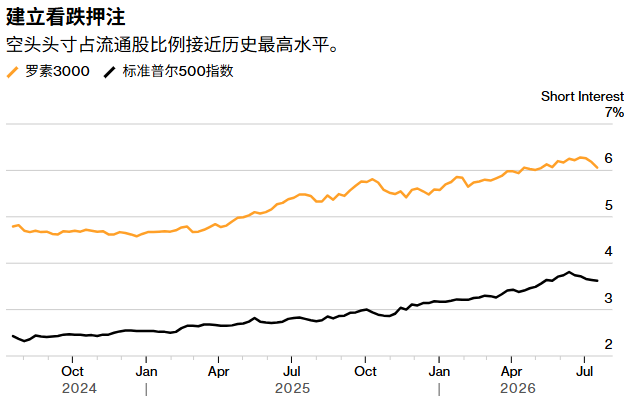
Data compiled by Reynolds Strategy shows that since February, short positions in NYSE listed stocks have continued to rise, reaching a record high of 9% of tradable stocks in late June — in comparison, this ratio was only 5% during the global financial crisis and around 6% during the COVID-19 pandemic. Brian Reynolds, the company's chief market strategist, described recent short positions as “showing a vertical upward trend”.
The concentration of bears at the individual stock level is even more astonishing. According to S3 Partners data, the shorting ratio of at least 16 stocks exceeded 20% of the circulation market. Among them, the short position of SpaceX (SPCX.US) has soared from 4.5 billion US dollars on June 15 to 25 billion US dollars, accounting for about 29% of publicly traded shares. Ihor Dusaniwsky, managing director of S3 Partners, said: “There has been an increase in short selling activity, and the range of stocks being shorted has also expanded”.
The main battleground for bears: AI and semiconductors have become the hardest hit areas
The direction of concentration of bears' bets clearly points to the AI and semiconductor sectors. According to S3 Partners data, stocks with the largest short positions (in dollars) include the “Big Seven Tech” and chip makers such as Micron Technology (MU.US) and Broadcom (AVGO.US).
Michael Burry, the prototype of the movie “The Big Short,” recently revealed a new round of bearish betting. The short list covers Nvidia (NVDA.US), Applied Materials (AMAT.US), Tesla (TSLA.US), Caterpillar (CAT.US), and iShares Semiconductor ETF. Burry made it clear that it has established short positions around the artificial intelligence and semiconductor sectors.
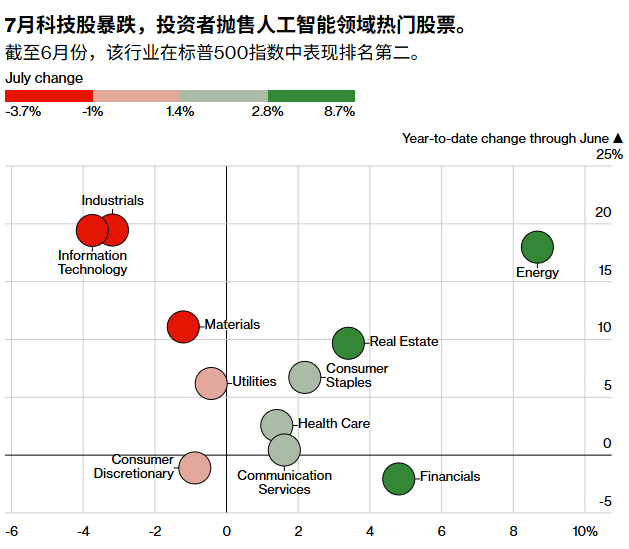
Bears are not without their bets in this area. According to Bespoke Investment Group data, the stocks with the most short holdings in the Russell 3000 Index — such as HTZ.US (HTZ.US), Eos Energy (EOSE.US), etc. — fell an average of 15% this year, while all other stocks in the index rose nearly 21%. Hertz Rent a Car fell 65% during the year, and about 79% of its shares were shorted, bringing rich returns to the bears.
SpaceX is also an empty “cash machine.” Since the June IPO, SpaceX shares have fallen below the issue price of 135 US dollars, and short book profits are close to 5 billion US dollars. S3 Partners managing director Dusaniwsky revealed that among companies that have been listed for less than a month, SpaceX's shorting ratio is already at the highest level.
Multiple risks driving short bets
Questioning the return on AI investment is a central concern. Over the past 8 weeks, hedge funds have sold technology stocks at an unprecedented rate, setting a record high in terms of cumulative sales ratio. US AI technology stocks were violently sold off last week. The NASDAQ index fell 2.9% weekly, and the Philadelphia Semiconductor Index fell close to 10% weekly. The retracement of the Morgan Stanley US technology momentum factor has taken 17 trading days, falling 40% from its peak, setting a record for the fastest retracement in history.
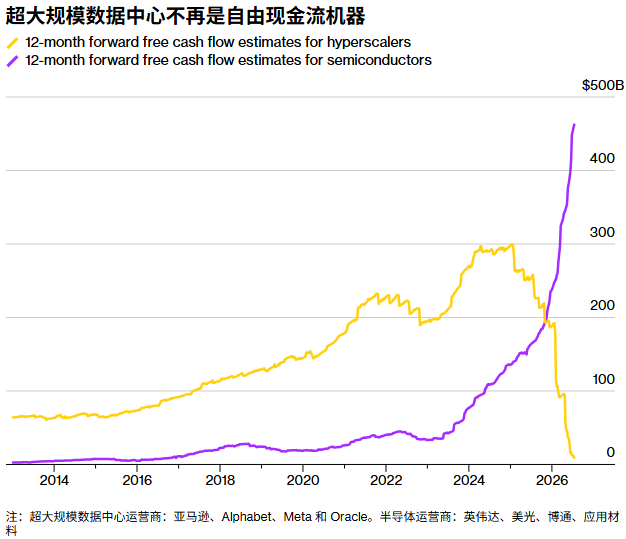
Goldman Sachs characterized the phenomenon of the Philadelphia Semiconductor Index retreating more than 20% from its June high and falling into a technical bear market as “one of the largest momentum strategy sell-offs on record.” The main reason was not the deterioration of fundamentals, but the most popular matchmaking deal of the year for hedge funds and mutual funds to “go long on semiconductors and short hyperscale cloud computing companies” on a large scale. Goldman Sachs partner Mark Wilson pointed out that the root cause of this round of sell-offs is position congestion and concentration of leverage.
Geopolitical risks, too, cannot be ignored. The United States has launched air strikes on Iran for many nights, and the safety of shipping in the Strait of Hormuz is at risk. Continued attacks between the US and Iran push WTI crude oil prices to break through $80 per barrel again. Geopolitical conflicts drive up oil prices and inflation expectations, putting pressure on overall risk assets. Analysts pointed out that the escalation of the situation in the Middle East, the rise in oil prices, and the proximity of the Federal Reserve's interest rate meeting to the three main lines will jointly determine future asset price trends.
The uncertainty of the earnings season is the most immediate short-term catalyst. This week, Alphabet and Tesla will be the first to disclose quarterly results. Some analysts have warned that if Google releases any signal to cut the AI investment budget, it could have a serious impact on AI transactions. Joseph Saluzzi, partner at Themis Trading, said: “The increase in short positions shows that investors are concerned.”
Long and short confrontation: two forces cancel each other out
The sharp rise in short positions did not trigger a market crash. The S&P 500 index has fluctuated around this level since it first hit 7,500 points on May 14. This “must fall or not fall” resilience stems from the simultaneous presence of multiple forces.
Reynolds pointed out that investors' buying behavior is likely to have offset rising bearish sentiment — it is these two mutually countervailing forces that have kept the stock market sideways over the past month, thereby curbing speculative behavior that could pave the way for a rebound. In the report, he said: “We still believe that retail investors will continue to push stocks to new highs, and that in any downturn, stock repurchases will accelerate, thus helping stocks break out of their lows”.
According to S3 Partners data, investors invest about twice as much in long positions as in short positions. This means that the market is currently in a fragile equilibrium: once the bulls weaken or bear strength builds up further, the balance may be broken at any time.
Meanwhile, hedge funds are operating in reverse. Goldman Sachs data shows that recently hedge funds have made up short positions in individual US stocks at the fastest speed in three months. The complexity of this long and short game shows that the market is not simply “bullish” or “bearish,” but is looking for direction in the midst of high uncertainty. The information technology sector became the sector with the largest net purchases, and fund managers concentrated on making up semiconductor positions.
Earnings Season: An Empty “Judgment Day” or “Carnival”?
This week's earnings from tech giants will be a key variable in determining the fate of bears. According to FactSet data, Mag 7 as a whole is expected to achieve a 31.1% year-on-year increase in second-quarter earnings, which is higher than 22.8% of the remaining S&P 500 constituents. Earnings growth is expected to be strong — but the problem is that the market is already pricing the good news very well.
Michael Hartnett, chief investment strategist at Bank of America, warned that the bank's bull and bear indicators have risen to a historical extreme value of 9.6, and the market is in an “extreme position” state. Citigroup's quantitative report shows that the NASDAQ index has only about 1% of downside left to trigger CTA systemic sales.
Goldman Sachs believes that the root cause of the recent collapse in technology stocks is overcrowded positions and concentrated leverage rather than deteriorating fundamentals. The closing process is “nearing completion”, but there is a short-term reversal catalyst, valuations are still high, and market structure risks still exist.
J.P. Morgan is more cautious, pointing out that after the stock long and short fund leverage ratio rose to the highest level since 2017 in June, it declined in July, but “this adjustment is only part of a broader deleveraging process.” The bank expects technology stocks to remain under pressure for several months.
The “wall of fear” in a bull market
The share of bears in the S&P 500 index is 3.79%, the Russell 3000 index is 6.3%, and the NYSE overall is 9% — these numbers together paint an unprecedented bearish picture. In the last four years of the bull market, bears have always been at a disadvantage, but not only have they not backed down, but they have continued to increase.
The essence of this long and short confrontation is a fundamental disagreement over the AI investment cycle. Many parties believe that AI will reshape the global economy just like the Internet, and that huge capital expenses will eventually be exchanged for excessive returns; the air side is worried that AI infrastructure construction has entered a “money-burning model,” and uncertainty about capital returns is accumulating.
Earnings season will provide the latest evidence. If tech giants surpass expectations and raise AI investment guidelines, bears may face large-scale shortfall — Goldman Sachs previously pointed out that the $2.13 trillion short position itself could fuel the rise in the market. If performance disappoints or signals a cut in AI investment, the bears' bets will pay off handsomely.
“The earnings season and the geopolitical situation will be important factors affecting the market for the rest of the month,” Saluzzi said. Above the “powder keg” of a $2.13 trillion short position, a breakthrough in any direction could trigger sharp one-way fluctuations — whether it's an empty surge or a panic sell-off.