


The Zhitong Finance App learned that as uncertainty about the Fed's policy path and short-term interest rate prospects intensifies, US money market funds are further reducing interest rate risks and speeding up the allocation of ultra-short-term assets to preserve the flexibility to reinvest at higher yield levels in the future.
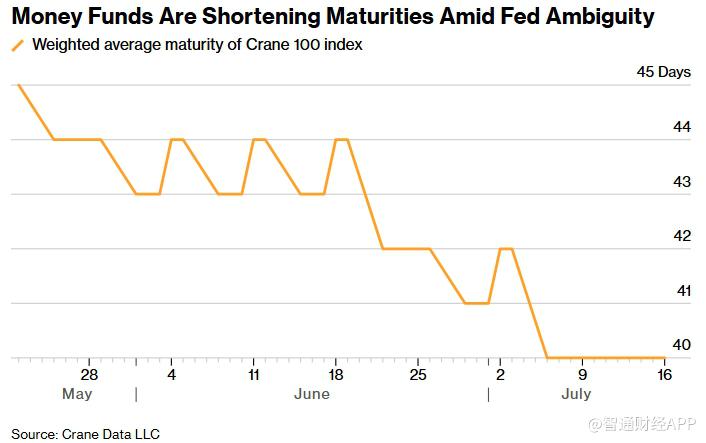
According to Crane Data, the weighted average maturity period for money market fund positions has dropped from 45 days in mid-May to 40 days at present. Fund managers are allocating more capital to overnight repurchase agreements, short-term securities, and variable interest rate US Treasury bonds and institutional bonds. At the same time, the allocation ratio for US treasury bonds has declined, even though the US Treasury continues to expand the scale of short-term treasury bond issuance.
Recently, the rise in international oil prices and the hawkish stance of Federal Reserve Chairman Walsh once made the market bet that the Federal Reserve would raise interest rates this month as soon as possible. However, the two moderate inflation figures released last week have once again confused the policy outlook, prompting investors to readjust interest rate expectations.
In this context, US money market funds that manage assets of more than 8 trillion US dollars prefer to allocate assets that will expire within a few weeks, be renewed on a rolling basis, or where interest rates can be quickly reset, so that when interest rates rise again, funds can be reallocated to higher-yield products in a timely manner.
Deborah Cunningham, chief investment officer of Federated Hermes Global Liquidity Markets, said: “Investors want to keep sufficient 'ammunition' to seize better investment opportunities in the future, so they will appropriately shorten the weighted average maturity period of their portfolios.”
Market sources pointed out that fund managers want to avoid repeating the situation in early 2022. At the time, some institutions held long-term assets, and the Federal Reserve then began one of the fastest interest rate hikes in decades, causing portfolios to bear greater interest rate risk. This experience made managers more cautious when the current policy direction was unclear.
Geoff Gibbs, managing director of DWS Group, said at the Crane Money Market Fund seminar last month that the company has allocated about half of its portfolio to repurchase agreements since this year and is expected to maintain this strategy in the future, especially after the market recapitulates interest rate hikes.
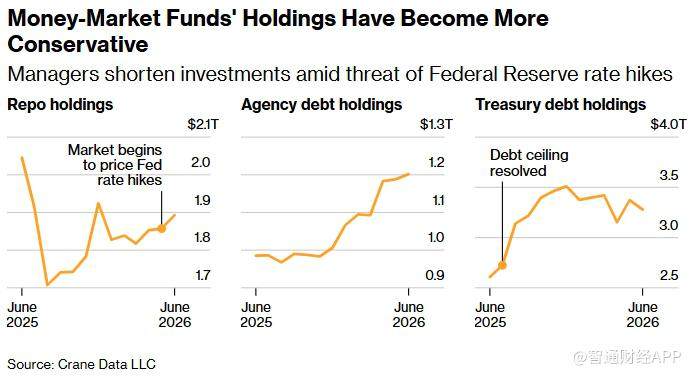
Data shows that in June of this year, the US money market fund's allocation for repurchase agreements increased by about 36 billion US dollars, and the total scale reached about 1.89 trillion US dollars.
At the same time, the fund continues to increase the allocation of floating interest rate bonds. Wells Fargo strategists Angelo Manolatos and Francis Brown pointed out that the floating interest rate bond holdings of US Treasury bonds rose to a record 523 billion US dollars in June, reflecting the desire of fund managers to lock in the higher yield of three-month treasury bills while avoiding lengthening the longevity of their portfolios.
In addition, Federal Home Loan Bank financing data shows that the balance of FHLB bonds has increased by about 180 billion US dollars since this year, of which about 140 billion US dollars are floating interest rate bonds issued. Over the same period, the overall institutional bond holdings of money market funds increased by about US$1950 billion. In contrast, although the US government continues to expand the issuance of short-term treasury bonds, the amount of US treasury notes held by money market funds decreased by nearly 105 billion US dollars last month.
Cunningham anticipates that the average term of money market funds will be further shortened as the Federal Reserve continues to focus on reducing inflation to target levels.
Manolatos, on the other hand, said that there is still a possibility of interest rate hikes in September. In addition, many Federal Reserve officials continue to release hawkish signals, it is expected that money market funds will continue to gradually shorten their holding periods. “For fund managers, unless there is a good reason, they prefer to allocate additional capital to repurchase agreements or variable interest rate bonds rather than bear additional long-term risks.”