


The Zhitong Finance App learned that in the context of the Iran war continuing to disrupt global oil supply, Saudi Arabia has always relied on the Red Sea route as an alternative export channel to the Strait of Hormuz to maintain its crude oil exports. However, the fragility of this circumvention strategy has recently been fully revealed — the Yemeni Houthis, supported by Iran, once again escalated their threat to Red Sea shipping, resumed attacks on ships near the Strait of Mande in early July, and directly announced an immediate maritime blockade against Saudi Arabia on July 20.
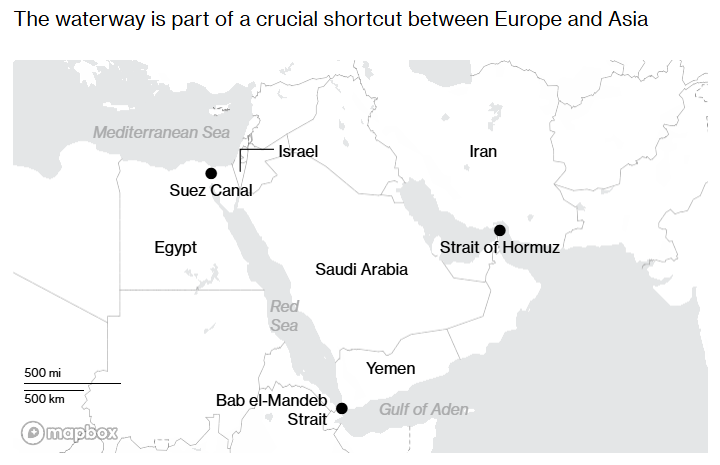
The strategic value of the Red Sea Waterway should not be underestimated
The combined route of the Suez Canal, the Red Sea, and the Strait of Mande is the shortest sea route connecting Eurasia. Before the Houthis attack began in 2023, nearly 10% of the world's shipping trade volume passed through the Mander Strait every year. According to data from the PortWatch platform jointly developed by Clarkson Research and the International Monetary Fund and the University of Oxford, the ratio plummeted to about 3% last year due to multiple waves of attacks. In order to avoid risk, many shipping operators are forced to choose a detour to the southern tip of Africa. This detour not only adds thousands of miles, but also extends a single voyage by up to two weeks. Despite this, the Mander Strait is still an important pipeline for the Middle East, Asia, and Russia to export oil, gas, and other commodities; during the Iran war, as Saudi Arabia increased its use of this waterway to maintain exports, its traffic even rebounded.
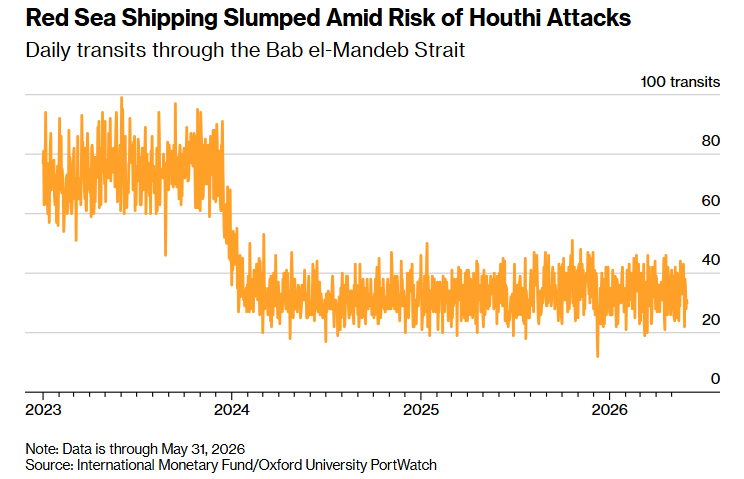
How will a new round of Houthi attacks stir up the oil market?
Should the attack expand, oil exports from the Saudi Red Sea port of Yanbu will be the first to be affected. Saudi Arabia has long used Yanbu as a strategic fulcrum to avoid the risk of potential closure of the Strait of Hormuz, and is transporting more crude oil westward through domestic pipelines. In May, the average daily crude oil shipment volume of Yanbu Port reached 3.65 million barrels, accounting for more than half of the country's total pre-war exports. However, in order to take these goods and ship them to Asian customers, tankers must sail through the narrow waterways of the Mander Strait and cross Yemen's rugged coastline — an excellent cover for the Houthis to launch an attack. Once tankers are unable to pass through this route due to safety risks, oil prices are likely to soar sharply.
Since 2022, the Houthis and Saudi Arabia have basically maintained a fragile truce, halting cross-border attacks and Saudi military operations aimed at driving them out of Sana'a. Recently, however, Saudi warplanes attacked Sana'a International Airport to prevent an Iranian plane carrying a Houthi delegation returning from Tehran to attend the funeral of Iran's Supreme Leader Khamenei — Khamenei was killed in an air strike in the early days of the Iranian war. Afterwards, the Houthis vowed to maintain flights between Sana'a and Tehran and warned that they would disrupt the Saudi airport until their so-called “siege” of Sana'a airport was lifted.