


The Zhitong Finance App learned that Arizona held the 2026 midterm election intra-party primary election on Tuesday local time. This was the only primary election in the US in July and an important weather vane before the November midterm elections. This primary election is not only a head-to-head battle between the Republican Party's establishment and the Trump campaign, but also a critical test of the “electoral integrity” agenda that President Donald Trump continues to push — the “SAVE America Act” — mobilizing at the grassroots level.
Meanwhile, continuing concerns among American voters about the cost of living and the war with Iran are reshaping the political landscape. In Arizona, the “purple state” that supports Trump in 2024 but also has a Democratic governor and multiple Democratic state officials, the double pressure of economic transformation and political polarization is pushing this primary election to the forefront.
Primary Election Overview: Trump's Endorsement Power Faces Comprehensive Test
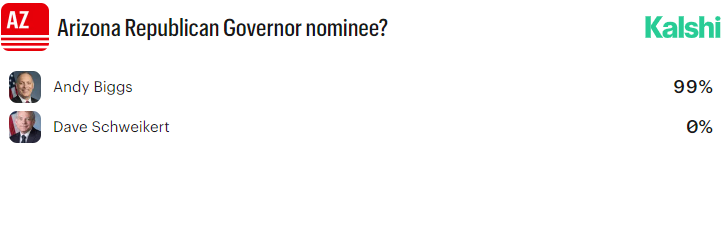
Arizona's primary election covers key state-level positions such as governor, attorney general, and secretary of state, as well as multiple congressional districts. In the Republican presidential primary election, Representative Andy Biggs (Andy Biggs), who was endorsed by Trump, led by an overwhelming margin. Polls showed that his main opponent, David Schweikert (David Schweikert), who is also a member of the House, was 30 to 50 percentage points ahead. Biggs is the former chairman of the House Freedom Caucus. He participated in the removal of former Speaker McCarthy, opposed the government spending bill, and opposed certifying Arizona's 2020 electoral votes.
In the Republican primary election for the Secretary of State, Representative Alexander Kolodin (Alexander Kolodin), who advocated problems in the 2020 election, led the former Arizona Republican Party Chairman Gina Swoboda (Gina Swoboda) by 44% to 20%. Collodine has been sanctioned by the Arizona State Bar Association for filing multiple legal challenges to the 2020 election results. In the Attorney General primary election, State Senate Speaker Warren Petersen (Warren Petersen) played against attorney Rodney Glassman (Rodney Glassman). Peterson handed over the details of the 2020 vote audit of Maricopa County by the state Senate to the FBI in March, triggering strong criticism from the Democratic Party.
Trump's “Election Integrity” Agenda: The SAVE America Act Game
The political context of the primary election was the “SAVE America Act” (the full name of the “Safeguarding American Voter Eligibility Act”), which Trump continues to push. The bill requires voters to show proof of citizenship and photo ID in federal elections, and strictly restricts mail-in voting. The bill was passed by the House of Representatives in April 2025, but has been repeatedly blocked in the Senate. On June 25, the Senate again rejected an attempt to add the bill to the immigration funding package by 48 votes to 50. The Republican Party currently has 53 seats in the Senate, but 60 votes are needed to pass the bill.
In his prime time address to the nation last Thursday, Trump claimed that China had obtained the personal information of hundreds of millions of registered voters, which was “the largest leak in election data history,” and urged Congress to pass the bill on this grounds. However, the remark was met with lukewarm reaction within the Republican Party. Alaska Republican Senator Lisa Murkowski made it clear that the speech “did not change my opinion.” House Speaker Mike Johnson is considering adding the bill to the government funding bill in an attempt to bypass the Senate's 60-vote threshold.
Arizona Secretary of State and Democrat Adrian Fontes (Adrian Fontes) publicly refuted Trump's accusations that “had no factual basis,” saying that his remarks dragged the country into a “illusory situation with no factual basis.” Fontes called on Trump to provide specific evidence: “Those voters who are not eligible to vote, give me their names, and we will remove them from the voter list.”
Economic anxiety dominates voter agendas
Despite Trump's focus on election integrity issues, American voters are still most concerned about the cost of living and the war with Iran. Republican strategist Paul Schumeck put it bluntly: “If candidates don't talk about the economy, affordability, and how to make ordinary people's lives cheaper, they're not talking about voters' concerns.”
About one-third of Arizona's population is of Hispanic origin, and immigration policies have special significance for the state's voters. Polls show that more than half of Spanish-speaking voters still tend to support the Democratic Party (52% vs. 27%), but the approval ratings of both parties are below the 2024 level, reflecting widespread voters' dissatisfaction.
In the gubernatorial campaign, Biggs has begun to shift the tone of the campaign to people's livelihood issues in an attempt to portray himself as a “bridge builder” capable of uniting voters. Republican adviser Chad Haywood said, “Biggs has turned his message and attention to the election.” However, Biggs's political record — including opposition to certification of 2020 electoral votes, support for a federal abortion ban, etc. — could become the target of attacks by the Democratic Party in the November election.
Arizona in economic transformation: the double pressure of data centers and chip factories
Arizona's economic landscape is undergoing profound changes. The construction of data centers and semiconductor factories is reshaping the local economy, while putting new pressure on energy and water supplies. The state is also directly affected by the Trump administration's tightening immigration enforcement policies.
At the federal level, the Trump administration is preparing to approve South32's $2 billion zinc-manganese project in Arizona. The drone company supported by the Trump family also signed an arms purchase agreement with the US Air Force. These policies are not only the Trump administration's economic and political achievements in Arizona, but also reflect the state's strategic position in the national security supply chain.
However, the dividends of economic transformation have not translated into general voter satisfaction. Cook's political report rated current Democratic Governor Katie Hobbs as the “most dangerous” current Democratic governor in the US, but the November election was still rated “biased against the Democratic Party.”
Market impact
Andy Biggs (Andy Biggs) locked in the Republican gubernatorial nomination with a probability of nearly 100%, which fully met market expectations. The primary election results themselves did not cause any significant asset price fluctuations. However, as a key weather vane for the November midterm elections, the real impact of this primary election is to provide important political coordinates for market pricing logic in the coming months.
The Arizona primary election is not only a nomination dispute within the party, but also a practical test of Trump's “election integrity” agenda in key swing states. The significance of the Arizona primary election is not in itself, but rather that it confirms that the midterm elections have entered a central stage of comprehensively influencing the pricing of a broad range of assets.
The current core line of the US financial market can be highly summarized as follows: the November midterm elections completely locked down Trump's administration, creating a double impasse where “no one dares to fight a war, no relaxation.” This pattern directly dominates recent trends in major asset classes such as the US dollar, energy, and US bonds.
Before the midterm elections, in order to prevent oil prices from driving up inflation and impacting voters' vital interests, Trump fell into the dilemma of “wanting to fight, not wanting to stop” in the US-Iran conflict. This means that the tail risk of a sharp rise in oil prices due to the escalation of the situation in the Strait of Hormuz has been partially suppressed — but not eliminated, but rather suppressed by the political constraints of the midterm elections.
If an election denialist candidate wins in November, it may intensify legal disputes surrounding the election process and push up the political risk premium. The Trump administration has asked the Supreme Court to allow states to review voter lists a few days before election day. Voting rights advocates warn that this move could result in eligible voters being denied the right to vote. In this context, in order to avoid economic fluctuations and stabilize voters' confidence, the Trump team will never allow the Federal Reserve to take austerity measures to raise interest rates.
Furthermore, elections may diverge fiscal and regulatory policy paths. The victory of Trump candidates such as Biggs may strengthen the policy direction of tax cuts and deregulation at the federal level, but it may also increase the pressure on the fiscal deficit.
Historical experience shows that US stocks have a higher win rate after the midterm elections are over and the policy path is clear — since 1980, the S&P 500 won 100% within 6 and 12 months after the midterm elections. Gold had a relatively definite allocation value during the midterm elections.