


The Zhitong Finance App learned that on July 22, the China Passenger Transport Association published an article stating that on July 1-19, the national passenger car market retailed 770,000 vehicles, down 16% from the same period last month, down 4% from the same period last month. The cumulative retail sales volume since this year was 9.471 million units, down 20% year on year; from July 1 to 19, passenger car manufacturers sold 747,000 vehicles, down 17% from the same period last month, down 14% from the same period last month. Since this year, 13.293 million vehicles have been sold, down 6% year on year.
New energy: From July 1 to 19, the national passenger car new energy market retailed 485,000 units, down 4% from the same period last month, down 6% from the same period last month. The cumulative retail sales volume of 5.19 million units since this year was 5.19 million units, down 13% year on year; from July 1 to 19, passenger car manufacturers across the country sold 509,000 new energy vehicles, up 5% from the same period last month, and 7.296 million vehicles have been wholesale since this year, up 5% year on year.
Penetration rate: On July 1-19, the penetration rate of NEV retail sales in the national passenger car market was 63%; on July 1-19, the NEV wholesale penetration rate of passenger car manufacturers nationwide was 68.1%.
Production: In the first to three weeks of July, the country produced 250,000 pure fuel light vehicles, down 56% from the same period last year, down 17% from the same period last month; overall hybrid and plug-in hybrid production in the first to three weeks of July was 219,000 units, down 16% from the same period last year, down 1% from the same period last month.
Retail sales trend in the national passenger car market in July 2026
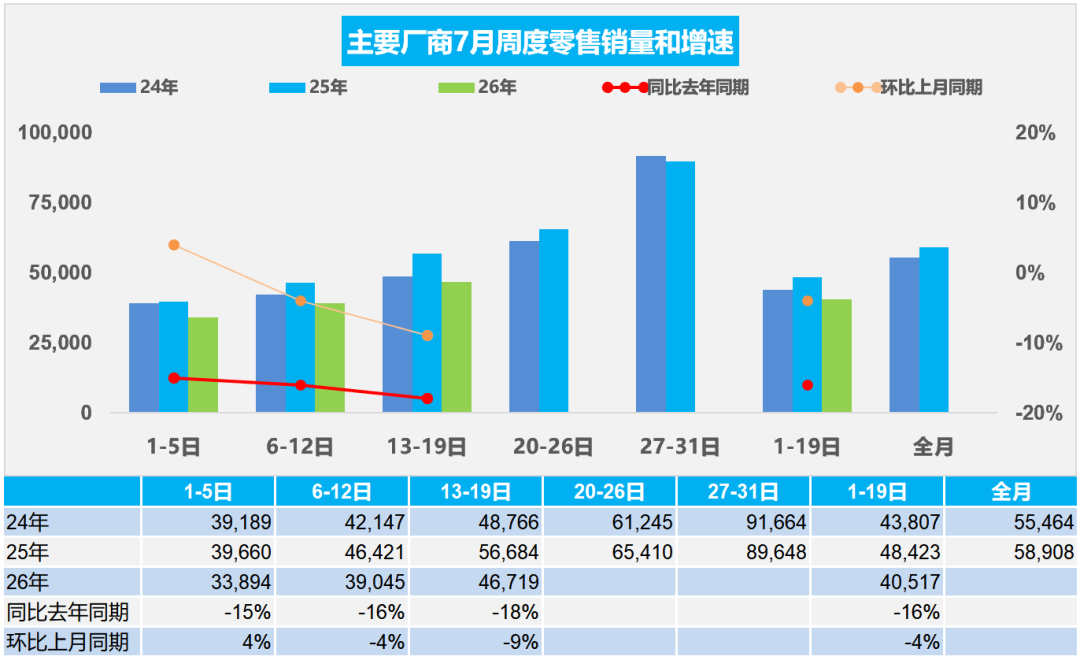
In the first week of July, the national passenger car market sold 34,000 vehicles per day, down 15% from the same period in July last year, and up 4% from the same period last month.
In the second week of July, the national passenger car market sold an average of 39,000 vehicles per day, down 16% from the same period last July and 4% from the same period last month.
In the third week of July, the national passenger car market sold 47,000 vehicles per day, down 18% from the same period in July last year and 9% from the same period last month.
From July 1 to 19, the national passenger car market retailed 770,000 vehicles, down 16% from the same period in July last year, down 4% from the same period last month; since this year, 9.471 million vehicles have been sold, down 20% year on year.
In July, terminal retail was in the traditional low season, and overall consumer demand was weak, which became the core cause of weakening wholesale data. The World Cup, combined with the hot weather in midsummer, led to a sharp drop in offline customer traffic. Naturally, demand for car purchases was sluggish in the market. Consumer wait-and-see sentiment was strong, the household exchange cycle was lengthened, and the release of new cars was insufficient. At the same time, the terminal price war continued to overdraft the market in the first half of the year. Discounts from car companies and dealers were normalized, and the mentality of consumers holding coins to buy intensified, further suppressing the scale of terminal transactions. Affected by weak retail, dealers' inventory turnover efficiency decreased, and inventory pressure continued to accumulate, forcing the channel side to reduce receiving goods from manufacturers, forming a chain transmission effect of “weak retail - weak inventory replenishment - wholesale decline”.
There are highlights of partial structural recovery in the terminal market, which support the basic market market as a whole. Summer graduation car purchases and family self-driving trips drive family cars, SUVs, and new energy vehicles just need to be released slightly to stabilize basic retail sales. Furthermore, the national replacement subsidy policy continues to be implemented, effectively leveraging the replacement demand for old models and providing incremental support for mid-range model retail sales. With product iteration, policy dividends and cost performance advantages, the market resilience of new energy models is significantly superior to fuel vehicles, continuing to hedge against the sharp decline in fuel vehicle retail sales and ease the overall downward pressure on the terminal market.
Wholesale sales trend of national passenger car manufacturers in July 2026
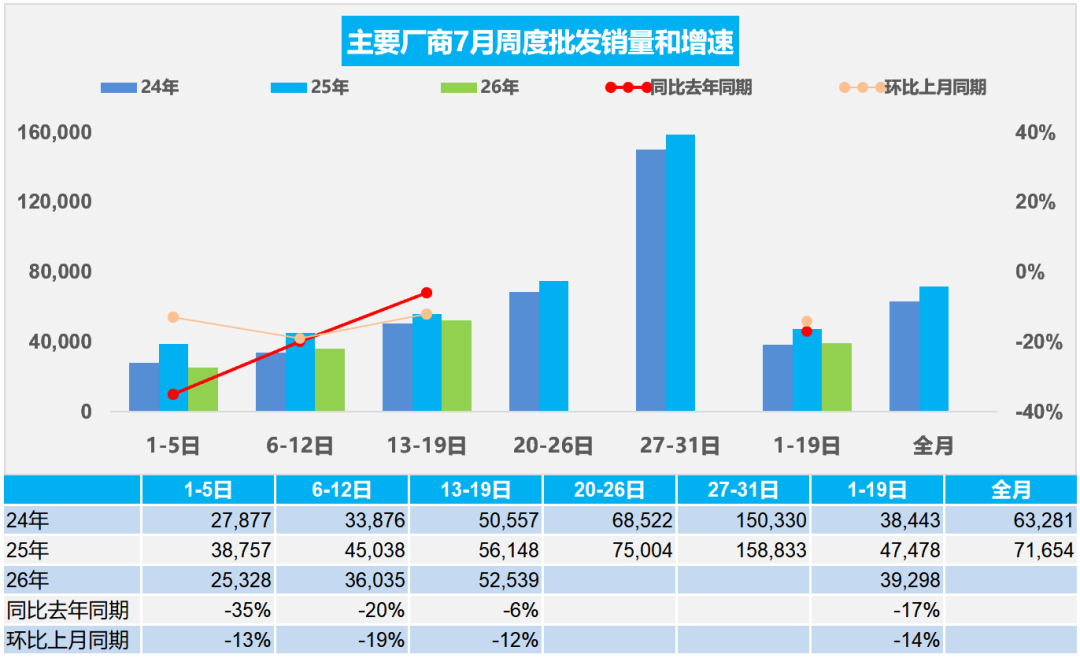
In the first week of July, the national passenger car market sold an average of 25,000 vehicles per day, down 35% from the same period last July and 13% from the same period last month.
In the second week of July, the national passenger car market sold 36,000 vehicles per day, down 20% from the same period in July last year, and down 19% from the same period last month.
In the third week of July, the national passenger car market sold an average of 53,000 vehicles per day, down 6% from the same period last July and 12% from the same period last month.
From July 1 to 19, passenger car manufacturers across the country wholesale 747,000 vehicles, down 17% from the same period in July last year, down 14% from the same period last month; a total of 13.293 million units have been sold since this year, down 6% from the previous year.
The core suppressing factors for manufacturers' sales in July were concentrated on the characteristics of the off-season market. In June, car companies' half-year impulse overdrafted market demand ahead of schedule, compounding the industry's high base for the same period last year, which greatly dragged down the current wholesale data. At the same time, terminal demand is weak, channel inventory is high, dealers' cash flow is under pressure, and the willingness to actively replenish stocks is sluggish, making it more difficult for car companies to store warehouses. Most brands choose to control production and reduce volume, further dragging down batch shipments.
Currently, the wholesale side has structural support factors to hedge against some downward pressure. At the policy level, automobile trade-in and local car purchase subsidies continue to be implemented, combined with the implementation of the new national standard for new energy sources, and centralized distribution of compliant new models to provide structural increases for manufacturers to wholesale. At the production level, there are relatively sufficient working days in July. Some car companies rely on stable production capacity to guarantee the shipment of new products. At the same time, automobile exports continue to be booming, and overseas orders effectively divert surplus domestic production capacity, becoming an important supporting force for the wholesale side. Overall, the benefits are mainly structural hedging, and it is not possible to effectively reverse the overall decline in domestic wholesale volume for the time being.
Ministry of Public Security licensing and driver data analysis for the first half of 2026
According to statistics from the Ministry of Public Security, by the end of June 2026, the number of motor vehicles in the country reached 476 million, including 371 million cars; 567 million motor vehicle drivers, including 533 million car drivers.
In the first half of 2026, 15.81 million new motor vehicles were registered nationwide, a decrease of 6.3%. Among them, 10.51 million new cars were registered, a decrease of 15.9%, and 5.11 million new motorcycles were registered, an increase of 23%.
In the first half of 2026, a total of 18.52 million motor vehicle transfer registration transactions were processed nationwide, a decrease of 6%. Among them, 17.05 million car transfer registrations were processed, a decrease of 7%. The country registered 3.45 million offsite transactions for used passenger cars, an increase of 11.98% over the previous year.
By the end of June 2026, the number of NEVs in the country reached 48.97 million, accounting for 13.19% of the total number of vehicles, an increase of 2.92 percentage points over the same period last year. Among them, the number of pure electric vehicles is 36.75 million, accounting for 68.77% of the total number of new energy vehicles. In the first half of the year, 5.195 million new energy vehicles were registered, accounting for 49.42% of the number of newly registered vehicles, an increase of 4.45 percentage points over the same period last year. According to simple estimates, many new energy vehicles were scrapped. 360,000 vehicles were scrapped in 2025, and 195,000 vehicles were transferred in the first half of 2026.
By the end of June 2026, Chengdu, Chongqing, and Beijing had more than 6 million cars, and Zhengzhou, Suzhou, Shanghai, Xi'an, Hangzhou, and Wuhan had more than 5 million cars. The number of cars owned in Hangzhou surpassed Wuhan this year, and in 2022, Wuhan was the first to break through 4 million. At that time, Hangzhou was not enough. Among the cities that surpassed 5 million this time, Hangzhou performed well.
Vehicle value added 8.7% in June 2026
In 2026, the country will implement more active and promising macroeconomic policies, increase countercyclical and cross-cycle adjustments, continue to expand domestic demand and optimize supply. Overall market demand is rising steadily and achieving a good start.
In the first half of 2026, total retail sales of consumer goods amounted to 248,72.2 billion yuan, an increase of 1.3% over the previous year. Among them, automobile consumption was 1,9688 billion yuan, a year-on-year decrease of 13%; retail sales of consumer goods other than automobiles were 22.903.4 billion yuan, an increase of 2.8%. In June, total retail sales of consumer goods amounted to 4,269.1 billion yuan, an increase of 1.0% over the previous year. Among them, automobile consumption was 379.1 billion yuan, a year-on-year decrease of 16%; retail sales of consumer goods other than automobiles were 3,890 billion yuan, an increase of 3.0%.
In June, the value added of industries above scale actually increased by 5.3% year on year. From January to June, the value added of industries above scale increased by 5.4% year on year. The value added of the automobile industry increased by 7% from January to June '26. Among them, the value added of the automobile industry increased by 8.7% in June, and the automobile industry's production performance was very strong. From January to June 2026, automobile production was 15.1 million units, down 4% year on year; new energy vehicle production was 7.4 million units, up 6% year on year, penetration rate 49%; fuel vehicle production was 7.7 million units, down 12% year on year. In June 2026, 2.82 million vehicles were produced, down 0% year on year; new energy vehicle production was 1.62 million units, up 29% year on year, penetration rate 58%; fuel vehicle production was 1.2 million units, down 24% year on year.
From January to June 2026, fixed asset investment in the automotive industry fell 4.2% year on year, and is still above the 5.7% average of all industries. Recently, investment pressure has been high in the tertiary sector. In particular, investment in public infrastructure, education, culture, and health has declined sharply.
Currently, the external environment is becoming more complex and severe. The situation in the Gulf is complicated, and high oil prices impact the stability of the industrial chain supply chain and consumer demand; the foundation for domestic economic recovery is not stable, prices are high, spending on clothing and food has skyrocketed, problems such as insufficient effective demand, and lack of market vitality, and the task of steady industry growth is still arduous. Since the 2026 trade-in passenger car subsidies were far less strong than commercial vehicles, commercial vehicle subsidies contributed particularly well to the growth of NEV retail sales, and NEV passenger vehicles plummeted. Currently, there is a lot of pressure on passenger car consumption. It is expected that there will be a long-term strong continuation policy in the future, reducing personal taxes for car buyers, promoting new energy vehicles going to the countryside, setting standards for economical electric vehicles, optimizing C7 economy electric vehicle driver license applications, greater tax concessions for compliant pure electric vehicles with a battery life of less than 200 kilometers, and encouraging marriage and childbearing car purchases to boost economic growth.
The national passenger car industry will stock 3.43 million vehicles at the end of June 2026
At the end of June 2026, the national passenger car industry inventories were 3.43 million units, down 50,000 units from the previous month and up 110,000 units from June 2025, forming a trend where inventories continued to flatten. Among them, manufacturers' inventories accounted for 30.2%, which is relatively high.
The Passenger Link Branch predicts that the team's optimism for June 2026 is 31%, and the satisfaction rate after June at the beginning of July is 37%. Expectations are low but satisfaction is poor, mainly because the impact of high oil prices is too big. The team's optimism about the July market fell to 19%. This is a historically low forecast index for judging recent market optimism.
Inventory supports future days based on future N+3 monthly retail forecasts. Future retail changes on a rolling basis, so it is not a fixed monthly data, and the number of inventory days will also change according to forecast adjustments. Based on inventory at the end of June 2026 and a comprehensive estimate of domestic retail sales volume for the next 3 months, the number of future sales days is 62 days. Compared with 54 days in June 2023, 55 days in June 2024, and 63 days in June 2025, the overall inventory pressure in June this year is relatively high.
The total inventory of companies that only produce new energy vehicles remained at 790,000 units in June 2026, the same as the previous month, an increase of 10,000 units from the peak inventory in November 2025, but a decrease of 10,000 units from 800,000 units in June 2025. Recently, the manufacturer and channel inventories of new energy distributors faced lower than expected retail sales in the market, and the overall pressure on industry inventories was high.