


The Zhitong Finance App learned that after the market on July 22 EST, Google's parent company Alphabet (GOOGL.US) announced financial results for the second quarter of 2026. Although the cloud computing business recorded the strongest growth in history, the stock price once fell nearly 5% in after-hours trading due to the company's sharp increase in capital expenditure guidelines for the full year of 2026 to a maximum of 205 billion US dollars, and the first negative free cash flow in a single quarter in history, compounded by continued delays in the flagship AI model Gemini 3.5 Pro.
According to financial reports, Alphabet achieved consolidated revenue of 119.8 billion US dollars in the second quarter, an increase of 24% over the previous year, exceeding market expectations of 116.9 billion US dollars. Total sales after deducting partner shares were $103.6 billion, which was also higher than analysts' expectations of $101.07 billion.
However, the profit side was divided. Affected by a sharp rise in the valuation of its portfolio (including holdings in companies such as Anthropic and SpaceX (SPCX.US)), investment income for the quarter increased by nearly 100 billion US dollars, driving GAAP net profit to soar. The diluted earnings per share reached 9.11 US dollars, far exceeding Wall Street forecasts. However, after excluding non-recurrent items such as investment income, adjusted earnings per share were $2.85, which was slightly lower than market expectations of $2.89. This “mixed” profit performance, compounded by a sharp increase in capital expenditure, made investors uneasy.
Sky-high capital expenditure increased again, and free cash flow turned negative
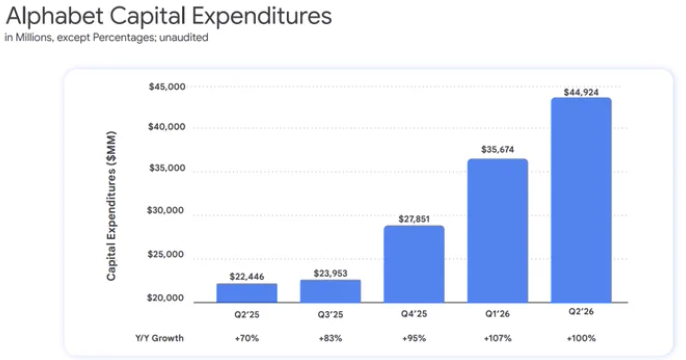
What has affected market nerves the most is the increase in capital expenditure that exceeds expectations. Chief Financial Officer Anat Ashkenazi announced during an analysts' conference call that the company's capital expenditure for the full year of 2026 will reach 1950 billion to 205 billion US dollars, which is a significant increase from the 180 billion to 190 billion US dollars guidance given in the previous quarter, and far exceeds Wall Street's previous forecast of about 186 billion US dollars. At the same time, she reiterated that capital expenditure will increase “significantly” in 2027.
In fact, as early as April of this year, Ashkenazi warned that 2027 spending would “increase significantly” from this year, and the market has already begun to aggressively price this — according to FactSet data, analysts' consensus expectations for capital expenditure in 2027 have risen to about $257 billion. Evercore analysts even gave a forecast of $262 billion in last weekend's report, and jokingly asked if this figure would move towards “300 billion? 350 billion?” At the same time, it is feared that the final expenses may be higher than predicted.
Huge expenses directly erode cash flow. Although operating cash flow of US$39.1 billion was achieved during the quarter, free cash flow was negative US$5.9 billion. This is the first time in Alphabet's history that there has been a negative free cash flow in a single quarter.
Thomas Monteiro, senior analyst at Investing.com, commented: “After a quarter of negative cash flow, Alphabet raised capital expenditure again, which made the market uneasy. The most reliable cash creators on the market are now spending more than they earn. As long as revenue continues to grow at an accelerated pace, investors may be able to tolerate it, but capital has regained its actual cost, and the room for fault tolerance is shrinking every quarter.”
Ashkenazi explained that the company has greatly expanded AI infrastructure capacity in the past three years, but “market demand still exceeds our investment,” and some production capacity is delivered faster than expected, which is also one of the reasons for this spending increase plan. In the second quarter alone, Alphabet's capital expenditure reached 44.92 billion US dollars, slightly exceeding market expectations of 44.15 billion US dollars, of which “the vast majority” was invested in AI technology infrastructure. About 60% of technology infrastructure investments are spent on servers and 40% on data centers and network equipment.
As capacity supply continues to be limited, Ashkenazi also announced a new strategy: “We plan to expand the use of third-party cloud capacity in the third quarter as a transition plan during the internal capacity increase period.” The strategy is based on the existing GPU lease agreement between Alphabet and SpaceX. Currently, the company pays SpaceX 920 million US dollars a month to rent Nvidia (NVDA.US) GPUs to run AI models.
CEO Sundar Pichai added that the company is working to support some hyperscale cloud customers through this special period of demand explosion. “The incremental opportunities they bring are reflected in extremely high short-term costs in just a few months, but judging from the entire transaction life cycle, the return on investment will be very impressive as our own production capacity is launched one after another.” However, Ashkenazi also admits that using external capacity “will put some pressure on profit margins in the short term.”
Cloud Computing: Revenue surged 82%, backlog of orders surpassed the 500 billion mark
Despite this, weak spending guidance overshadowed the company's already solid second-quarter results.
The cloud business became the biggest highlight of this quarter's earnings report. Google Cloud achieved revenue of 24.8 billion US dollars, a year-on-year increase of 82%, far exceeding analysts' expectations of about US$22.46 billion. Cloud operating profit reached $8.8 billion, more than tripling from the same period last year, and operating margin jumped from 20.7% to 35.6%.
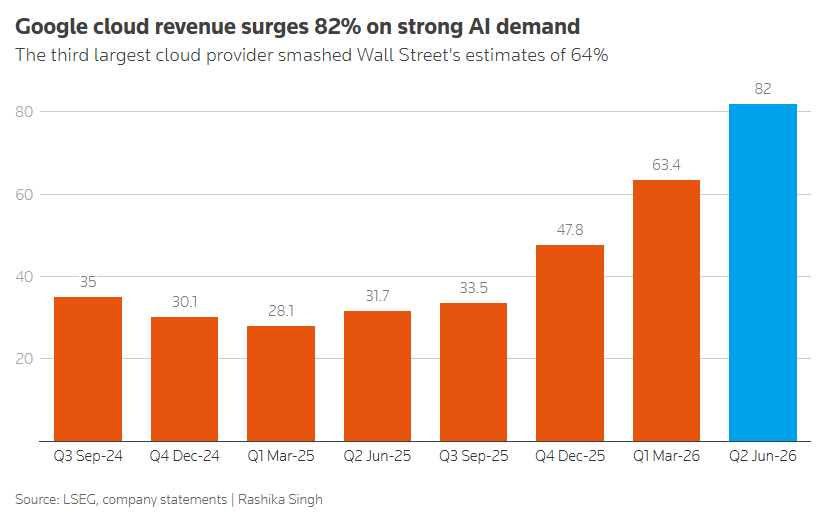
Pichay pointed out that the strong performance of the cloud business “is due to strong demand for AI infrastructure and AI solutions.” GCP core services, AI solutions, and AI infrastructure are all important growth engines. It is worth noting that Alphabet confirmed sales revenue for directly delivering TPU systems to customer data centers for the first time this quarter, although the vast majority of related revenue will not be recorded until next year.
What excites the bulls even more is the cloud backlog order indicator representing future revenue. By the end of the quarter, the total number of orders in the cloud backlog had soared to $514 billion, an increase of more than $50 billion over the previous quarter. The company expects more than 50% of this to be recognized as revenue within the next 24 months. Ashkenazi said this growth was driven by widespread demand for enterprise-grade AI products.
Pichay also revealed that Gemini Enterprise has been adopted by nearly 90% of the Fortune 100 companies; in the past year, nearly 500 cloud customers have each processed more than 1 trillion tokens, and more than 2,000 companies have spent more than 100 billion tokens. In the field of security, 90% of Fortune 100 companies are Google Cloud security users. Nearly 90% of WiZ customers have enabled AI-driven security features, and AI workload protection increased by more than 45% month-on-month.
Advertising and YouTube: World Cup boost, deep AI penetration
Google's services business contributed 95 billion US dollars in revenue for the quarter, up 15% year over year, mainly driven by search. Search and other revenue surpassed $63 billion, with retail and financial industries contributing the most. YouTube ad revenue was $11.1 billion, up 13%, driven by direct responses and brand ads, and significantly benefited from the 2026 FIFA World Cup. Pichay said that more than 1.7 billion independent viewers around the world watched World Cup related content on YouTube, of which more than 550 million people watched it on TV, making this tournament the most watched World Cup in YouTube history.
At the advertising technology level, Chief Commercial Officer Philip Schindler said that the company is fully integrating Gemini into the advertising infrastructure to improve the ability to understand queries, especially making breakthroughs in long-tail searches that were difficult to monetize in the past. The relevant display of shopping ads increased by 20%. Additionally, the AI Max tool has been tested and used by 500,000 advertisers. Combined with AI-driven campaigns such as Performance Max, advertisers have increased search conversion volume or value by an average of 15% under similar return on ad spend.
AI Arms Race: Model Delays Become Worries, Gemini 4 Holds High Hopes
Despite the breakthrough in the cloud business, Google's own large-scale model development faced headwinds. The flagship model Gemini 3.5 Pro, which was originally scheduled to be released in June, continues to push tickets. In the market for AI programming and other tools, Google has clearly lagged behind the enterprise-level upgrade products that Anthropic and OpenAI continue to launch, and the rise of open source models in China has also increased competitive pressure.
Analysts repeatedly questioned the competitiveness of cutting-edge models during conference calls. Pichay admits, “We are still at the cutting edge in some fields, but we acknowledge that there are also areas that need to be improved. Programming and smart coding are just one example.” He immediately changed his focus, revealing that the company has begun training the next generation of stronger models, Gemini 4, and is putting a lot of computing power and energy into it, and is “very confident that it will maintain a leading position in the next generation of models.” In addition, the company is also planning to speed up the pace of model releases, possibly moving towards a monthly update frequency.
At the product level, “main” models such as the newly released Gemini 3.6 Flash and 3.5 Flash-Lite are receiving attention. According to Pichay, more than 9 million developers use Google models every month through APIs and product development. The model API processes about 22 billion tokens per minute, a significant increase over the previous quarter. The Gemini app reached 950 million monthly active users, higher than expected but slightly lower than the peak level of the previous quarter. Daily active users tripled over the same period last year. Since the global expansion last year, AI Mode has surpassed 1 billion monthly active users and is integrated with AI Overviews into a “seamless search experience.”
Other businesses and portfolios: Waymo unveiled a new car, and investment appreciation skyrocketed
The “Other Bets” division achieved revenue of $382 million for the quarter, which was lower than expected. However, there are still highlights of its projects: Waymo has opened the latest model Oasis, equipped with the sixth-generation Waymo Driver; the drone delivery Wing has completed more than 1 million home deliveries and continues to expand with partners such as Walmart (WMT.US) and DoorDash (DASH.US); and the AI drug development company Isomorphic Labs has raised more than 2 billion US dollars to support its drug design engine and candidate pipeline.
Furthermore, the valuation of Alphabet's portfolio surged by nearly 100 billion US dollars this quarter, becoming the main driver of the sharp rise in net profit figures and once again demonstrating the company's broad layout in the field of science and innovation investment.
Despite the impressive performance of the cloud business, surges in capital expenditure and model delays still dominated market sentiment. Alphabet's share price fell more than 4% after the market. The stock has accumulated a cumulative increase of nearly 11% during the year, but since the end of April, due to factors such as Gemini's delayed release, the departure of many executives, and regulatory pressure, the stock has accumulated a correction of about 9%.
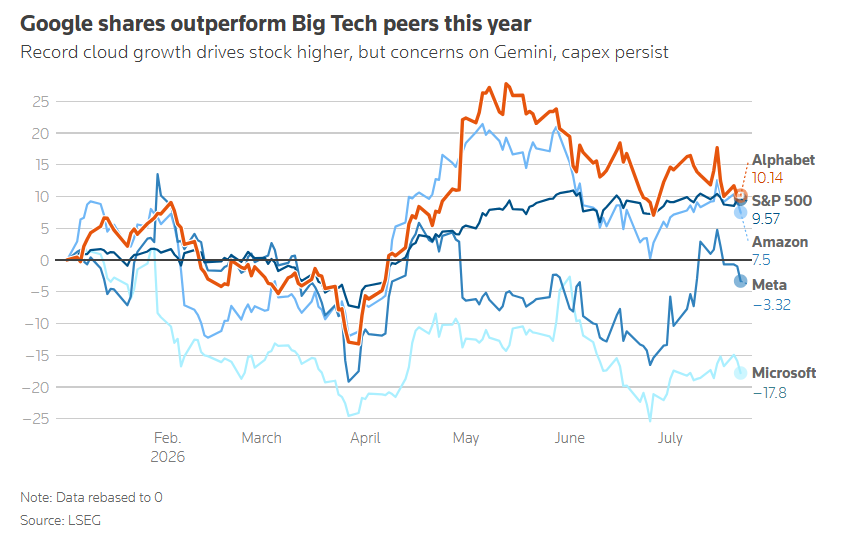
As Microsoft (MSFT.US) and Amazon (AMZN.US) are about to release financial reports next week, Alphabet's model of “exchanging high investment for high growth but under pressure on profit quality” may cast a new question mark on the sustainability of the entire AI infrastructure investment boom.
Investing.com's Monteiro said that the increase in cloud backlog orders is at least a clear sign that “investment is being transformed into rapidly growing, profitable revenue, and contracts can be launched immediately once production capacity is built,” but the market's patience with cash consumption is being tested. “The market's expectations that the company will always be self-sufficient in cash flow may be beginning to falter.”