


The Zhitong Finance App notes that the number of people employed in Australia increased sharply in June, continuing the growth trend of the previous month, highlighting the continued strength of the country's labor market and boosting the market's bets on another rate hike. Data released on Thursday showed that after an upward revision of the number of employed people in May to increase by 44,000, the economy added 76,300 jobs in June, which is more than five times what was expected.
Affected by this, Australian dollar and treasury yields rose higher. The unemployment rate remained at the forecast 4.4%, reflecting an increase in labor participation.
Mary Jo Vergara, a capital markets economist at the Royal Bank of Canada, said, “OMG, this data is so strong. The rising cost of living is clearly pulling people from wait-and-see into the labor market. And for those who are already working, more people are desperate to get more jobs.”
The Reserve Bank of Australia kept the benchmark interest rate at 4.35% last month. Previously, in order to cope with recovering inflationary pressure, the central bank raised borrowing costs at the first three meetings of this year. The central bank does not expect inflation to return to the midpoint of its 2%-3% target range until mid-2028, and a tight labor market is unlikely to help in this effort.
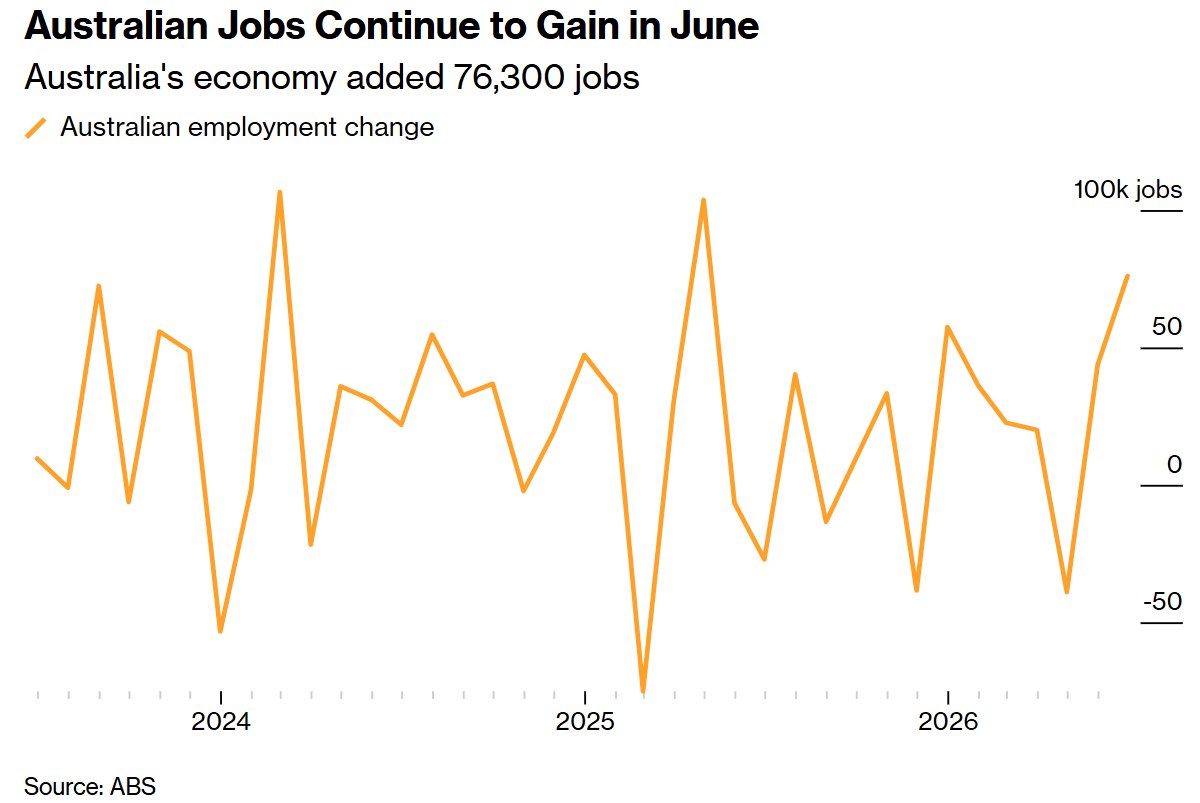
Australia's employment numbers continued to rise in June
RBA Chairman Michelle Bullock said at a June press conference that the central bank is trying to slow economic growth to help lower inflation. However, recent recruitment data suggests that economic activity may be stronger than expected by the central bank.
As traders increased their bets on another rate hike, the Australian dollar rose 0.3%, and the policy-sensitive three-year Treasury yield climbed 5 basis points at one point. Although the money market has fully taken into account the 25 basis point rate hike expectations before December, the market believes that the probability of raising interest rates at the September meeting is about 50%.
The data came at a time when war was reignited in the Middle East and oil prices may rebound sharply as a result, putting more pressure on the economy.
Security Group economist Mai Bui said, “The employment report was slightly better than we expected. We believe they will raise interest rates in August given that inflation is too far from the target range and there are upward risks such as a second round of fuel shocks.”
In addition to another interruption of shipping in the Strait of Hormuz, the attack has spread to the Red Sea, which has become an essential alternative route for crude oil exports, particularly Saudi crude oil exports. Overnight, the Yemeni armed group the Houthis said they attacked two oil tankers in the Red Sea.
In early July, Reserve Bank of Australia Assistant Chairman Sarah Hunt warned that as global turmoil intensifies, there may be more supply-side shocks for some time to come. She said this further reinforces the need to pursue low and stable inflation.
Australian policymakers will keep a close eye on quarterly inflation data before the RBA holds its next policy meeting next week, August 10-11.
Harry Macauley, an economist at the Australian branch of the Oxford Institute of Economics, said, “The still tight labor market provides some room for the Reserve Bank of Australia to act to prevent inflation from continuing longer than expected. Having said that, we insist that interest rates will remain the same for the foreseeable future, and that damaged consumer and business confidence will be an obstacle to suppressing consumption.”