


The Zhitong Finance App learned that Seeking Alpha analyst Daniel Jones warned that a recession in the US economy may be imminent, and urged investors to be cautious in the context of continuing escalating geopolitical conflicts and rising crude oil prices. Despite the overall turbulence in the US stock market, Jones assessed Wednesday's market trend as “concealing a mystery.” Under the impression of calm, economic pressure continues to increase.
Jones said that in the last 30 minutes of trading, the three major US indices fluctuated very little: the Dow Jones Industrial Average remained flat, the S&P 500 index fell slightly by 0.1%, and the Nasdaq Composite Index fell 0.6%.
“The market seems to be straining because the big earnings report is about to be released.” Jones explained that the financial disclosure period is currently at its peak, and corporate performance will help investors understand how the economy is doing.
In particular, he pointed out that the second-quarter earnings report released by electric vehicle giant Tesla (TSLA.US) after the market is an indicator that investors are paying close attention to. According to reports, Tesla's second-quarter revenue exceeded market expectations. Net profit, earnings per share, and gross margin were lower than Wall Street expectations, and free cash flow was negative, reflecting the profit pressure brought about by the company's continued increase in investment in artificial intelligence (AI) and robotics. The stock fell more than 4% after the market.
The analyst said that the escalating geopolitical conflict is a major disadvantage in suppressing the market. Investors had previously anticipated a gradual easing of the US-Iran conflict, but the situation continued to worsen.
The Houthis have deployed missiles and drones to attack ships in parts of the Red Sea. At the same time, the US and Iran have stepped up their mutual attacks, causing WTI crude oil prices to rise 3% in a single day.
“Whatever your opinion on the reasons behind this conflict, it is undeniable that this is a net negative for the economy in the short term.”
The geographical conflict continues to push up international oil prices and increase inflationary pressure, compounded by the continued weakening of the fundamentals of the US domestic economy, and the stagflation dilemma is highlighted. Jones warned, “It is increasingly likely that the Federal Reserve will restart interest rate hikes during the year.”
“I think the US economy may soon fall into recession, so I urge investors to act with caution,” Jones said.
The haze of “unequal heat and cold” interest rate hikes in the US economy quietly envelops the market
According to the data, the annualized growth rate of US real GDP in the first quarter of 2026 was 2.1%, up from 0.5% at the end of 2025, and the unemployment rate remained low. Although traditional macro indicators show a certain degree of resilience, there is a huge temperature difference between enterprises and households. In the first quarter, personal consumption expenditure, which accounts for about 70% of the total US economy, increased by 0.5%, lower than the 1.9% growth rate in the fourth quarter of last year; driven by the artificial intelligence boom, corporate investment increased sharply by 10.6%, higher than the 2.4% growth rate in the fourth quarter of last year.
Although the situation in the Middle East remains volatile, the Polymarket prediction platform shows that traders currently believe that the probability that the US will fall into a “technical recession” by the end of 2026 is only 12%, far lower than the level of earlier this year.
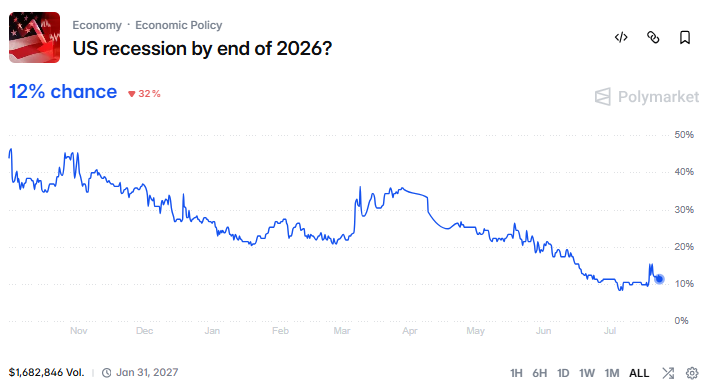
However, with the recent escalation of the US-Iran conflict, international oil prices have risen again, market concerns about rising inflationary pressure have once again heated up, and the haze of the Federal Reserve's interest rate hike quietly envelops the market.
The Federal Reserve will hold its next monetary policy meeting from July 28 to 29. As the meeting approached, there were significant differences in the market over the Federal Reserve's policy direction. This was mainly due to the fact that the new chairman Kevin Walsh abandoned the traditional “forward-looking guidance” strategy, increasing the uncertainty of the policy path.
Traders currently expect that the probability that the Federal Reserve will announce a 25 basis point rate hike on July 29 is about 30%, and the probability of keeping interest rates unchanged is about 70%. This huge divergence of expectations that appeared on the eve of the meeting was seen as the new normal of the Federal Reserve's policy in the Walsh era.
Currently, the interest rate swap market is fully calculated that the Federal Reserve will raise interest rates by 25 basis points in September, and the cumulative rate hike is expected to exceed 50 basis points by March next year, which means that the market still expects two or more interest rate hikes in the future.
Keith Lerner, chief investment officer of Truist Advisory Services, warned that currently “oil prices are driving interest rates upward,” which complicates the Fed's decisions. He believes that although the current rate hike is not a foregone conclusion, the changing direction of related risks is clearly bad for the market.