


The Zhitong Finance App learned that Southwest Airlines (LUV.US) announced financial results for the second quarter of 2026 after the market on Wednesday. Southwest Airlines' adjusted earnings per share (EPS) for the second quarter significantly exceeded Wall Street expectations, benefiting from a historic shift in business model, rising ticket prices, and a strong recovery in corporate travel demand. However, due to sharp fluctuations in aviation fuel prices caused by the escalation of the situation in the US and Iran, the company lowered the lower profit guidance limit for the full year 2026 and gave a third-quarter performance forecast that fell short of market expectations.
Q2 results: Fuel costs soared by nearly $900 million, and profits bucked the trend and increased 9.4%
Southwest Airlines' second-quarter earnings report showed rare resilience. The company recorded a record revenue of US$8.4 billion, up 16.4% year over year, slightly below market expectations; adjusted revenue reached US$8.7 billion, an increase of 20.3%. Net profit increased 9.4% from US$213 million in the same period last year to US$233 million. Adjusted earnings of 94 cents per share far exceeded Wall Street's average estimate of 51 cents.
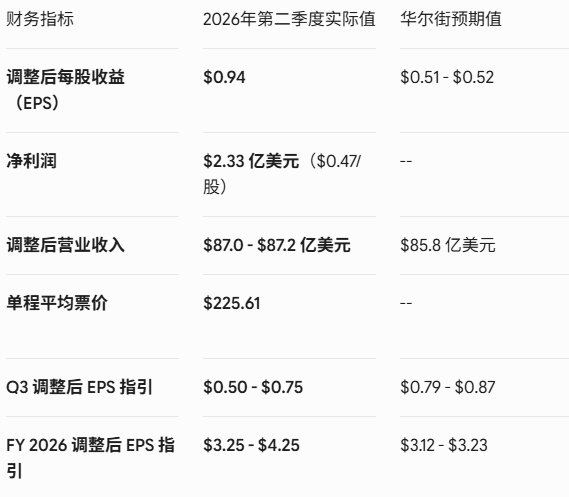
The reverse side of this profit miracle is an astonishing surge in fuel costs. The company's fuel expenditure in the second quarter reached US$2.22 billion, a year-on-year surge of 67%, or about US$889 million. Fuel alone dragged down adjusted earnings per share of approximately $1.17. The actual fuel cost was $3.92 per gallon, lower than the previously estimated range of $4.10 to $4.15.
High ticket prices have become a core weapon to hedge against fuel costs. The average one-way fare for Southwest Airlines rose nearly 21% year over year, from $186.65 to $225.61. With capacity basically flat (only an increase of about 0.5%), adjusted unit revenue soared 20.1% year over year, far exceeding the previous guideline of 16.5% to 18.5%.
Business model revolution: Two years of drastic changes from “free luggage” to “paid upgrades”, and price increases are beneficial
The foundation of this profitable resilience is Southwest Airlines' reshaping of its “soul” over the past two years. In January 2026, Southwest Airlines officially ended the decades-long free seat selection model and switched to a reserved seat system. In May of the same year, the company ended its iconic “free shipping for two pieces of luggage” policy and began charging $35 for the first bag and $45 for the second bag. The company has also introduced basic economy fares, increased legroom options, and tightened rules for using flight points.
CEO Bob Jordan said in an earnings statement: “Our business model now benefits from a broader and more diverse mix of revenue and commercial leverage than at any time in history. The growth momentum of Managed Commerce, Rapid Rewards, and our Chase co-branded credit card, along with continued strong demand for our enhanced products, confirms the solid progress we've seen at Southwest Airlines.”
The results of the transformation are already evident in the data. Business travel revenue grew 30% year over year to a record quarterly high, and loyalty program registrations and credit card acquisitions also saw strong growth. The number of Rapid Rewards members is close to 100 million, and the number of new registrations increased 35% year over year; the number of Chase co-branded credit cards issued increased 28% year over year.
Q3 and full-year guidance: “range thinking” under fluctuating fuel prices
Although Q2 results surpassed expectations, Southwest Airlines' outlook for the second half of the year was clearly cautious. The company expects third-quarter adjusted earnings of 50 to 75 cents per share, far below analysts' expectations of 82 cents. Mainly based on the forward market as of July 17, the company expects the average fuel cost for Q3 to be $3.70 to $3.75 per gallon. The company expects unit revenue to increase by 17.5% to 19.5% year-on-year in the third quarter, and capacity will shrink by 1% or remain flat.
In terms of full-year guidance, the company has greatly broadened the profit forecast range. Adjusted earnings per share for the full year 2026 are expected to be between $3.25 and $4.25, replacing the previous “at least $4” guideline. Although the lower limit of the new guidance has been lowered, it is still higher than analysts' average expectation of $3.17.
The company also lowered its annual capacity growth forecast, from 2% to about 1.5%. This “downsizing and improving quality” strategy comes at a cost in the short term — the company is removing 6 seats from each Boeing 737-700 to add additional legroom seats, which will increase non-fuel unit cost growth by 1.1 percentage points in the third quarter.
Industry perspective: collective pressure under the impact of oil prices
Southwest Airlines is not alone in its plight. After the outbreak of the US-Iran conflict, aviation fuel prices more than doubled. In May, American Airlines fuel bills soared 85% year over year to nearly 6.7 billion US dollars. Prices declined after a brief suspension of fire between the US and Iran in June, but climbed again with the resumption of hostilities in July. For the third quarter, Southwest Airlines expects average fuel costs of $3.70 to $3.75 per gallon based on the July 17 forward market.
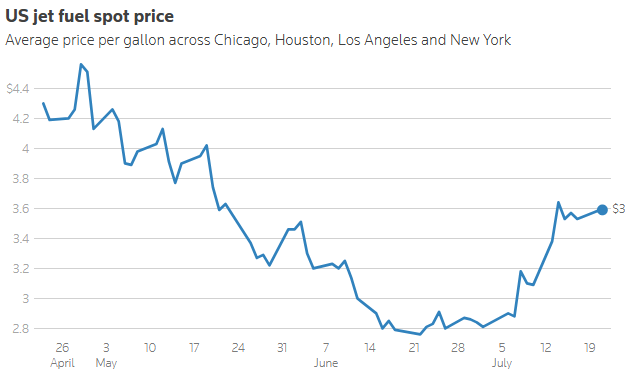
Delta previously predicted that fuel costs in 2026 would increase by 4 billion US dollars compared to 2025. The average fuel price for Delta in the second quarter reached $3.93 per gallon, and United Airlines reached 4.19 US dollars. United Airlines expects fuel costs to increase by $6 billion. American Airlines previously predicted that in 2026 it will spend more than 4 billion US dollars more than 4 billion US dollars due to rising fuel prices, and the adjusted profit range per share for the whole year will be drastically lowered from 1.7 to 2.7 US dollars to a loss of 0.4 US dollars to a profit of 1.1 US dollars.
“Even in a volatile fuel environment, we achieved significant profit growth and margin expansion in the second quarter, and prepared for the rest of 2026,” Jordan said in the earnings report.
How to survive in a macro-storm
Southwest Airlines' Q2 earnings report tells a story about “hedging” — not only about fuel prices, but also about business models. When the traditional “low price, free luggage, open seat selection” model revealed its vulnerability during the geopolitical storm, the company completed a complete self-transformation in two years. Additional baggage fees, seat selection fees, and business-class revenue are becoming a “buffer” against fuel fluctuations.
However, this transformation is far from complete. The lower-than-expected outlook for the third quarter reminds the market that business model transformation can enhance resilience, but it cannot completely free airlines from the fuel cycle. Against the backdrop of the ongoing conflict between the US and Iran and the intensification of oil price fluctuations, whether Southwest Airlines' “price increase revolution” can continue to support profit growth remains the biggest question in the second half of the year.
Unlike Delta and United Airlines, Southwest's weak third-quarter outlook indicates that fuel shocks are more directly eroding its profitability. The capriciousness of the US-Iran conflict is turning the cost of aviation fuel into a Damoclean sword hanging over the industry. For Southwest Airlines, which is undergoing the most aggressive business model transformation in history, revenue growth brought about by the new fee system is racing against geopolitics-driven cost shocks.