


The Zhitong Finance App learned that the Passenger Link branch said that July is the traditional low season for the car market. The half-year impulse overdraft effect in June is showing, and the market will return to being driven by real demand. High temperatures, torrential rains, and floods in many places curbed offline passenger flow and terminal delivery, and consumers are less willing to buy cars. The trade-in policy and the volume of new car deliveries provided bottom support for the market. The car market maintained a low platform operation and showed a seasonal decline. According to preliminary estimates, retail sales of passenger cars in the narrow sense of the term were about 1.52 million units in July, of which retail sales of new energy could reach about 980,000, and the penetration rate is expected to increase to 64.5%.
Market review for June 2026
In June 2026, terminals concentrated their impulse, and the passenger car market rebounded month-on-month. According to data from the Passenger Vehicle Market Information Joint Branch of the China Automobile Dealers Association, retail sales of passenger cars in the narrow sense of the word reached 1.602 million units in June, down 23.2% year on year and 6.1% month on month. Among them, retail sales of 591,000 fuel vehicles, down 38.9% year on year and up 6.3% month on month. The market improved significantly from month to month due to manufacturer impulse and falling oil prices; retail sales of new energy passenger vehicles were 1.007 million units, down 9.4% year on year, up 6.0% month on month. The penetration rate reached 62.9%, and the monthly penetration rate remained high.
Passenger car retail sales in the first half of 2026 were 8.701 million units, down 20.2% year on year. The market is bottoming out after falling back from a high level. Among them, retail sales of new energy passenger vehicles were 4.704 million, a year-on-year decrease of 14.0%, and the penetration rate was 54.1%. New energy steadily maintained its dominant position in the passenger car market. The cumulative sales volume of fuel vehicles in the first half of the year was 3.996 million, down 26.4% year on year. Market share shrank at an accelerated pace. Driven by the “black swan” incident of rising oil prices, the structural reshuffle of the overall car market accelerated.
I. Sales trends of manufacturers
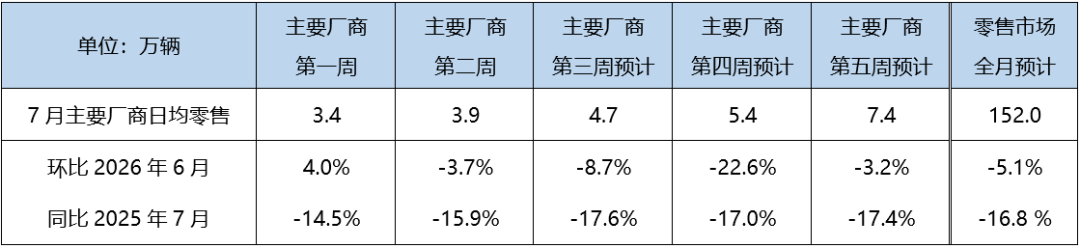
According to the latest research results, retail targets for leading manufacturers, which account for about 70% of total market sales, declined slightly from last month. Various manufacturers have entered the summer recuperation period, and the market pace is relatively stable. Combined with terminal performance estimates, the size of the passenger car retail market in the narrow sense of July was about 1.52 million units, down 5.1% from the previous month. Among them, retail sales of new energy are expected to be around 980,000 vehicles, a slight decrease from month to month. The penetration rate is about 64.5%, and the penetration rate is further increased.
II. Weekly trend estimation
At the end of June, manufacturers hit semi-annual targets, and some demand was released early, creating an overdraft effect. In the first week of July, the market recovered seasonally, with average retail sales of 34,000 units per day; in the second week, due to local extreme weather interference and weak terminal repairs, the average daily retail sales increased slightly to 39,000 units; in the third week, high temperatures curbed travel and car purchase demand, and terminal popularity was poor, with average daily retail sales of 47,000. The trend was slightly weaker than normal seasonality. In the fourth and fifth weeks, the market is expected to continue to operate on a low platform, maintaining a year-on-year decline of around -17%. Retail sales for the full month are expected to reach 1.52 million vehicles, a year-on-year decrease of 16.8%.
The car market declined seasonally in March and July
The core driving force for the phased recovery of the car market in June was not a substantial recovery on the consumer side, but rather driven by promotions and centralized delivery of new cars under the pressure of semi-annual assessments. Entering July, these short-term factors subsided, and the market returned to being driven by real demand.
According to data from the Bureau of Statistics, total retail sales of social consumer goods increased 1.3% year on year in the first half of 2026, and the domestic consumer market is running smoothly, but total retail sales of automobile consumer goods fell 12.6% year on year, which is still a drag on bulk consumption. Consumers' willingness to buy cars continues to weaken, and the mentality of holding coins to buy is strong.
The traditional off-season in July was compounded by extreme weather such as high temperatures and heavy rainfall, further curtailing offline in-store traffic and terminal transactions, and demand for car purchases naturally returned to a slump. Structurally, new energy models have shown superior market resilience compared to fuel vehicles with rapid product iteration and cost performance advantages. The year-on-month decline was less than that of fuel vehicles, continuing to hedge against the shrinking gap in the fuel vehicle market and ease the downward pressure on the terminal market.