


The Zhitong Finance App learned that since July, high-momentum trading in the US stock market has experienced a rapid correction, causing retail investors who have been chasing popular topics for a long time to be hit hard. However, after experiencing a sharp pullback, many Wall Street institutions began recommending that investors adjust to the dips, believing that US high-momentum stocks have gradually shown allocation value.
According to the data, a basket of stocks composed of popular retail stocks such as Robinhood (HOOD.US) and Maywell Technology (MRVL.US) fell by a cumulative total of 13% in July, which is expected to be the worst monthly performance since 2022. Meanwhile, the stock portfolio with the highest retail participation in the Russell 1000 Index compiled by Jefferies has accumulated a cumulative decline of more than 25% since June.
Retail investors have long been passionate about chasing the most popular investment themes in the market. This type of trading strategy known as “YOLO” (You Only Live Once) has experienced clear setbacks in this round of high-momentum stock adjustments.
According to the 11 quantitative investment factors tracked by Bloomberg, up to now, the momentum strategy, that is, buying stocks with the biggest recent gains and shorting the worst performing stocks, has become the worst performing quantitative strategy since July.
Viraj Patel, a global macro strategist at Vanda Research, said that the semiconductor and AI hardware sectors have always been the main driving force for momentum, and are also the core positions in retail portfolios.
Market participants believe that this round of momentum stock pullbacks was mainly affected by a combination of factors. First, the market is beginning to worry that tech giants will continue to increase investment returns on AI capital spending, prompting hedge funds to cut tech stock positions at a record rate. At the same time, the escalation of the situation in the Middle East and market uncertainty about the future interest rate path of the Federal Reserve have further dampened investors' risk appetite for crowded transactions.
As high-momentum trading cooled down, retail investors' overall enthusiasm for trading also declined markedly.
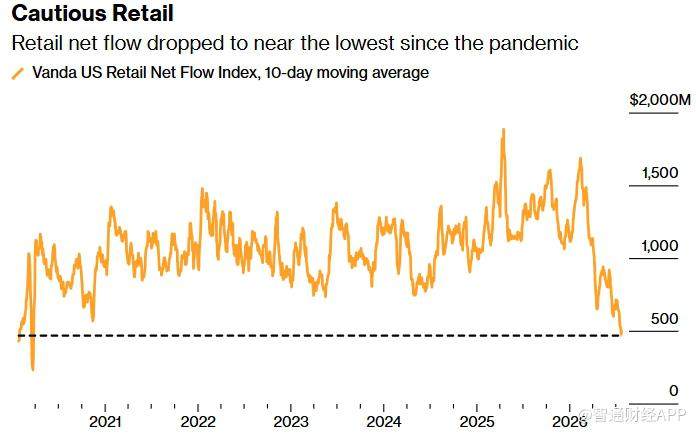
According to data from Vanda Research, the rolling weekly net purchase amount of US retail investors has fallen to its lowest level since the COVID-19 pandemic. According to J.P. Morgan Chase data, the net inflow of retail investors into US stocks was about 5.7 billion US dollars in the week ending this Wednesday, which is lower than the weekly average of 6.8 billion US dollars over the past 12 months.
From an industry perspective, technology ETFs generally experience capital outflows. Among them, Triple Go Long Semiconductor (SOXL.US) and VanEck Semiconductor ETF (SMH.US) became the semiconductor ETF with the most obvious outflow of capital, and the selling pressure of both funds reached about 1.6 standard deviations above the historical average.
J.P. Morgan strategist Arun J.P. J.P. J.P. J.P. J.P. J.P. J.P. J.P. J.P. J.P. J.P. J.P. J.P. J.P. J.P.
However, the data shows that retail investors have not completely withdrawn from the stock market, but have begun to more carefully select investment targets.
According to J.P. Morgan data, Microsoft (MSFT.US) and Nvidia (NVDA.US) continue to receive inflows of retail capital, while Apple (AAPL.US) and Tesla (TSLA.US) have become one of the stocks with the biggest selling pressure from retail investors.
Patel said that compared with last year's “buy as long as it is AI” investment style, retail capital flows are now more scattered, and stock selection is more careful.
Despite the intensification of short-term fluctuations, some Wall Street institutions believe that this round of adjustments has released a large speculative bubble, and high-momentum stocks are becoming attractive again.
UBS Securities strategist Michael Romano said that this round of decline has probably absorbed most of the speculative sentiment previously accumulated in the market and provided a supporting foundation for stock prices.
The Bank of America trading department also advises customers to buy high-momentum US stocks on dips, believing that after previous profit returns, the sector has entered an attractive allocation range.
According to the data, the US high-momentum stock portfolio compiled by Bank of America rose 8.9% for three consecutive trading days as of Thursday, the biggest three-day increase since November 2024; the UBS Momentum Index rose 11% during the same period, recording the biggest three-day increase since 2022, indicating that capital has begun to flow back into the high-momentum sector.
Patel said that high-momentum trading and retail investors have recently experienced a round of “roller coaster” markets, but as selling pressure gradually eases and buying returns, the market is gradually equipped with conditions for a clear rebound.