


The Zhitong Finance App notes that at a time when hyperscale cloud computing vendors are speeding up the deployment of AI, large-scale capital expenditure is squeezing short-term free cash flow (FCF). As an industry trend vane, Microsoft (MSFT.US)'s upcoming financial report on July 29 will be a key point for the market to test “whether AI investments can be efficiently converted into commercial returns.”
The market agreed that Microsoft's revenue for the quarter was about US$87.7 billion to US$87.7 billion, up about 15% year on year, within the range of US$86.7 billion to US$87.8 billion according to the company's own guidelines; the adjusted earnings per share consensus was about US$4.21 to US$4.24, up about 16% year on year.
Analysts generally expect capital expenditure in a single quarter to exceed $40 billion this quarter and drive capital expenditure to about $190 billion in the 2026 calendar year. Some analysts warned that rising memory and component costs, as well as the beginning of depreciation in data centers, are putting a phased squeeze on operating margins. The market is anxious to see huge investments return in the form of sustainable profits and cash flow, rather than just infrastructure expansion.
Following Alphabet's earnings report, the market's sensitivity to the cloud computing giant's capital expenditure increased significantly. Investors are anxious to see standardized spending and clear returns in the AI sector. For Microsoft, whether the huge investment in the previous quarter was successfully exchanged for competitive advantage, business growth, and future return of capital will soon be fully tested by the market.
Azure is a core metric that really matters
Azure is central to evaluating Microsoft's quarterly results. As the core of Microsoft's cloud computing, the platform not only carries traditional data storage and application operation, but has also become a model training and deployment hub in the AI era. In a context where the market is paying close attention to the AI monetization capabilities of tech giants, Azure's performance is a key variable that determines the direction of the stock price.
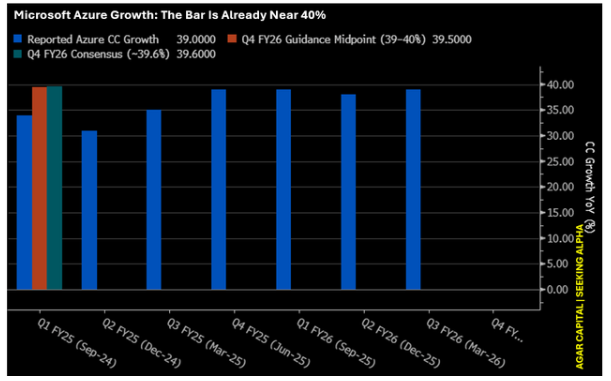
Analysts note that demand for cloud and AI workloads remains extremely strong. However, the problem of limited physical computing power production capacity is expected to continue until the end of 2026. If Azure's growth rate can be maintained at 40% or above, it will strongly confirm that supply is being rapidly digested; conversely, if the growth rate hits the lower limit of the guideline (around 39%), it may raise market concerns that “computing power bottlenecks are dragging down the speed of commercial monetization.”
At a fixed exchange rate, Azure experienced 39% growth in the last fiscal quarter. As market expectations have been raised extremely high, even strong growth of close to 40% may be viewed as a lackluster performance in line with expectations. As a result, the market will focus more on the outlook for the next quarter.
Currently, demand for AI computing power continues to exceed available production capacity, and this limitation is expected to continue until at least the end of 2026. This has formed a clear pattern of short supply, but it also means that Microsoft must invest huge sums of money to build data centers and purchase servers in the current period, while part of the revenue will not be realized in the future. Investors are most concerned about whether these huge infrastructure investments can be quickly absorbed and drive Azure's growth rate to continue to exceed 40%.
Capital expenditure and free cash flow squeeze
As physical capacity limits approach, Microsoft is advancing huge amounts of cash to expand production capacity. Management's previous capital expenditure guidance for a single quarter was over $40 billion, and capital expenditure for the 2026 calendar year is expected to reach around $190 billion. Of this, about two-thirds of the capital was used to purchase short-term computing power equipment such as GPUs and CPUs, and the remaining one-third was used for long-term infrastructure construction such as data centers.
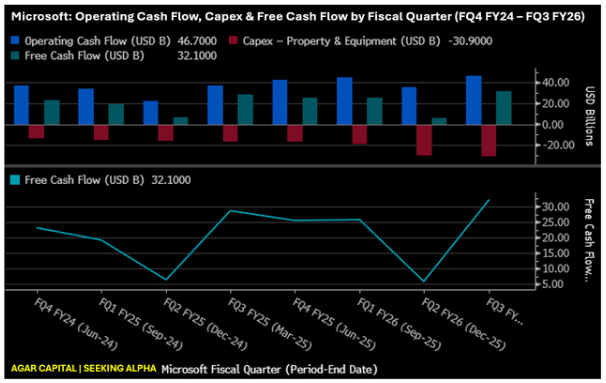
This expenditure structure has a direct impact on the company's cash flow. Unlike data centers that can be amortized over a long period of time, computing power chip technology such as GPUs iterates rapidly, has a high elimination rate, and requires a faster monetization rate. Although Microsoft's operating cash flow and operating income have continued to grow, free cash flow has been under great pressure in the short term due to a sharp rise in capital expenditure.
The phased decline in free cash flow does not directly represent a deterioration in the business model; it is a matter of time difference. However, if subsequent revenue and profit growth rates do not match the expansion of capital expenditure, the return on invested capital will face challenges. Furthermore, part of the increase in capital expenditure is due to rising costs of raw materials and components, which has also raised market concerns that “unit expenditure has not been exchanged for the same increase in computing power.”
Defensive strength against unfulfilled orders and profit statements
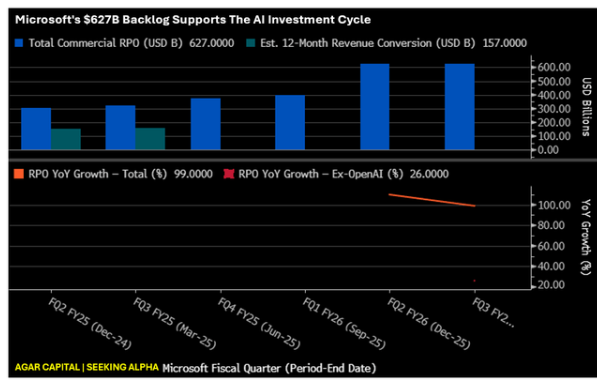
Despite market concerns raised by high capital expenditure, Microsoft still has multiple supporting factors. The first is the $627 billion remaining performance obligation (RPO), of which approximately $157 billion will be converted into revenue over the next 12 months. This shows that Microsoft's huge capital expenditure is not a blind expansion, but rather to meet the needs of huge customers that have signed contracts.
Second, Microsoft's core profitability remains stable, and the operating profit margin remains high at 46.3%. The company expects that the growth rate of revenue and operating profit throughout the year will continue to be faster than the growth rate of operating costs, showing good operating leverage. Although the gross margin of the cloud business has declined slightly due to the increase in AI workloads, Microsoft is reducing computing power costs and improving the efficiency of single-dollar token production by developing its own models, optimizing algorithms, and introducing self-developed hardware (such as the Maia 200 chip). As long as operating profit grows faster than operating expenses, high capital expenditure is only a matter of time difference, not the unhealthy underlying business model.
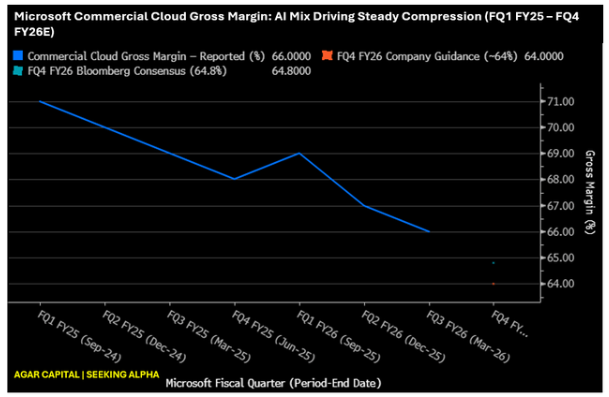
Microsoft Cloud gross margin falls to 66%
In response to the upcoming financial report, the market is mainly focusing on three potential scenarios. Under the optimistic scenario, Azure's growth rate is expected to reach 40% to 41%, and the guidance for the next quarter will be raised to 41% to 42%. At the same time, capital expenditure did not exceed expectations. Cloud gross margin rebounded to more than 65%, and Copilot paid users surpassed 27 million. Under such circumstances, the stock price is expected to rise 8% to 12%.
The benchmark scenario shows that Azure's growth rate is in line with expectations of 39% to 40%, and capital expenditure remains in the range of 40 billion to 44 billion US dollars. Although the performance is steady, due to the lack of a catalyst for revaluation, the market will continue to wait and see expenditure efficiency, and the stock price is expected to rise slightly by 3% to 6%.
If there is a pessimistic scenario, where Azure's growth rate falls below 38%, capital expenditure exceeds US$45 billion, and guidance for the next quarter falls below 40%, it will cause the market to worry about an “imbalance in the input-output ratio”, leading to a sharp decline in valuation.
Wall Street's stance is still a “strong buy”
Wall Street's overall position on Microsoft is still a “strong buy”. Of the more than 60 institutions it tracks, it gives a buy or increase its holdings rating, and only holds or sells individually. The 12-month average target price is concentrated in the range of 545 to 560 US dollars, implying more than 40% upward space compared to the current price of about 380 US dollars.
Specifically, Goldman Sachs maintains a purchase target price of $610, modelling Azure's fixed exchange rate growth rate of 40% — 41%; Morgan Stanley's target price of $600; Deutsche Bank of $550, Truist $575, HSBC $567, FBA $549, Citigroup $570, Wolfe $525, BMO $515, Oppenheimer $515, and Argus $510. Overall, showing the recent characteristics of “reducing the target price but protecting the rating” -- multiple institutions in AI The upward pressure on capital expenditure and memory prices lowered the target, but did not shake the buying position.
The core differences in analysts' opinions focus on the capital expenditure narrative: bulls believe that the 19% to 21% correction in stock prices during the year has overreflected pessimism; Azure continues to grow 40% +; the $627 billion RPO backlog, Copilot uses acceleration to form fundamental support; and the 2027 revenue growth rate of 18% is expected to outperform 16.8%; prudents emphasize that Q4's capital expenditure in a single quarter will exceed US$40 billion, and the 2027 fiscal year may reach 250-270 billion US dollars. Under pressure on free cash flow and cloud gross margin from 67% The trend of slipping to 66% is difficult to reverse in the short term, and the high year-over-year base of OpenAI's contribution to RPO also brings concerns about concentration.