


Recently, two major events have occurred in the global commercial space industry. First, the launch of SPCX told the capital market a grand story of a long-term space AI infrastructure construction foundation. Afterwards, China's Long March 10B carrier rocket was accurately captured by a giant flexible network system of the “Pilot” recycling ship in the scheduled waters of the South China Sea on July 10. This is the first time that China has successfully implemented one-stage controlled recycling of a launch vehicle, and the first time in the world that a launch vehicle offshore network can be recovered.
Together, these two events, “one west, one east,” confirm the booming momentum of global commercial space development. Under this industry trend, commercial space targets with unique competitive advantages have received the focus of market capital. This includes Chengdu Guoxing Aerospace Technology Co., Ltd. (hereinafter referred to as Guoxing Aerospace), which submitted its listing to the Hong Kong Stock Exchange for the third time.
The Zhitong Finance App observed that on May 14, Guoxing Aerospace submitted a listing application to the main board of the Hong Kong Stock Exchange, and Guotai Junan International was the sole sponsor. Notably, the company previously submitted statements to the Hong Kong Stock Exchange on January 27 and August 25, 2025.
As a full chain participant in China's commercial space industry, China Star Aerospace focuses on R&D, manufacturing, sales and operation of low-Earth orbit commercial satellites (especially AI satellites). The company is the launcher of China's first AI application satellite, the first AI intelligent computing satellite, and the world's first AI intelligent computing satellite constellation. It has core advantages in commercial space and AI.
Judging from the performance, Guoxing Aerospace is in a period of rapid growth. According to the prospectus, from 2023 to 2025, Guoxing Aerospace's revenue was 508 million, 553 million, and 703 million yuan respectively. The revenue scale has been rising steadily for three consecutive years, showing strong business growth momentum and continuous customer development capabilities.
If Guoxing Aerospace is successfully listed in Hong Kong this time, it is expected to become the “first space AI stock” in the Hong Kong stock market. The Hong Kong stock market pays high attention to hard technology companies with core technical barriers, and particularly values the closed-loop verification ability of enterprises and a clear path to profit realization; China Star Aerospace is accelerating the transformation of technological achievements to large-scale revenue, and its high growth and scarce track attributes are expected to be fully priced and revalued by the capital market.
The satellite business exploded and increased the quality and efficiency of the satellite-based business
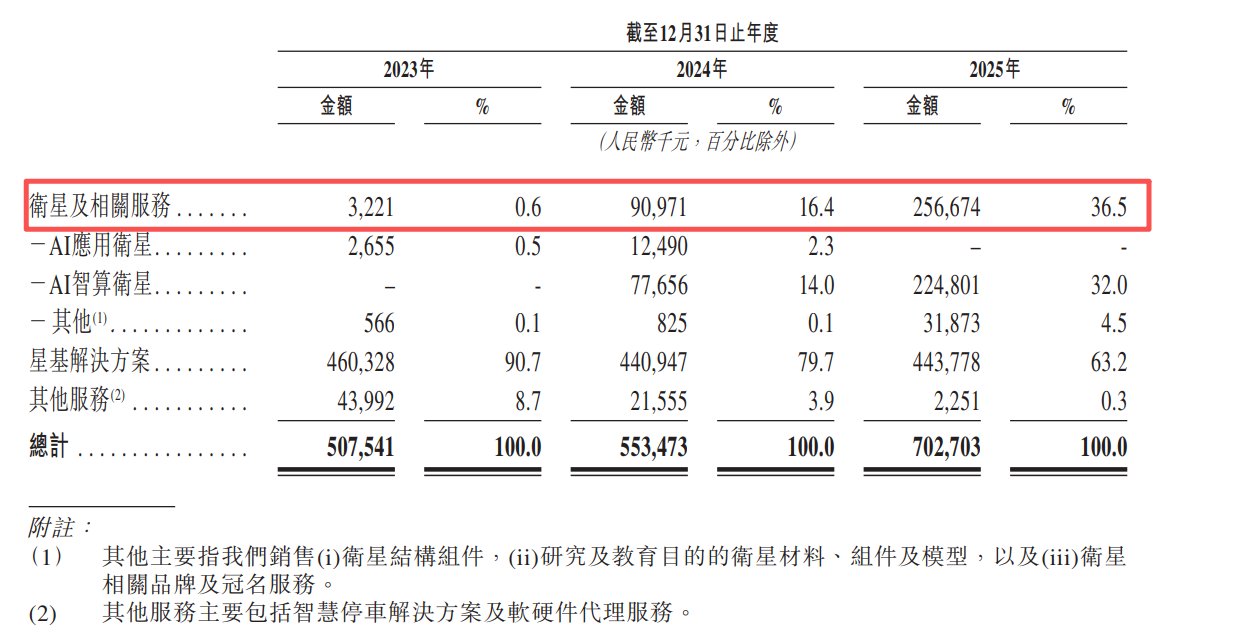
Established in 2018, China Star Aerospace has formed three major business segments after nearly eight years of intensive cultivation, namely satellites and related services, satellite-based solutions, and other services. Among them, satellites and related services refer to end-to-end services that can provide end-to-end services including payload, platform and satellite R&D, manufacturing, assembly and testing, launch coordination, in-orbit delivery, and operation management. In 2025, Guoxing Aerospace's revenue from satellites and related services accounted for 36.5%.
Satellite-based solutions, on the other hand, refer to the use of satellite remote sensing data and advanced AI algorithms through the Spirituality Engine to provide customized application solutions, such as 3D digital modeling of cities. These solutions meet the major needs of industries such as spatial intelligence and computing power services, digital city applications, urban governance, cultural tourism and gaming applications, and support customers to make informed decisions and promote sustainable growth. In 2025, this business accounted for 63.2% of the company's total revenue.
Other services refer to smart parking solutions and software and hardware agency services. However, in order to further focus on its main business, China Star Aerospace stated in its prospectus that the business will cease operations after fulfilling all existing contractual obligations. The business's share of revenue has shrunk to 0.3% in 2025.
There are two main reasons for the rapid growth of the revenue side of Guoxing Aerospace. One is the explosion in the volume of satellites and related services; the second is the high-quality development of satellite-based solutions. Specifically, from 2023 to 2025, Guoxing Aerospace's revenue from satellites and related services was about 3.221,000 yuan, 909.71 million yuan, and 257 million yuan respectively, with a compound annual growth rate of 793.25%.
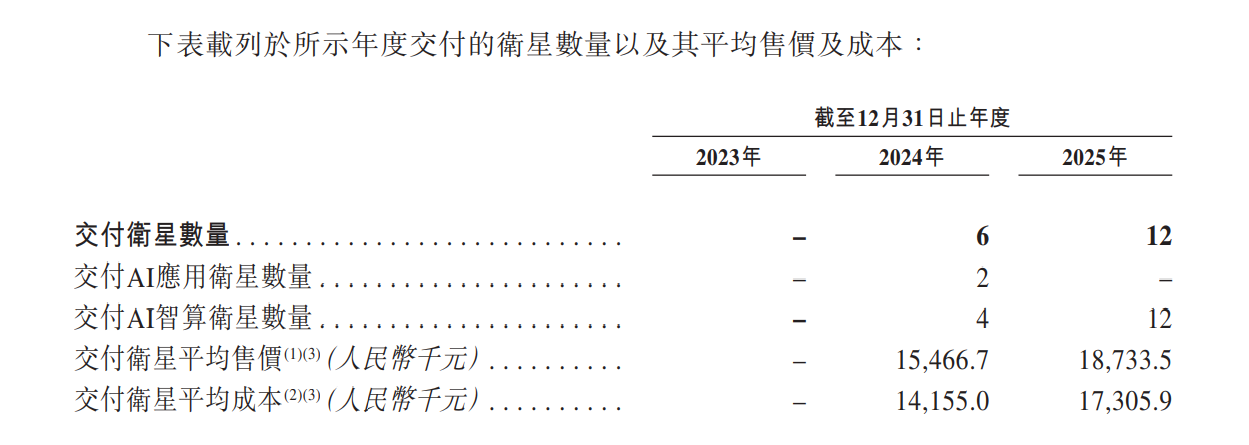
The explosion of satellites and related services is mainly due to a marked increase in the number of satellites delivered by companies. In mid-2023, the number of satellites delivered by Guoxing Aerospace was 0. By 2024, the company had delivered 6 satellites, 2 of which were AI application satellites and 4 were AI intelligent computing satellites. By 2025, the total number of satellites delivered by Guoxing Aerospace has doubled to 12, and all of them are AI intelligent computing satellites.
At a time when satellites and related services are exploding, the high-quality development of Guoxing Aerospace's satellite-based solutions business has also provided effective support for outstanding performance on the revenue side. In recent years, Guoxing Aerospace has actively adjusted its business strategy, focusing its satellite-based solutions on standardized products and services with higher gross margins, and strategically abandoning some low-value projects. Under this active trade-off of “improving quality and reducing volume”, the sector's revenue from 2023 to 2025 stabilized at 460 million, 440 million, and 443 million yuan, showing strong business resilience and quality-oriented development strength.
If rapid revenue growth is a significant “plus” for China Star Aerospace, then the potential for improving profitability also cannot be ignored by investors. Thanks to the increase in the number of satellites delivered, Guoxing Aerospace's gross margins from 2023 to 2025 were -107.1%, 12.4%, and 13.7% respectively, showing a continuous upward trend.
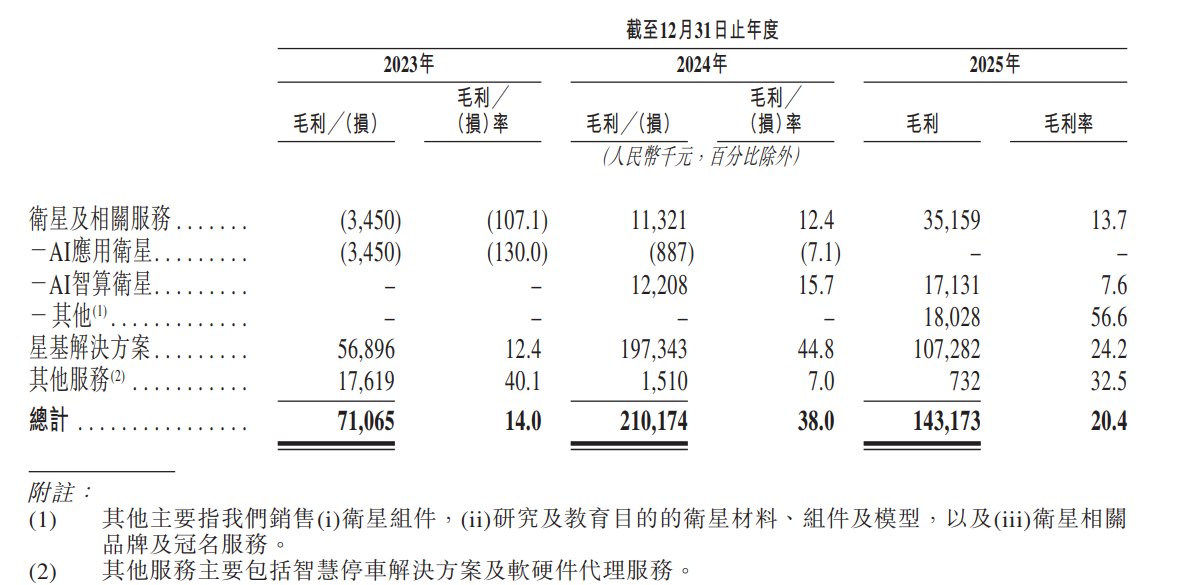
At the same time, driven by the focus on high-value projects, the gross margin of the business increased sharply from 12.4% to 44.8% in 2024, an increase of more than 30 percentage points. This is enough to show that the high-quality development of the satellite-based solutions business clearly boosts profitability. Although the gross margin of this business declined in 2025, this was mainly due to changes in the portfolio of delivered solutions. As high-quality development strategies continue to advance, the business's gross margin is expected to rise again to a higher level.
It can be seen from this that the profitability improvement paths of Guoxing Aerospace's two core businesses are unique and complement each other: satellites and related services have shown typical economies of scale, and gross margin is being steadily repaired and jumped from the initial investment stage to a positive profit range, with scale release leading to a systematic increase in profitability; while the gross margin of satellite-based solutions fully reflects strategic orientation. With the increase in the proportion of high-value standardization projects, the business has shown remarkable profitability elasticity, and product structure optimization is expected to continue to deliver high profit returns.
1.2 billion orders anchor the certainty of performance growth, and the 100 Star launch plan outlines a blueprint for growth
The rapid growth of Guoxing Aerospace is rooted in the booming wave of China's commercial space industry. According to Frost & Sullivan data, China's commercial aerospace output value has increased from about 1.3 trillion yuan in 2021 to 2.8 trillion yuan in 2025, with a compound annual growth rate of 21.1%.
However, under the dual catalyst of technological breakthroughs and policy upgrades, this industry is entering a higher growth channel. At the technical level, on July 10, 2026, Long March 10B successfully flew for the first time in Hainan. The first-level “Pilot” platform captured vertical recycling through the world's first network system, setting a double record for China's first single-level controlled recycling and the world's first marine network recycling. The reusable rocket “orbit+recycling” ran through a closed loop, and the inflection point of industrial technology has arrived.
At the policy level, the 2025 “Report on the Work of the Government” positions commercial aerospace as a strategic emerging industry, proposes “carrying out large-scale application demonstration actions for new technologies and new products and new scenarios to promote the safe and healthy development of emerging industries such as commercial aerospace and low-altitude economy”, and supports the initial shift from “active cultivation” to “active promotion”, focusing on technology implementation and industrial ecosystem construction.
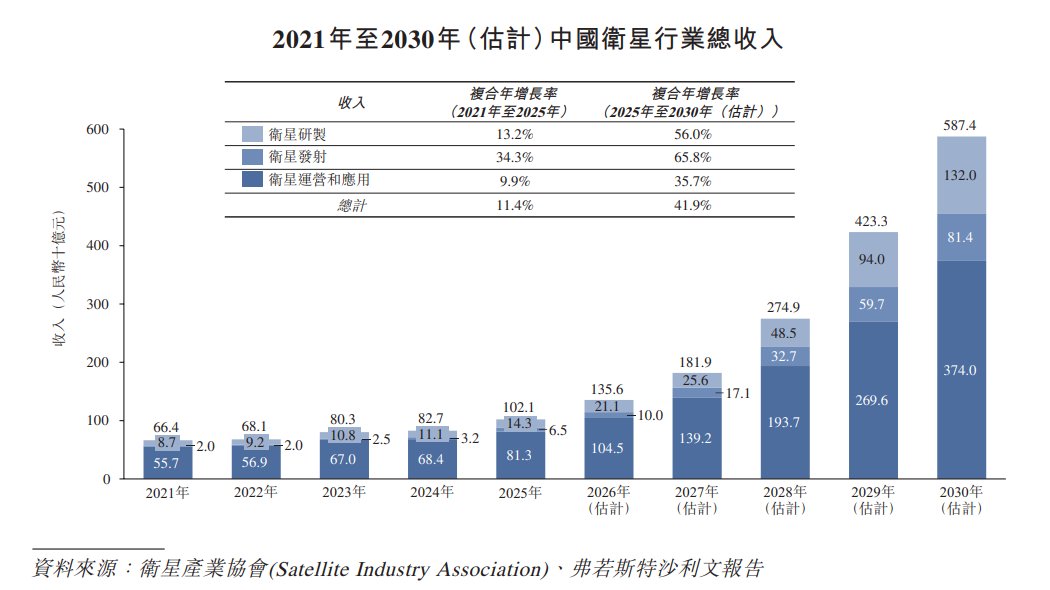
Under the resonance of technological inflection points and policy dividends, the satellite industry, as the core carrier of commercial aerospace, is experiencing explosive growth. According to forecasts from authorities, the total revenue of China's satellite industry will surge from 102.1 billion yuan in 2025 to 587.4 billion yuan in 2030, with a compound annual growth rate of 41.9%.
Judging from the segmented circuit, the three core links in the industrial chain are all in a period of rapid release. Among them, satellite development and satellite launch were due to technological breakthroughs and cost reductions, with growth rates of 56% and 65.8% respectively, leading the entire chain; the growth rate of satellite operation and application was also as high as 35.7% during the same period.
As a full chain participant, China Star Aerospace is already in the first tier of commercialization, and it is expected that it will continue to reap the industry's beta dividends. According to Frost & Sullivan data, according to 2024 revenue, the company ranked 8th (2% share) among the top ten private commercial space enterprises in China engaged in satellite-related business; if we focus on the top five private enterprise dimensions of “managing the complete satellite industry value chain,” the company ranked second, with a market share of 22.1% — the scarcity of the company's full chain layout is clearly highlighted.
However, the abundant contract value is not only an intuitive reflection of Guoxing Aerospace's core competitive advantage, but also a strong guarantee for the reliable growth of its future performance. As of May 4, 2026, China Star Aerospace has 37 AI satellite customer orders to be delivered, with a total contract value of about 1,231 million yuan, and a total of 103.6 billion yuan in satellite-based solution projects. As a comparison, China Star Aerospace delivered 12 satellites in 2025, while the 37 AI satellites to be delivered have laid a certain foundation for the steady development of the company's satellites and related services within the next year or two.
If you look at it from a longer-term perspective, China Star Aerospace's launch plan has outlined a more ambitious growth blueprint for the capital market. China Star Aerospace said that the company has obtained approval from the ITU for 3,156 satellites. The company plans to launch the first batch of 100 satellites under the Star Computing Program within 2028, and successfully launched 12 satellites on May 14, 2025.
Obviously, between 2026 and 2028, China Star Aerospace will launch the remaining 88 satellites. Meanwhile, in March 2026, China Star Aerospace signed an agreement with a launch service provider to launch 8 AI intelligent computing satellites in 2026.
Predictably, with the continuous launch of satellite orders awaiting delivery, Guoxing Aerospace's satellite and related service business is expected to usher in a “double whammy” of revenue growth and increased gross margin, and the business is expected to continue to play a role as a growth engine to drive the company's total revenue growth.
Taken together, China Star Aerospace's IPO is expected to be favored by capital in the capital market due to rapid revenue growth and the high certainty of future performance growth in large contract values. Also, it is worth noting that Guoxing Aerospace completed the pre-IPO round of financing in April 2026, with a post-investment valuation of about 11.554 billion yuan. If China Star Aerospace completes the launch plan for 100 satellites by 2028, it may have the potential to bring several times more returns to investors in the long term.