


The Zhitong Finance App learned that on Wednesday morning Beijing time, SK Hynix (SKHY.US) announced the results for the second quarter of 2026. According to financial reports, the company's Q2 revenue reached a record 79.32 trillion won ($54.55 billion), up 51% month-on-month and 257% year-on-year, falling short of market expectations of 84 trillion won; operating profit also reached a record 60.54 trillion won, up 61% month-on-month, surging 557% year over year, still falling short of market expectations of 64 trillion won.
Thanks to a one-time return on investment, SK Hynix's Q2 net profit soared 1242% year over year to 93.92 trillion won.
It is worth noting that SK Hynix's operating profit margin reached 76% in the second quarter, up from 72% in the first quarter.
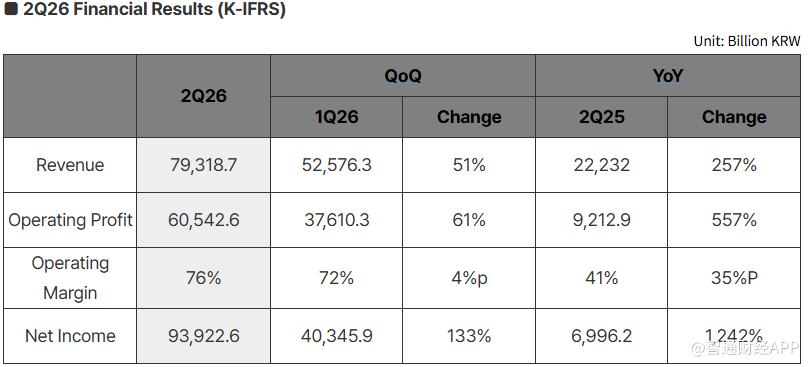
SK Hynix said in its financial report that demand for AI continued to be strong, and sales of high value-added products drove quarterly results to record highs; cumulative revenue in the first half of the year exceeded 100 trillion won for the first time.
After the financial report was announced, SK Hynix's US stock fell 5% after the market, then recovered and bucked the trend and turned 1.7% higher.
SK Hynix's annual expenses point to 40 trillion won in storage competition to expand production heightens concerns about oversupply
SK Hynix revealed on Wednesday that this year's capital expenditure is expected to reach a high level of 40 trillion won (about 27.5 billion US dollars), which will intensify its competition with Samsung Electronics for the dividends of the AI investment boom.
SK Hynix surpassed Samsung and took a leading position on the hot AI high-bandwidth memory chip circuit. But since June, its market value has evaporated by more than $500 billion, as investors have begun to question whether the industry's high spending can support such a high valuation. Investors are also worried about the rising debt levels of technology companies. The growing leverage ratio of companies such as SK Hynix has increased the volatility of the Korean stock market. In about a month, the company's market value evaporated by about 45%.
Josh Gilbert, chief analyst at eToro Asia Pacific and Middle East, said, “As Nvidia's main supplier of high-bandwidth memory chips, the boom in AI will directly affect SK Hynix's profits. This means the market is unlikely to focus only on superficial data. The more important question is whether profit margins and performance guidance can support its recent stock price performance.”
Investors are worried that soaring chip costs may trigger a wider economic slowdown: the price of electronic products will rise, forcing terminal manufacturers such as computers and smartphones to cut production. A number of brokerage firms, including Mirae Asset Securities, have lowered SK Hynix's profit expectations for the second quarter in recent weeks due to a slowdown in the average price increase of chips.
Memory chip manufacturers countered that demand for chips will still exceed supply in the long run. The manufacturer said that downstream customers such as cloud service providers continue to increase memory chip purchase orders, boosting shipment volume and profit margins simultaneously. Guo Luzheng, CEO of SK Hynix, said earlier this month that the serious shortage of memory chips currently plaguing computer, car and equipment manufacturers may continue beyond 2030.
SK Hynix, along with Samsung and Micron, are leading the global memory supply. In recent years, these three companies have continued to shift their production focus to high-bandwidth memory for Nvidia's AI accelerators, leading to a tightening of traditional memory supply.
SK Hynix said on Wednesday that it has signed multi-year contracts with around 10 customers. Last week, SK Group and Nvidia signed a cooperation agreement. The two sides said the total value of the transactions covered by the agreement may exceed 500 billion US dollars.
Nvidia CEO Hwang In-hoon said that this figure includes Nvidia's expenses to buy memory chips and supercomputers. He said, “The total amount of future cooperative transactions between the two sides will reach 500 billion US dollars.”
SK Hynix is one of the key suppliers of HBM4. HBM4 is currently the most advanced high-bandwidth memory and a key component of Nvidia's new Vera Rubin AI chip. SK Hynix said last month that it had delivered samples of the next generation HBM4E to major customers, and a month earlier, Samsung announced that it would seize the opportunity in a competitive market.
SK Hynix said on Wednesday that batch shipments of HBM4 began in the second quarter and will gradually increase production in the second half of the year.