


The Zhitong Finance App learned that TD Securities said that if the Federal Reserve keeps interest rates unchanged this week, the US dollar will weaken. The agency's strategist Howard Doe said that the exact decline in the US dollar will depend on whether the Fed's policymakers all support the position of Federal Reserve Chairman Kevin Walsh. He believes that the market is mispricing the risk of the Fed's interest rate hike, and said, “If the Federal Reserve decides to keep interest rates unchanged and there are no more than two objections, the dollar should fall in the short term as the incident risk premium subsides.”
The US dollar index has risen nearly 3% since the end of February, driven by expectations of the Federal Reserve's interest rate hike and safe-haven demand caused by the Middle East conflict. According to a recent report from the US Commodity Futures Trading Commission (CFTC), speculative foreign exchange traders, including asset managers and non-commercial traders, have recently increased their positions betting on the rise of the US dollar. Currently, their bullishness about the US dollar has reached its highest level since 2015. In response, Du said, “The current dollar long position already includes part of the market's risk premium on the possible hawkish results of the July interest rate meeting.”
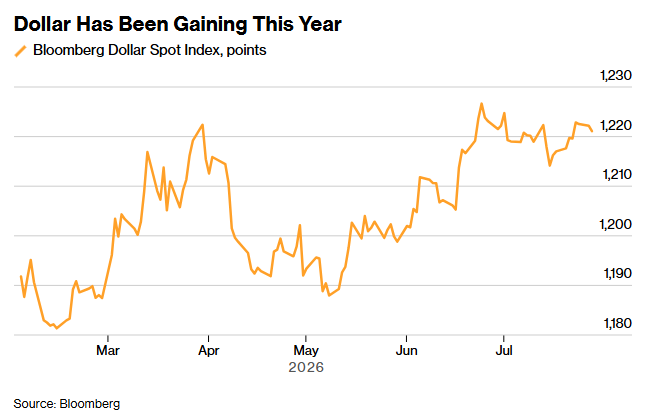
Du added that if there were no objections to the Federal Reserve's July interest rate decision, “this will surprise the market and indicate that Walsh may have successfully promoted a certain degree of consensus, which should lead to a relatively larger short-term sell-off in the US dollar.” TD Securities expects the dollar index to fall 0.5% if the Fed's policymakers agree at this interest rate meeting.
Although “hawkish momentum is growing,” TD Securities strategists expect that there may be two objections at the Federal Reserve meeting on Wednesday, from Cleveland Federal Reserve Chairman Beth Hammark and Dallas Federal Reserve Chairman Lori Logan, respectively. Under these circumstances, the agency expects the dollar index to fall by 0.3%.
The strategist said in the report: “The tense situation in the Middle East has driven up oil prices, increased the risk of inflation, and strengthened the reasons to support interest rate hikes. But we think more evidence is needed to win the support of most policy makers.”
Walsh will announce his second interest rate decision since taking office at 2 a.m. Beijing time on Thursday. Global capital markets are gazing at an unprecedented suspense with bated breath. Just a month ago, the market was almost certain that the Federal Reserve would stand still in July. Now, the CME “Federal Reserve Watch” tool shows that the probability that the Fed will raise interest rates by 25 basis points this week has soared from 13% a week ago to over 30%.
The cooling of the US CPI data for June once convinced the market that the Federal Reserve could continue to stand still. However, as the situation in the Middle East escalated again and oil prices rose again, the cumulative increase in Brent crude oil since the June Federal Reserve meeting has reached 25%. The rise in oil prices quickly spread to gasoline and diesel prices, putting pressure on both consumers and US industry costs. Meanwhile, the Trump administration announced new tariffs of 10% to 12.5% on 60 countries on July 24, as an alternative to the Supreme Court's previous rejection of the “Liberation Day” tariffs. Furthermore, investment in artificial intelligence (AI) continues to be strong, driving related demand growth. The combination of three factors reversed the market's judgment on cooling inflation.
Citi said bluntly that this was “the moment of greatest disagreement since September 2024.” The data shows that after reaching 909,714 open positions on Friday, the number surged further to 967,136 on Monday, setting a new historical record. In the past, when it was time before the meeting, the market's expectations for policy results were usually highly consistent, but this time it was completely different.
The biggest variable in this meeting came from Walsh himself. Since taking office on May 22, Walsh has completely disrupted the Federal Reserve's communication paradigm. He clearly promised to abandon “forward-looking guidance” — that is, no longer hint to the market about interest rate paths ahead of time. At a congressional hearing on July 15, he declined to provide any specific insight into interest rate trends over the next few months.
The consequences of Walsh's approach are showing — the market has lost the “policy compass” it has become accustomed to for the past decade or so. Goldman Sachs pointed out that investors believe that there is “unusually great uncertainty” about the results of the July interest rate meeting. The reason is that opinions within the Federal Reserve are divided, and Walsh's own position is still unclear.
However, some analysts suggest that Walsh himself may not support the current rate hike. In his congressional testimony on July 15, he described the energy price shock as “a specific shock at a specific price that we cannot control.” Furthermore, in June, CPI declined for the first time in six years, and employment growth slowed, providing a reason to stay on hold. According to the agency's survey of 76 economists, all respondents expected the Federal Reserve to keep interest rates unchanged.
For Walsh, the test he faces is that he has pledged “zero tolerance” for inflation in Congress but has been slow to reveal the exact path. As BlackRock previously pointed out, Walsh “realizes that credit is still the central bank's most powerful policy tool,” but “ultimately, these words need to be supported by action.”