


Marriott International stock has delivered a strong 5 year run, yet current valuation checks suggest the shares are trading at a premium to an intrinsic value estimate and to market based multiples.
- Marriott International has returned 179.9% over the past 5 years, which puts extra attention on whether the current share price still reflects a reasonable pay off for that performance.
- Recent expansion moves into all inclusive resorts and branded apartments may support long term cash flow expectations, while the timing and execution of these projects could introduce risk if returns do not match investor hopes.
- On Simply Wall St's broader checks, Marriott International is flagged as expensive rather than a clear bargain, with the stock screening as undervalued in 0 of 6 valuation tests.
The issue now is whether Marriott International's current price leaves enough room for investors to be comfortable with the growth that is already implied in the valuation.
Does Marriott International Look Pricey on Cash Flow?
The Discounted Cash Flow (DCF) model estimates what Marriott International might be worth based on projected future cash that the business could return to shareholders. For Marriott International, the model uses latest twelve month free cash flow of about $2.6b in $ and assumes these cash flows keep growing rather than shrinking.
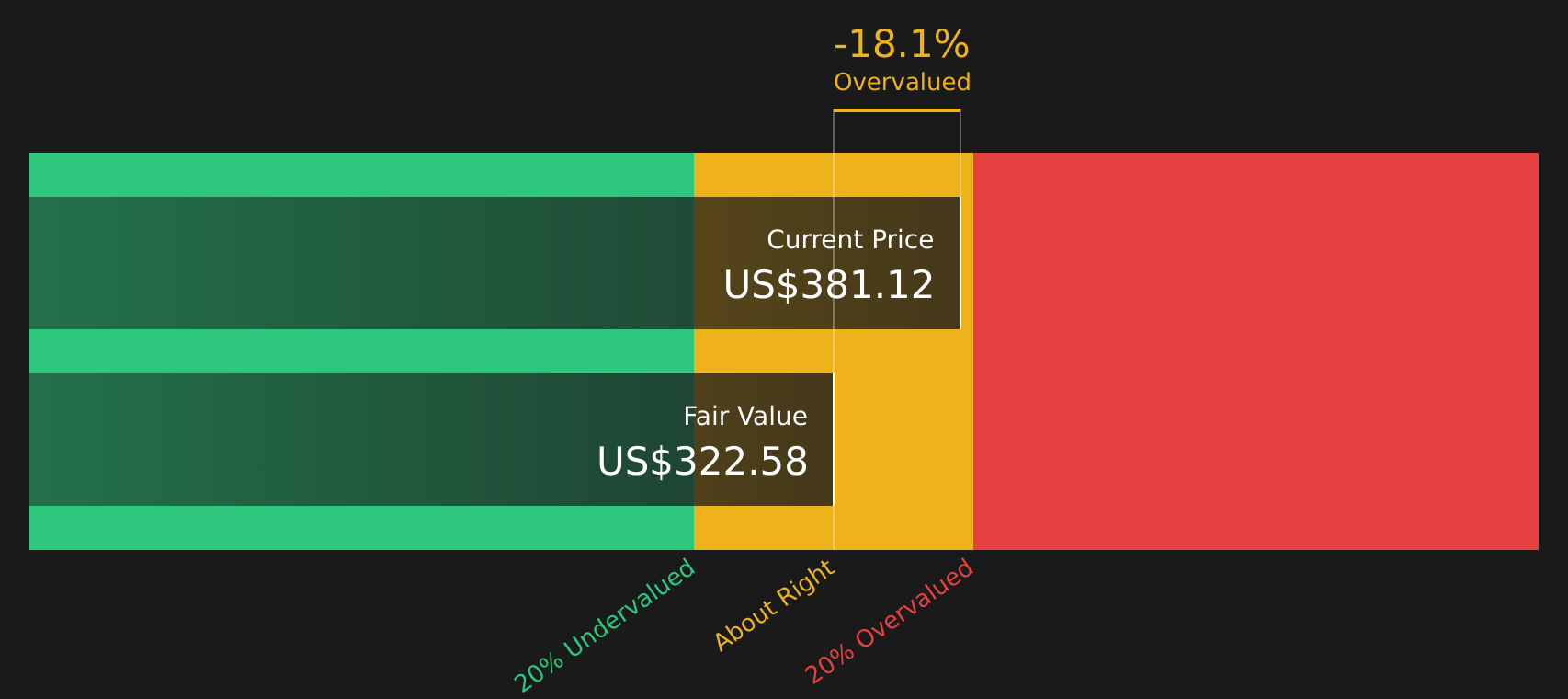
On that basis, the DCF model points to an intrinsic value of about $325 per share. Compared with the current share price, this implies the stock appears around 18.1% above this estimate of intrinsic value on a pure cash flow view. Marriott’s push into all inclusive resorts and branded apartments, including new projects in Jamaica, Tanzania and Cleveland, may help explain why the market is willing to pay a premium to the cash flows that are currently modeled.
Overall, the DCF workup suggests Marriott International currently trades above its estimated intrinsic value.
Our Discounted Cash Flow (DCF) analysis suggests Marriott International may be overvalued by 18.1%. Discover 49 high quality undervalued stocks or create your own screener to find better value opportunities.
Is Marriott International Getting Expensive on Earnings?
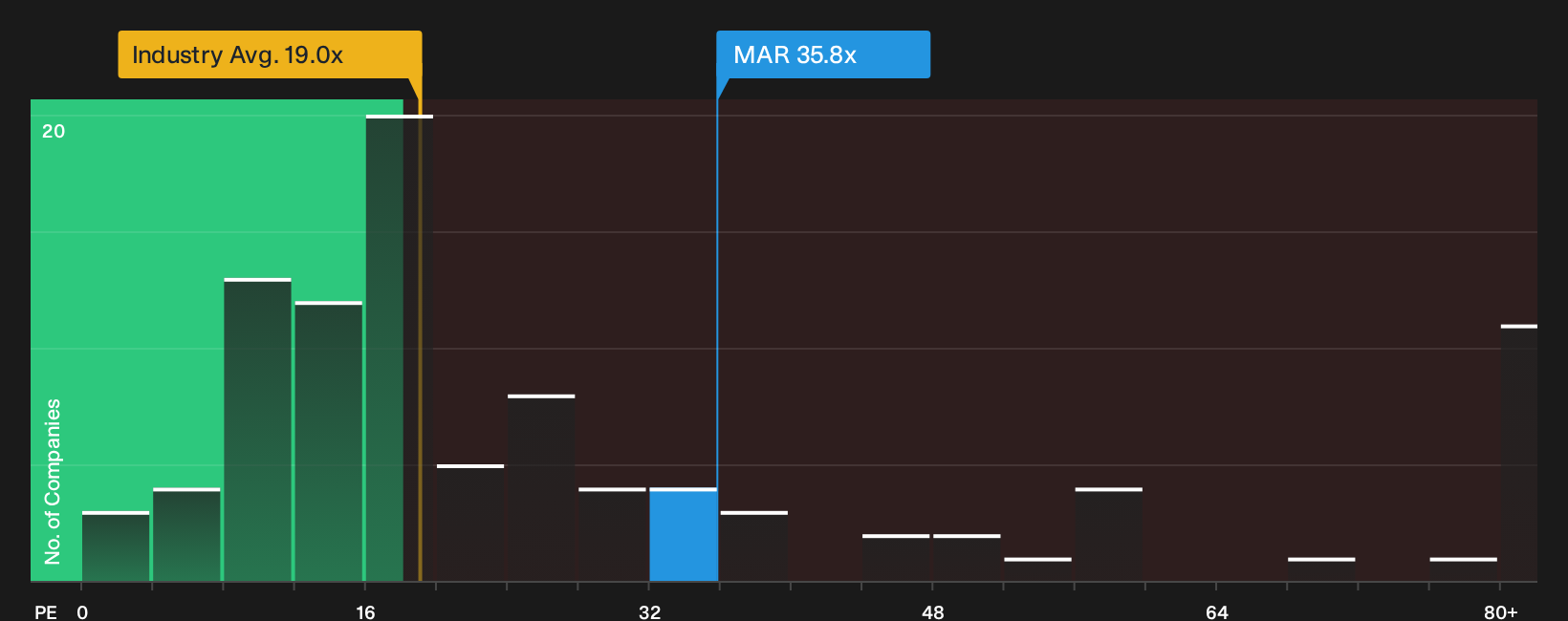
The P/E ratio is a useful way to see what you are paying for each dollar of Marriott International’s earnings. On this measure, Marriott International trades on a P/E of about 39.1x, which is higher than the hospitality industry average of roughly 25.8x and also above the peer group average of about 31.8x.
A tailored fair P/E for Marriott International, which blends its size, margins and risk profile, comes out closer to 31.2x. That is materially below the current 39.1x P/E, so the stock appears to trade at a premium to what this framework suggests as a more grounded level.
On the P/E multiple, Marriott International stock currently appears overvalued compared with both its industry and a calibrated fair ratio.
See what the numbers say about this price — find out in our valuation breakdown.
The Marriott International Narrative: What Would Justify Today's Price?
Simply Wall St Narratives for Marriott International pick up where this valuation puzzle leaves off. They explain which assumptions about Marriott International's future growth, margins and earnings would need to hold for the stock to be worth materially more or less than today's price, all housed on the Community page. Each narrative links a specific set of potential catalysts and risks to its own fair value marker, so you can later compare which storyline is tracking reality.
Community views on Marriott International sit far apart, with one camp seeing plenty of room left in the story and the other focused on valuation risk.
Bull case: 33% undervalued
"Marriott Bonvoy has evolved beyond a points system into a behavioral ecosystem. Members frequently prioritize properties within the network to maximize benefits, which creates recurring demand independent of broader travel volatility..."
Read the full Bull Case to see why Marriott International could be undervalued
Bear case: 22% overvalued
"Once these zero-margin pass-through costs are stripped away, the true operating margin of Marriott's franchise and management business shines at a staggering 60% to 70%..."
Read the full Bear Case to see why Marriott International could be overvalued
Do you think there's more to the story for Marriott International? Head over to our Community to see what others are saying!
The Bottom Line
For Marriott International, both the Discounted Cash Flow (DCF) work and the P/E comparison currently point to an overvalued stock. The intrinsic value estimate sits below the market price, and the tailored fair P/E is also lower than where the shares trade today. This is consistent with the broader low value score. From here, the key question is whether Marriott International can deliver cash flow and earnings that justify this richer valuation, especially as it executes on new projects in areas such as all inclusive resorts and branded apartments.
This article by Simply Wall St is general in nature. We provide commentary based on historical data and analyst forecasts only using an unbiased methodology and our articles are not intended to be financial advice. It does not constitute a recommendation to buy or sell any stock, and does not take account of your objectives, or your financial situation. We aim to bring you long-term focused analysis driven by fundamental data. Note that our analysis may not factor in the latest price-sensitive company announcements or qualitative material. Simply Wall St has no position in any stocks mentioned.
Have feedback on this article? Concerned about the content? Get in touch with us directly. Alternatively, email editorial-team@simplywallst.com